


 Shkruar nga Pamfleti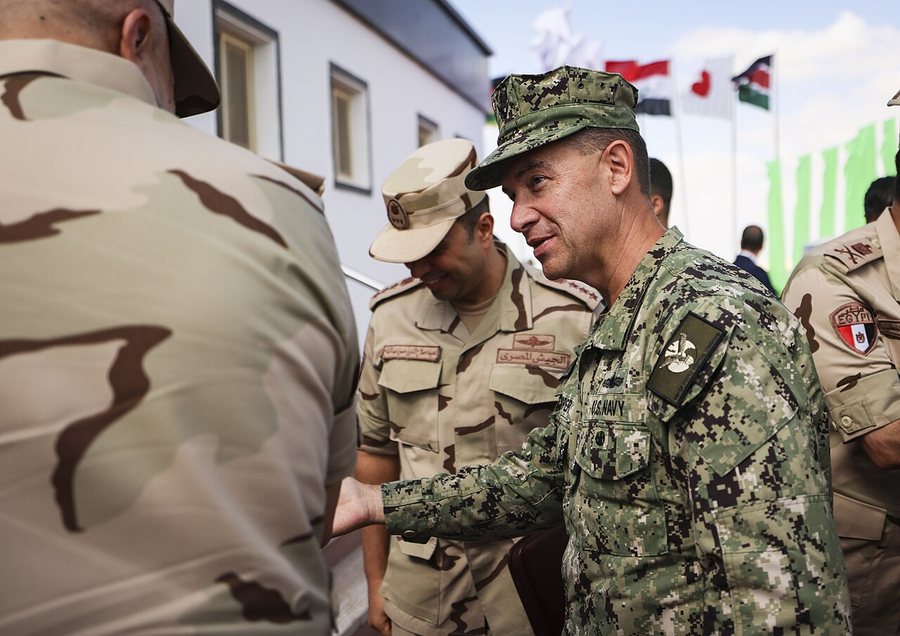
Admiral Brad Cooper faces crucial test amid US-Iran tensions
As US President Donald Trump has ordered the strengthening of the US military presence near Iran, the United States Central Command (Centcom) is evaluating all options under the direction of Admiral Brad Cooper, 59. He leads Centcom operations and would be responsible for managing any potential military operation against the Islamic Republic.
Who is Brad Cooper?
Cooper is the first U.S. Navy officer to head the Middle East Command since William J. Fallon in 2008. He took over after the departure of his predecessor, Michael Kurilla, who oversaw the June 2025 nuclear strike.
Unlike Kurilla, who displayed a more public profile and was considered closer to interventionist approaches, Cooper is known as a lower-profile and more operational leader. At this stage, he is analyzing a wide range of options in a complex strategic context.
Born in Salem, North Carolina, Cooper is a graduate of the U.S. Naval Academy, the National Intelligence University, and Harvard University. His 36-year career includes service as a Navy officer during the Gulf War, Kosovo, and Afghanistan. In 2024, he led naval forces in Operations Prosperity Guardian and Poseidon Archer against the Houthis in Yemen, after assuming command of the U.S. Fifth Fleet in 2021.
In August of last year he took over the command of the combatant command based in Tampa, Florida.
Strategic challenge
During his confirmation hearing in Congress, Cooper emphasized the importance of digitizing commands and using artificial intelligence in military units. He stated that, having experience leading the Navy's first task force on artificial intelligence and unmanned vehicles, the US must maximize the potential of its technology sector.
He has supported initiatives aimed at increasing military superiority through unmanned platforms based on artificial intelligence and digital integration. However, the current reality has confronted him with more traditional challenges: overseeing a large concentration of naval and air forces, the largest since the US-Iraq war in 2003.
Cooper currently leads one of the largest concentrations of the US military fleet in decades. If the aircraft carrier USS Abraham Lincoln were to be joined by the aircraft carriers Gerald Ford and George HW Bush with their strike groups, it would create the largest operational concentration since the Vietnam War.
At the same time, this force faces the threat of Iran’s missile and drone capabilities, which constitute an important element of Tehran’s deterrence strategy in the event of direct conflict. This situation reflects the balance between traditional American military superiority and the asymmetric challenges posed by regional adversaries.
Between strategy and diplomacy
Cooper has displayed a less declarative approach than his predecessor and appears to aim to reduce the risks in the event that Washington gives the order for intervention.
He participated in the first indirect talks with Iran in Muscat, the capital of Oman, on February 6. This engagement followed other diplomatic contacts, including dialogue with Turkey and Syria on the integration of the Syrian Democratic Forces into Damascus' new army.
These developments point to a more complex geopolitical reality, where regional decision-making is not determined solely by the US and Israel. In this context, any military action would have far-reaching and unpredictable consequences.
Admiral Cooper thus faces a dual challenge: to maintain military readiness and at the same time manage a complex diplomatic and strategic environment, where every decision can affect not only the region, but also the global balance. / Adapted from “Inside Over”


Lini një Përgjigje