


 Shkruar nga Pamfleti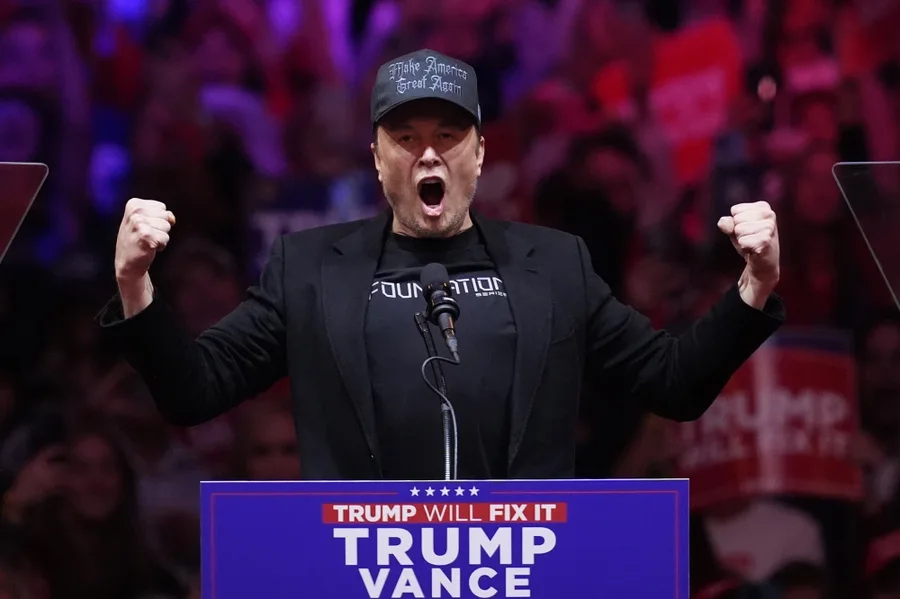
Musk aims to intensify his companies' business with the government through his already deep connection to Trump.
Tech billionaire Elon Musk and his business empire stand to reap massive rewards if former President Donald Trump returns to the White House. But Musk, who has turned X into a pro-Trump echo chamber, will have unprecedented conflicts of interest if he becomes a government efficiency czar.
The potential benefits for Musk and his companies are wide-ranging: perhaps touching on regulatory issues like labor laws and environmental protections, lower tax rates and the possibility of more government contracts for Musk's rocket company, SpaceX.
In dollar terms, few people may have more at stake in Tuesday's presidential election than Musk, and in recent months, Musk has acted accordingly, enthusiastically supporting Trump's campaign through appearances and over 118 million dollars donated through his super PAC.
Musk, 53, could also play an influential role in a second Trump administration, as an adviser on spending cuts or in a more substantive way — which could be an ethical mess if he comes to wield power over government agencies that regulate his businesses.
In addition to ethical issues, Musk's commercial investments abroad — particularly in China — combined with his company's sensitive federal contracts for the U.S. military's space program raise serious questions about conflicts of interest that could endanger America's national security. according to current and former US officials and experts.
Musk's electric vehicle company, Tesla, relies heavily on China, which is now seen by both political parties as the main security threat and economic rival of the United States. Tesla depends on China as a manufacturing base and as a crucial market for its vehicles. During a visit to China earlier this year, Musk echoed Beijing's line on Taiwan, describing it as an "integral part" of China.
Unlike some tycoons or corporate bosses, Musk has not shied away from weighing in on geopolitics even when it conflicts with US foreign policy, advocating positions on the Ukraine war that aligned with the Kremlin's stance. Musk has had phone conversations with Russian President Vladimir Putin, according to a source with knowledge of the matter, which was first reported by the Wall Street Journal.
Some lawmakers, who spoke to NBC News on condition of anonymity because of the sensitive nature of the conversations, worry that Musk could try to push US politics in a direction favorable to his financial interests. They worry that Musk could downplay America's goal of preventing China from gaining access to the latest technology that could be used to build its military and intelligence capabilities.
Experts say Musk's potential leverage over the US government stems from SpaceX's influential role. The company, where Musk serves as CEO, has been called a "de facto monopoly" by analysts because of its dominant market share in sending commercial and government satellites into space.
Musk aims to intensify his companies' business with the government through his already deep relationship with Trump, and potentially target aerospace rivals such as Boeing through Trump's efficiency drive. Musk has previously criticized Boeing, which has massive government contracts in partnership with other defense giants.
Trump has given conflicting accounts of how Musk might fit into his administration, telling Fox News in an interview last month that he would like Musk to be his “secretary of cost-cutting” but also “not in the cabinet".
Musk told Trump's rally at Madison Square Garden on Oct. 27 that he wants to cut $2 trillion from the federal budget — more than the $1.7 trillion discretionary budget. Musk did not specify what he would expect.
Rather than shying away from potential conflicts of interest, Musk has been outspoken about his desire to see Trump directly help his businesses by reducing regulations.
Trump, in turn, has promised to help, pledging his support for Musk's desire to send a rocket to Mars. Trump has also said that his administration will have the "lowest regulatory burden" for all major companies and manufacturers.
Musk's business interests are widespread. At the helm of Tesla and SpaceX, he is the largest shareholder in X and the founder of three other prominent startups: brain science firm Neuralink, tunnel builder The Boring Co. and artificial intelligence business xAI./ NBCNews


Lini një Përgjigje