


 Shkruar nga Pamfleti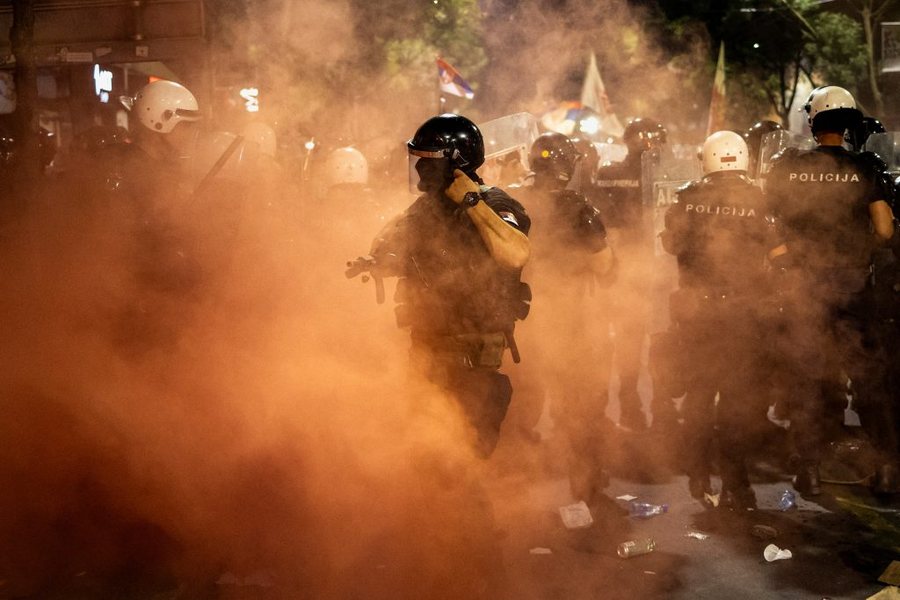
Since Vidovdan, a silent civil war has erupted in Serbia, with clashes between students and citizens and the police becoming a daily occurrence, as well as mass arrests. The government suspects them of terrorism and a threat to the constitutional order.
Since Vidovdan, there has been a fervent protest in Serbia. On that day, students organized a protest titled “See you on Vidovdan,” where Milo Lompar, a professor at the Department of Serbian Literature at the Faculty of Philology in Belgrade, addressed the gathering, those who, according to them, would change Serbia for the better. Among other things, he spoke about freedom, which “has two branches, the freedom of the Serbian people outside Serbia and the freedom of the country in relation to others.”
Lompar, known for his right-wing views, recently attracted attention as a participant in the promotion of the book “The Black Fable” by convicted war criminal Radovan Karadzic at the Serbian Literary Cooperative. In his speech at the student assembly in Vidovdan, he said that in the Constitution of Serbia “Kosovo and Metohija are ‘inalienable’ parts of Serbia”, and also mentioned the protection of the sovereignty of the Republic of Serbia, of the Serbian nation in Montenegro and of Serbian national rights in Croatia and North Macedonia.
Lompar said the students' demands for institutions to function are "the most sincere fight for Kosovo." During his speech, chants of "Kosovo is the heart of Serbia" could be heard from those gathered in front of the stage. The protest was dominated by Serbian flags, some of which bore the words "No surrender" painted in the colors of the Serbian flag across Kosovo.
On the same day that the protest was held with the call of students to blockade, a literary evening was held in front of Parliament with the call of "students who want to learn" and who have the support of the authorities, as they announced themselves.
The leader of the ruling Serbian Progressive Party (SNS) and former Prime Minister Milos Vucevic posted a photo on Instagram with representatives of military and police veterans in front of the Serbian Parliament.
"Proud of the Serbian veterans who defended the homeland where it was needed and when it was most difficult," wrote Vučević, posing with a T-shirt with the image of Miloš Obilić.
Next to him, as seen in the photo, is former Gendarmerie Commander Goran Radosavljevic Guri, who is linked to the murder of the Bytyqi brothers in Kosovo, which prompted the State Department to ban him from entering the United States.
The Vidovdan protest divided the anti-government bloc into those who have "abandoned" the students, disillusioned by nationalist speeches, and others for whom the students are still "our sacred children" who are supposed to lead Serbia towards a better future.
Since Vidovdan, a silent civil war has erupted in Serbia, with clashes between students and citizens and the police becoming a daily occurrence, as well as mass arrests. The government suspects them of terrorism and a threat to the constitutional order.
The students have declared the current government illegitimate and called for early elections. Interior Minister Ivica Dacic, a Milosevic disciple who has sovereignly ruled Serbia for three decades, condemned the attacks on police in the strongest terms and announced arrests and the use of all powers. After eight months, the oppressive regime in Serbia has finally shown its true, old and honest face. Naked force.
On the other hand, there are sad messages from students and citizens who, during clashes with the police in Belgrade, shouted 'Go to Kosovo' at the police.
Serbia, or more precisely that part of society that, instead of putting its own court in order, would like to replace this authoritarian government, embark on a path of catharsis and, in this year 2025, live in the year 1389.
The current situation in Serbia is well summed up in a comment by Branko Milanović, Visiting Professor at the Center for Graduate Studies at the City University of New York (CUNY), Professor at the London School of Economics, and one of the world’s leading contemporary economists: “ The Western media, which only belatedly began to pay attention to the seven-month protests against Aleksandar Vučić’s authoritarian rule in Serbia, failed to notice that the main driver of this ‘civic protest’ has since become a self-destructive version of extreme Serbian nationalism .”
You supposedly want to change the system, but recycling nationalist myths that we have heard for decades is unlikely to achieve this. How and why did the fight against corruption and crime lead back to Kosovo and Kosarë, myths that have shaken and destroyed these areas for decades? Vučić, who in the 1990s received a doctorate in nationalist ideology, is unlikely to be defeated by the same ideology.
Eight months after the collapse of the Novi Sad bus station, where 16 people died, and the student blockade protests, Serbia is still at an impasse. President Vučić has repeatedly declared victory, given the recent whiff of the 'color revolution', about which a book is still being published, has been threatened and insulted, but the levers of power are still firmly in his hands, even though his support and popularity seem to be waning. So far, nothing has changed. / Adapted from "Pamphlet" by "TheGeopost"



Lini një Përgjigje