


 Shkruar nga Pamfleti
For Donald Trump, the war in Iran is dividing the good and bad European countries.
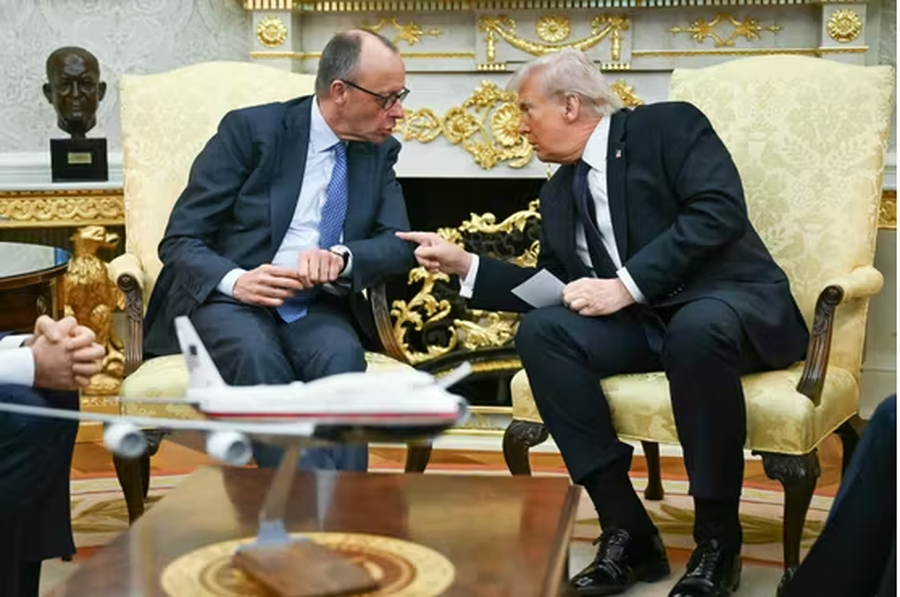
Donald Trump has a habit of praising foreign leaders, especially those he hosts at the White House. German Chancellor Friedrich Merz took advantage of that practice on Tuesday, March 3, when he sat next to the US president in Washington. Trump called him “a friend” who is “doing a very good job,” adding that there is a “strong affinity” between them.
For his part, Merz showed great restraint in comments about the war launched on February 28 against Iran. While French President Emmanuel Macron briefly mentioned international law during his solemn speech on Tuesday, the German chancellor did not refer to the issue.
His pragmatic approach reflects a mix of realism and European weakness. At this advanced stage of the US-Israeli offensive, raising principled objections seems counterproductive, at a time when Washington's support remains essential vis-à-vis Russia.
Friedrich Merz stated that he is “on the same wavelength” with the United States on the need to free ourselves from a “terrible terrorist regime.” He also emphasized that we must think together about the post-conflict period.
Donald Trump expressed confidence in the progress of the military operation, saying that Iran is losing its layers of defense. As for the future, the American billionaire approached the issue with a mixture of improvisation and nonchalance. “I imagine the worst-case scenario would be to do all this and then someone takes over [to run Iran] and is just as bad as the previous person,” he said.
Trump also claimed that within the Iranian regime "there are a lot of people you wouldn't expect who want to surrender. They want immunity."
Asked about the son of Iran's former shah, Reza Pahlavi, whom he has avoided hosting at the White House, Trump gave a similar response to the one he gave for Maria Corina Machado, the Nobel Peace Prize winner and Venezuelan opposition figure. "It seems to me that someone from within [the Iranian regime] might be a better fit. I said he seems like a very nice person," he added of Pahlavi.
According to Washington, the political transition in Venezuela, carried out in collaboration with Delcy Rodriguez, the number two in power in Caracas, constitutes the intended model.
Trump criticizes the United Kingdom and Spain
During his meeting with Friedrich Merz, Donald Trump criticized two European countries. The first was a historic ally of the United States, the United Kingdom. “We are not dealing with Winston Churchill,” he said contemptuously of Labour Prime Minister Keir Starmer.
According to Trump, Starmer had not initially authorized the use of British bases by US aircraft for missions against Iran. The US president also criticized London for its immigration and energy policies.
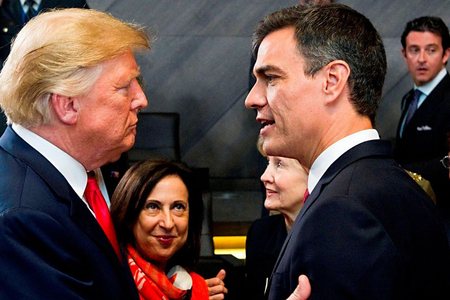
“On the other hand, Spain has been terrible,” Trump complained, announcing that the United States would “cut off all trade” with the country. “We want nothing to do with Spain,” he added.
Spain is a NATO member and has caused discontent in the White House because of its refusal to increase military spending to 3.5% of gross domestic product. The German Chancellor also mentioned this issue. "We are trying to convince them that this is part of our common security," Merz said.
In a meeting with German media, Friedrich Merz explained his cautious approach. He acknowledged that there is currently no “fully developed strategy for the future civilian leadership of Iran.”
Asked about his silence during Trump's verbal attacks on Spain, the German chancellor said he did not want to cause "an escalation" of tensions.
"During the private conversation, I made it clear: firstly, Spain is a member of the European Union and for this reason we conduct negotiations for a trade agreement with the United States only together, or not at all," he declared. / Adapted from Le Monde



Lini një Përgjigje