


 Shkruar nga Pamfleti
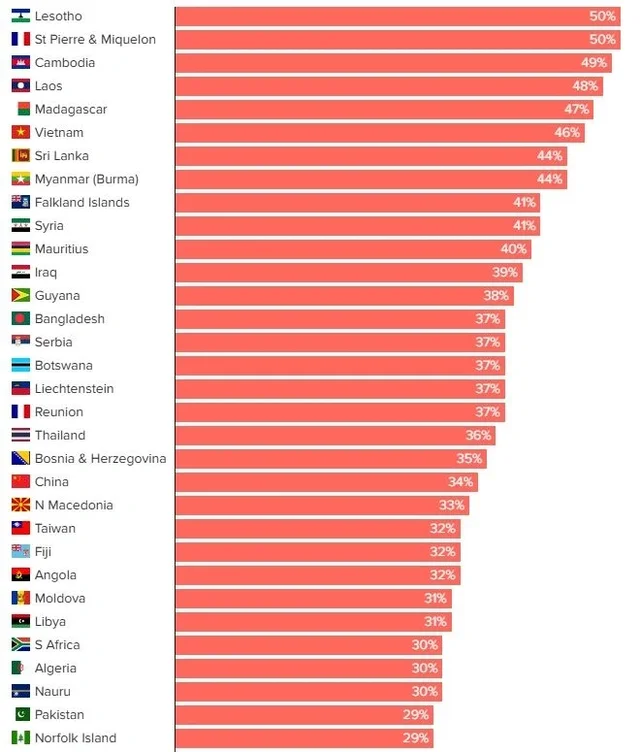
Trump's tariff policy has the slogan "Make America Rich Again" and includes a base tariff of 10% on all US trading partners, as well as tariffs of up to 50% on countries with which the US has a trade deficit.
The "voices" of analysts talking about a possible recession against the backdrop of a protracted trade war are becoming even louder after Donald Trump's announcements of new tariffs.
Investor reaction was immediate and markets plunged into "deep red" with billions in losses in the US, Europe and Asia.
The Trump administration sees the tariffs as pro-growth, anti-inflationary measures, although officials have acknowledged the potential for some turbulence.
At the same time, of course, financial planners revised their forecasts to reflect the new, more ominous economic outlook.
The trade war has begun.
Trump's tariff policy has the slogan "Make America Rich Again" and includes a base tariff of 10% on all US trading partners, as well as tariffs of up to 50% on countries with which the US has a trade deficit.
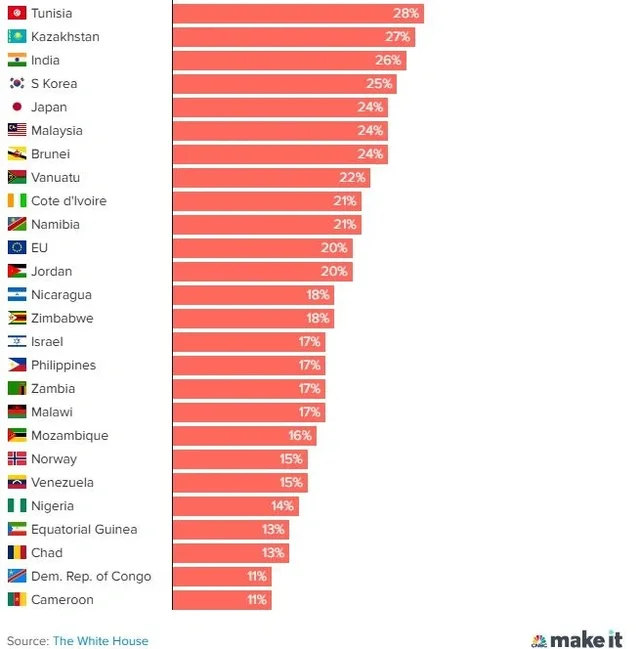
Imports from China, South Korea and Japan, for example, face tariffs of 34%, 25% and 24% respectively. Products from the European Union will pay a 20% tax.
If tariffs remain at recently announced levels, the average rate on all imports into the US will rise to 18.8%, from 2.5%, in 2024, according to estimates by the Tax Foundation.
Countries with tariffs exceeding 10%:


How likely is an economic recession?
Donald Trump's sweeping tariffs have raised the risk of a recession in the US and internationally to 60% this year, from 40% previously, Reuters reports, citing analysts at JP Morgan.
"Disruptive US policy has been identified as the biggest risk to the global outlook throughout the year," JP Morgan strategists led by Bruce Kasman said, adding that US trade policy has become less business-friendly than expected.
Kasman said the impact of this tax increase is likely to be magnified through retaliation, a slide in the US business climate and supply chain disruptions.
Similarly, Barclays and Deutsche Bank also warned that the US economy faces a greater risk of slipping into recession this year if Trump's new tariffs remain in place.
However, Kasman expects the tariff blow to be "softened a little" by the prospect of further rate cuts in the US.
JPMorgan reiterated its forecast for two 25-basis-point rate cuts by the US Federal Reserve in June and September this year, while investors expect a total of four rate cuts in 2025, according to data compiled by LSEG.
"A recession over the next 12 months looks more likely than at the beginning of the year, but we still think the economy is likely to expand in 2025 and especially in 2026," said Bill Adams, chief economist at Comerica Bank.
President Donald Trump's sweeping tariff campaign is putting the US economy at risk of recession, Allianz's chief financial adviser Mohamed El Erian warned on Friday.
"We've had a significant revision to the growth outlook, with the chance of a US recession rising to 50%, with inflation expectations as low as 3.5%," he told CNBC.
"I don't think a recession in the US is inevitable because the structure of the economy is so strong, but the risk has become uncomfortably high," he added.
The sweeping tariffs announced by US President Donald Trump on Wednesday pose a significant risk to the global economy at a time when growth remains sluggish, International Monetary Fund Managing Director Kristalina Georgieva said in a statement on Thursday.
Ms. Georgieva stressed the importance of avoiding actions that could further damage the global economy and called on the US and its trading partners to work constructively to reduce tensions. / Adapt Pamphlet /






Lini një Përgjigje