


 Shkruar nga Pamfleti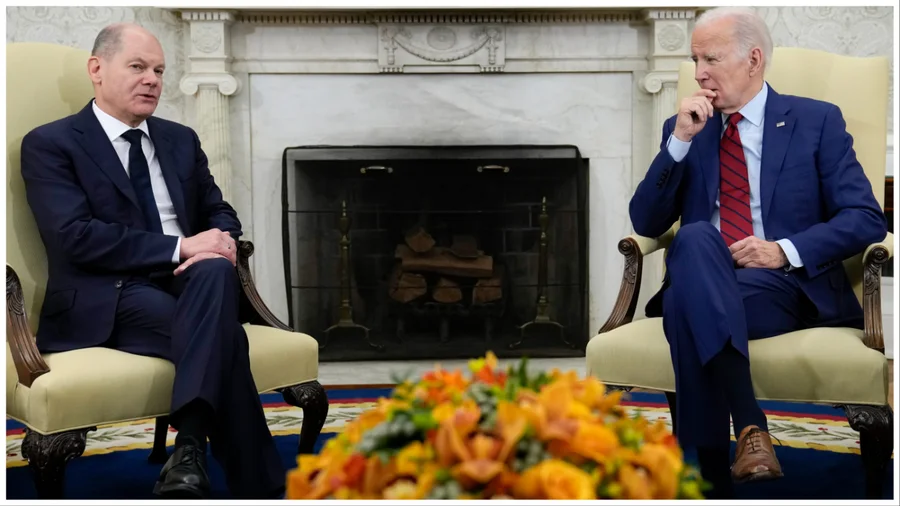
Post-war relations between Germany and the US were largely stable and strong until the arrival of President Trump. A great deal of uncertainty has gripped the relationship since 2017, and it has yet to fully stabilize following the departure of the great disruptor, Donald Trump, from the White House in 2021.
US President Joe Biden and German Chancellor Olaf Scholz are certainly more partners than were Trump and Angela Merkel, who had the worst relationship in modern politics.
This is true even if you consider the bilateral tensions that arose during the 2003 Iraq War, which resulted in a significant rift in the transatlantic alliance when Chancellor Gerhard Schroder opposed President George W. Bush's decision to topple Saddam Hussein's regime.
However, both Biden and Scholz have some key differences, despite their seemingly similar political and personal leanings. On the issue of Ukraine, for example, tensions have risen since the Russian invasion over the pace and extent of Western support for Kiev. An example of this was the dispute between the two leaders over whether to provide tanks.
The US administration also has significant concerns about Germany's China policy, given that Berlin, at least since Merkel's time, has been one of the main advocates of Western economic engagement with Beijing. Scholz in 2022 became the first G7 leader to visit Beijing since the start of the pandemic, which was an indication of the level of importance Germany attaches to trade ties with China.
This German stance has received strong criticism, however, at home and abroad. The perception that Scholz might try to keep much of Merkel's China policy intact has been widely condemned. For example, Obama-era US ambassador to NATO, Ivo Daalder, warned that Germany could potentially be "heading for a collision" with the Biden team.
Another issue complicating bilateral ties is the US Deflation Act, a large package of subsidies for clean technology, which poses a potentially major risk to the EU's aim to remain a major global hub for the green industrial revolution.
There is a growing feeling in Europe that its edge in this "race" is at stake. This has sparked a transatlantic dispute, and German Economy Minister Robert Habeck has stressed the need for an intensified European "industrial policy" that enables our companies to thrive in global competition, particularly through technological leadership.
As challenging as these differences are at times, Biden and Scholz have nevertheless sought to rebuild the US-Germany relationship, which is very important to both countries.
For the US president, Berlin's importance has only increased in the post-Brexit landscape. Likewise, Scholz – who had little experience in foreign policy before becoming chancellor, having previously served as finance minister and minister of labor and social affairs – was quick to acknowledge the importance of the US to Germany.
Building on that foundation, there will be much for the two leaders to agree on when they meet next week at the White House, including the importance of Biden's strategic goal of reuniting the Western alliance after the divisions caused by the Trump presidency. .
Both leaders agree on the importance of closer cooperation on a range of challenges, including international security, promoting economic prosperity and threats posed by climate change.
Biden perceives the US-Germany relationship as key to this mission, because in the post-Brexit era he sees Berlin as an increasingly important anchor point, perhaps alongside Paris, in transatlantic relations at a time of increasing geopolitical flux.
There may also be some diplomatic upside from easing bilateral tensions over irritants like the Inflation Reduction Act to help accelerate the global clean energy economy through secure, resilient supply chains and deeper cooperation on critical technologies and those in development.
Brussels and Washington are discussing a deal on critical minerals that would give European-based companies access to certain subsidies through the act if they in turn provide some of the raw materials needed in the US for manufacturing processes. This would replicate a similar US agreement with Japan.
At the same time, the US and the EU are said to be negotiating a global steel and aluminum deal. This is preventing the reinstatement of US and EU tariffs on steel and aluminium, which were frozen by an interim bilateral agreement in October 2021 that suspended measures introduced in 2018 when Trump imposed tariffs on European imports.
If such an ambitious deal is eventually reached, it would potentially create the political space for Washington and Brussels to try to reach compromises on the EU's recently introduced Carbon Cap Adjustment Mechanism. There is still no agreement on how US steel companies will deal with this new policy, under which European importers must pay duties corresponding to the cost of emissions generated during production.
Additionally, Biden has scaled back the rhetoric, in public, about some long-standing irritants in the U.S.-German relationship that Trump had highlighted, particularly on trade and defense spending.
On trade, for example, Trump described Germany as "very bad" because of its sizeable trade surplus, with exports outweighing imports. He was also vocal in his criticism of Berlin's failure to spend 2 percent of its gross domestic product on defense, a key NATO goal. Germany can now achieve this objective, as a result of the Russian invasion of Ukraine.
Taking all this together, it is clear that the US-German partnership under Biden and Scholz has positive potential, especially if new agreements can be reached in areas such as critical minerals, steel and aluminum.
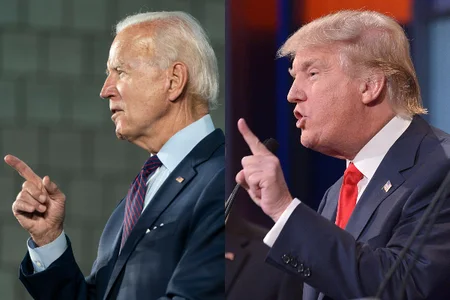
However, some fundamental uncertainties remain – and the relationship could still go into a diplomatic tailspin if Trump wins a second term in office in November.






Lini një Përgjigje