


 Shkruar nga Pamfleti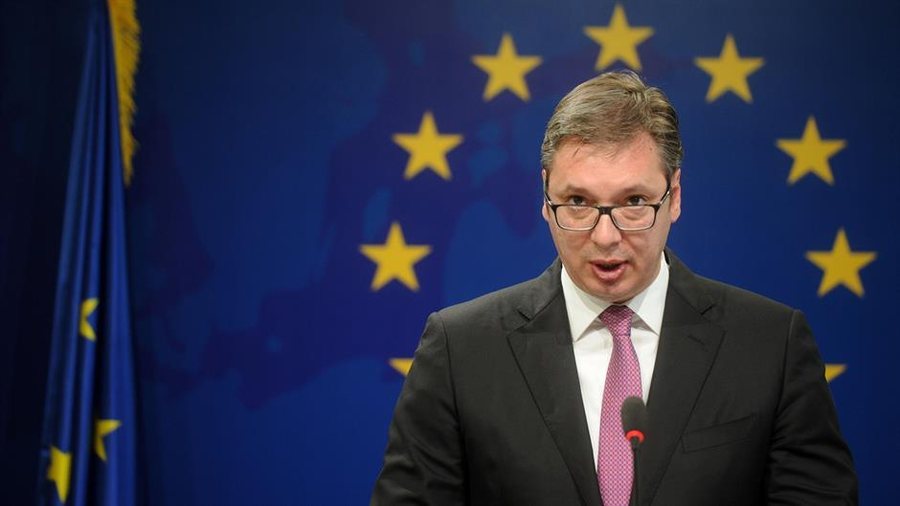
It is impossible to have the ambition to complete negotiations by the end of 2026, as the Serbian leadership claims, without a radical change in its position and behavior in a number of areas.
Although more than two decades have passed since the 2003 Thessaloniki Summit, when the EU first committed to the integration of the Western Balkans, Serbia and 5 other countries in the region are still awaiting membership in the bloc.
Currently, Montenegro and Albania have emerged as leaders in the EU enlargement process, while Serbia has struggled to make progress.
North Macedonia remains blocked due to bilateral disputes, while Bosnia and Herzegovina and Kosovo are still in the early stages of the membership process.
Tonino Picula, rapporteur in the European Parliament, says that Serbia's path towards membership in the European Union remains uncertain under its current leadership, which "sits in four chairs."
Picula claimed that Serbia's multivector foreign policy, balancing ties with the EU, the United States, Russia and China, complicates its efforts to join the bloc.
"I don't think it's possible to sit on four chairs all the time," Picula said, according to the Croatian news agency Hina. He added that "I don't think the EU shares geopolitical values and goals with China and Russia in most areas, let alone with the United States."
The statement comes amid ongoing debates in Brussels over Serbia's EU accession. While Serbia remains one of the top candidates for membership, the EU's scrutiny of its foreign policy and governance standards has been a persistent sticking point.
"My honest opinion is that President Aleksandar Vučić's ambition is not to join the European Union, because that would mean that he and his camp would have to respect the EU's very strict rules and standards in terms of the democratic system, media freedom, minorities and other issues. Instead, he is playing his own games," Picula said, adding that Serbia's leadership has not demonstrated a serious commitment to EU integration.
Belgian MEP Kathleen van Brempt and Austrian MEP Andreas Schieder echoed Picula's statements. The three MEPs are among those monitoring the EU's approach to the Western Balkans accession process.
Serbia's accession process has stalled significantly in recent years. Despite expressing ambitions to complete negotiations by 2026, Serbia has not opened a single EU chapter in the past four years, with no visible progress on key reforms such as the rule of law, anti-corruption measures and normalization of relations with Kosovo.
Picula made it clear that Serbia's aspirations to join the EU cannot be realized without a radical change in its political trajectory. "It is impossible to have the ambition to complete negotiations by the end of 2026, as the Serbian leadership claims, without a radical change in its position and behavior in a number of areas," he said.
EU membership remains a priority for Serbia's foreign policy, but long delays in the accession process have encouraged the Western Balkan country to build external economic ties wherever possible to grow the economy.
Serbia's last substantial progress in negotiations with the EU occurred in December 2021. As a result of the fading prospect of EU membership, and what Belgrade sees as constant moving targets, Serbia has been exploring other options.
Since 2008, Serbia's approach to foreign policy has been characterized by a pragmatic balancing act, maintaining good relations with all major powers, including the EU, the US, China and Turkey, while also strengthening ties with countries of the so-called "Global South".
The EU is divided. Some member states are against granting concessions without concrete progress on reforms and alignment with EU foreign policy. Others argue that failing to engage with Serbia could undermine momentum in the Western Balkans and push Serbia further behind than it already is. / Adapted from Pamphlet by Intellnews/


Lini një Përgjigje