


 Shkruar nga Martin Sandbu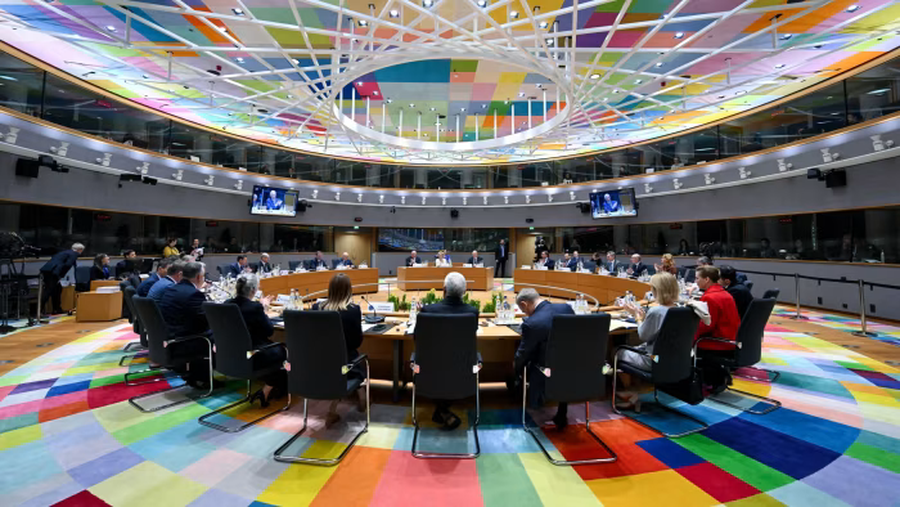
A more pragmatic form of federalism could be the key to moving important issues forward...
If the US motto, “out of many, one,” sounds like a hopeless aspiration in Trump’s divided America, the EU’s can be seen as an oxymoron. “United in diversity” clashes with the accepted wisdom that diversity is what hinders common solutions. Some might even say that fragmented rivalry was such a key to Europe’s past successes that it has become an ineradicable obstacle to further progress.
What if diversity were the path to unity, rather than a block to be overcome? We hear a lot about “coalitions of the willing” these days, mostly in connection with efforts to mobilize military support to protect Ukraine’s security. But the most important coalitions of the willing may be those that arise over more mundane issues.
This is an old debate in Europe about whether it is better for a vanguard to move forward with deeper integration or to take time to find solutions that all EU member states can agree on.
For some of the most difficult tasks involving major treaty changes, the former approach was followed. This was the case with the euro and the border-free Schengen travel zone. But for the most part, European leaders have viewed integration with less than full participation with suspicion.
In particular, “enhanced cooperation,” a provision for selective integration by just nine countries, has only been used a few times. Those who, like France, complain that integration ambitions are being hampered by lagging countries have in practice refused to use a ready-made mechanism to practice what they preach.
Nor has the European Commission made enhanced cooperation a pillar of its toolkit when unanimity is hard to come by. In fact, its modus operandi is to seek (but not always find) larger majorities than it needs to push through controversial legislation. The trade agreement with the Mercosur bloc is a concrete example.
Things are changing, however. In a speech last month, former European Central Bank President Mario Draghi called for a “pragmatic federalism… built by coalitions of goodwill around shared strategic interests.” He imagined “countries with strong technology sectors agreeing on a common regime that allows their firms to scale up rapidly,” those “with advanced defense industries pooling research and development and financing joint procurement,” and “industrial leaders investing together in critical sectors like semiconductors, or in grid infrastructure that lowers energy costs.”
Coalitions of the willing, in fact if not in name, are emerging. Some EU enlargements into new policy areas, notably permanent structured cooperation on defence, have been undertaken without full participation. Nineteen out of 27 countries have benefited from the EU's "SAFE" scheme of joint loans for joint defence spending.
Draghi's argument and these examples make coalitions of the willing seem like a last resort, a less important alternative to unity. But there may be a more positive political logic, where parting ways on new integration thrusts fosters unity in the end.
That is what we should hope for from the Spanish “competitiveness lab” initiative, which encourages groups of countries willing to move forward with elements of the unified capital markets agenda. Madrid has brought together interested finance ministers to work on relatively easy deliverables, common labelling for cross-border financial products, a common securitisation platform and common rules for credit ratings for smaller companies. The idea is that countries ready and willing to take the next integration step can produce successes on the ground that others will not want to miss. Call it a political theory of Fomo.
Old attitudes are hard to shake. At a recent meeting of finance ministers, one person present said that Draghi’s successor at the ECB, Christine Lagarde, asked “are we going to have two Ecofins now?”, a concern about undermining the formal ministerial council for economy and finance. There are two answers. Ideally, the threat of “two Ecofins” accelerates agreement across the group. If that remains difficult, progress on capital markets integration has been slow for a decade, so why not have a second Ecofin that moves faster?
Behind the skepticism may lie the learned helplessness of the era when the Franco-German pact was seen as the engine of European integration, as well as the strong sense of entitlement of these two countries. But today both countries struggle to agree with themselves, let alone with the other. The explosion of low-level coalitions of the willing suggests that it is high time for smaller countries to dare to take steps forward on issues where they see collective solutions.
If they keep at it, they may discover that unity, like love or sleep, comes when you focus on other things./ Adapted from "Pamphlet" by "Financial Times"



Lini një Përgjigje