


 Shkruar nga Pamfleti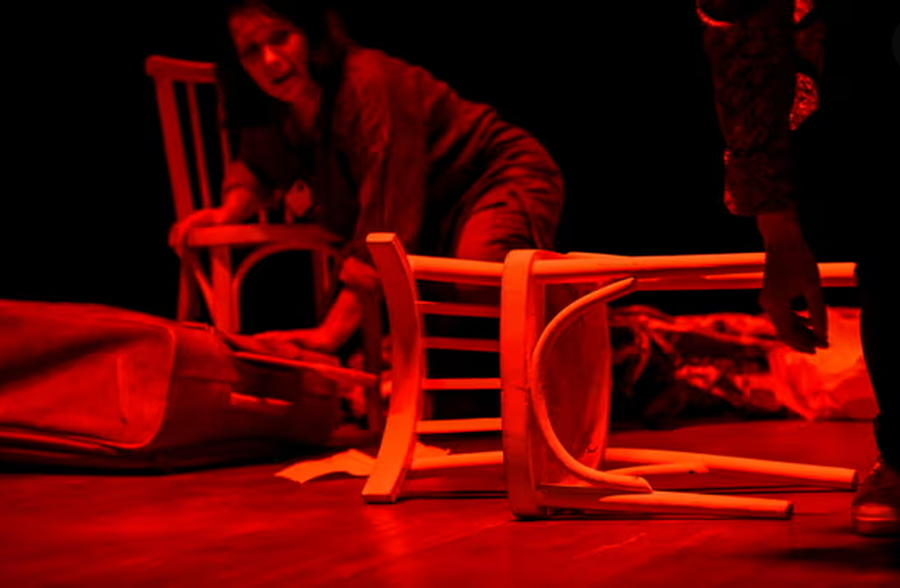
The show opens with the usual request for the audience to turn off their cellphones before the curtain rises, but along with that comes warnings - and instructions on how the audience should leave the hall in the event of an air raid.
That's because Drama Mariupol, a play based on the real-life experiences of a Ukrainian theater company during the Russian occupation of the titular city, was written and staged in the middle of the war. It re-enacts the terrifying moment on March 16, 2022, when their theater was bombed by Russian forces, even though by then it had turned into an evacuation shelter for nearly 1,000 people.
Performers from the Mariupol Theater company were among those sheltering inside when a bomb leveled the building and left an unverified number of people dead. Actors Olena Bila and Ihor Kytrysh witnessed the horror but managed to escape, along with their son, Matvii, then 10, and the company's head of music and drama, Vira Lebedynska. The four ended up in the western Ukrainian city of Uzhhorod, where writer Oleksandr Gavrosh had the idea to turn their first-hand accounts, along with others, into this verbatim piece.
It was organized for the first time only 6 months after the attack, in a house in Uzhhorod, despite the war going on all around. After playing in Kiev, also amid the dangers of conflict, he will travel to Britain to appear at Home, Manchester, this month.
Gavrosh and Bila, speaking remotely from Uzhhorod through translators, describe the impetus to transpose the war experience into drama. Gavrosh interviewed everyone from the actors to the director, make-up artist and technical staff, along with their relatives, to create a play not only about the moment of the bombing, but about their lives in Mariupol and the city itself before the war.
The drama recounts ordinary life before the invasion, as well as the initial disbelief, then the hope that it would end in a few weeks. There are reflections on art in a time of war, and there is a view of the conflict through the eyes of children, thanks to the new character of Matvii. "Nothing is fiction," says Gavrosh, adding "the only thing I did was arrange the facts in a logical and chronological order."
He's glad he recorded the survivors' accounts so quickly, he adds, "because memory can fade."
Bila talks about the powerful reception of the drama in Kiev, where it was staged in full at the Ivan Franko theater, on the second anniversary of the bombing.
"At the end of the show, there was an announcement where we named each actor." This is to emphasize that they were witnesses. "
David Maçreedy, an actor who first saw Bila in another play in Romania, helped bring Mariupol Drama to Manchester after seeing it in Ukraine. "Olena told me about this show," he says, adding, "I had to see it live, so I went to Uzhhorod. I have not only seen the show, but also the audience".
The home staging will stick to its original format, complete with air raid warnings, and will be performed in Ukrainian with subtitles. "Wherever I've been in Ukraine," says Maçreedy, "I've heard sirens every day. On my first night in the Carpathian region, I heard them at night. We won't have that, but what we will have is an audience open and listening to reality – being able to experience it as closely as possible without actually being there, which is literally what theater is all about.”
Conversations afterward are key. "Ukrainian theater is very inclusive," he adds, adding, "as soon as the play ends, the audience gets up to talk to the actors. It's an Eastern European tradition."




Lini një Përgjigje