


 Shkruar nga Pamfleti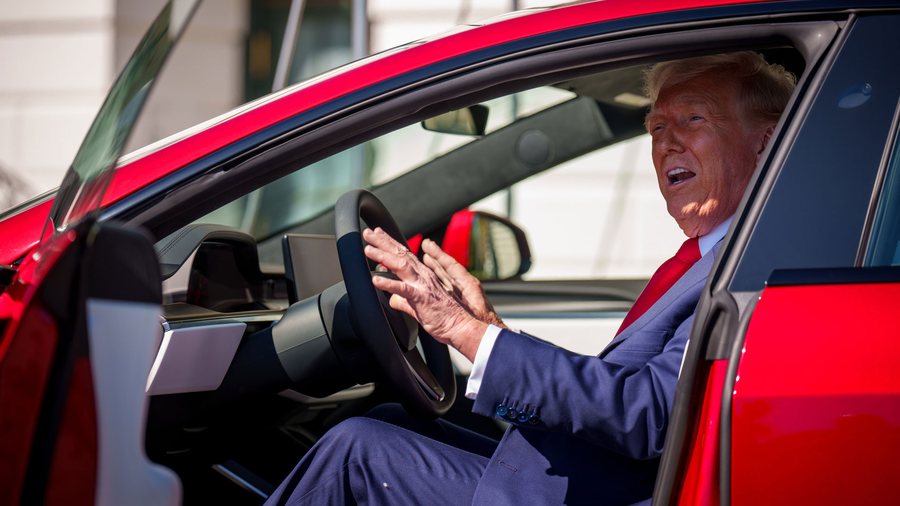
The Guardian has questioned Donald Trump's claims about his health, reflecting growing concerns among the American public. An analysis by Gaby Hinsliff examines the risk that a powerful leader's decision-making could be affected by impaired judgment, and the practical limitations of constitutional mechanisms to address this situation. In a context of international crises, the author emphasizes that transparency and institutional accountability remain essential...
Donald Trump's cognitive abilities are incredible. So amazing! So brilliant! So much better than any other "crazy" presidential candidate you can name, at least according to Trump himself, who last week boasted again that he has passed "perfectly a test that is very difficult for many people" several times. (He was presumably referring to the test for mild cognitive impairment in the elderly.)
Of course, the 79-year-old leader of the free world recently interrupted a mid-war cabinet meeting to talk at length about a conversation he allegedly had with the head of a company that makes Sharpie pens, regarding supplying the presidential administration with special pens that the company claimed it couldn't find in its records.
And he made a vague joke about Pearl Harbor during a press conference with the Japanese prime minister. And he called the Strait of Hormuz “Trump’s Strait,” before adding that this was absolutely intentional because “with me there are no coincidences.”
But anyway, to be clear, his mental state is excellent. The best!
Just imagine, though, if that weren't the case. Suppose, for the sake of argument, that the 61 percent of Americans (according to a Reuters-Ipsos poll) who think their president has become more unpredictable over the years and the 56 percent who don't believe he has the mental acuity to meet challenges (according to a Washington Post poll) aren't wrong.
Suppose that, as happened with octogenarian Joe Biden, millions of Americans through their television screens have sensed something that has actually affected the president's ability to send thousands of young men to a possible death in the Middle East, regardless of whether this can be classified as a clinical diagnosis.
Imagine that they are right to suspect that the lives of countless people around the world depend on someone whose judgment may not be entirely reliable, including 45 million people estimated to be at risk of acute hunger if farmers do not get enough fertilizer, a key byproduct of the now seriously troubled Persian Gulf gas industry.
What would it take, hypothetically, for the system to defy the will of an elected president?
It's strange that this has become a topic that, seemingly, is too sensitive to discuss publicly, given what's at stake.
Although the US has a system of checks and balances to prevent the president from going off the rails, none of these safeguards seem foolproof. The final safeguard is the requirement to seek congressional approval before declaring war, which could end this conflict and prevent others in the future.
Trump has gone so far as to prepare almost 10,000 soldiers to deploy to the Middle East for an invasion without this approval, and such large numbers could create their own dynamic in the conflict (although Trump may just be bluffing about taking Kharg Island, the center of the Iranian oil industry, and the Iranians may not know this).
Waves of alarm are finally surfacing within the Republican Party, following a confidential briefing for lawmakers last week, after which Representative Nancy Mace of South Carolina warned that the military objectives they were given were not those presented to voters.
But for now, Wall Street appears to be a more powerful controlling factor than Washington, with traders reportedly trying to calculate how much markets would have to fall for Trump to step down.
If all else fails, under the 25th Amendment, the president can be removed from office if the vice president and a majority of the cabinet agree that he is unfit to serve. But in practice, this is usually only used temporarily and with the president's consent, as in the case of George W. Bush while he was under anesthesia during surgery.
Even the medical checkups that American presidents regularly undergo do not guarantee full transparency, with the real extent of Biden's frailty only becoming clear after he dropped out of running for a second term.
Similarly, the public did not know until after his death that President John F. Kennedy used a combination of amphetamines and steroids during the Cuban Missile Crisis, just as the British did not know at the time that Winston Churchill drank heavily, or that Harold Wilson was likely suffering from the onset of dementia in his final days in Downing Street.
In practice, constitutional protections are only as strong as the will of the leader's inner circle, people often dedicated to keeping him in power at all costs, to uncover his weaknesses.
Why would anyone hide the truth about a leader who is weakening physically or mentally, given the potential consequences? Fear is an obvious response: of retaliation, loss of influence, or even public panic if the truth comes out in the midst of a crisis.
But a less obvious answer is the strong loyalty and protective instinct, even love, that comes after long years of service in politics.
If you are reading this as a son or daughter of elderly parents whose memory is beginning to fail, you will know how long the road often takes from the first uncomfortable feeling that something has changed to a final medical diagnosis, and how many sleepless nights there are in between.
Should they still drive, or have they become a danger to everyone on the road? Is it safe for them to manage their finances, or is it time to have the difficult conversation about legal authorizations?
The fear of intervening too early, risking angering a proud octogenarian, clashes with the feeling of guilt, because you know it will be your responsibility if someone gets hurt while you are still thinking about taking their car keys.
But precisely to overcome such emotional dilemmas, constitutional protections exist in the case of political leaders.
Because without them, we might all just be passengers in the truck of a speeding superpower: watching helplessly from the back seat as the driver lurches unsteadily and wondering how close we have to be to a crash before anyone speaks up. / Adapted from " The Guardian "



Donald Trapi kurre nuk do ta kishte shancin te ishte babai i nje Shqiptari e aq me teper babai im.