


 Shkruar nga Clive Crook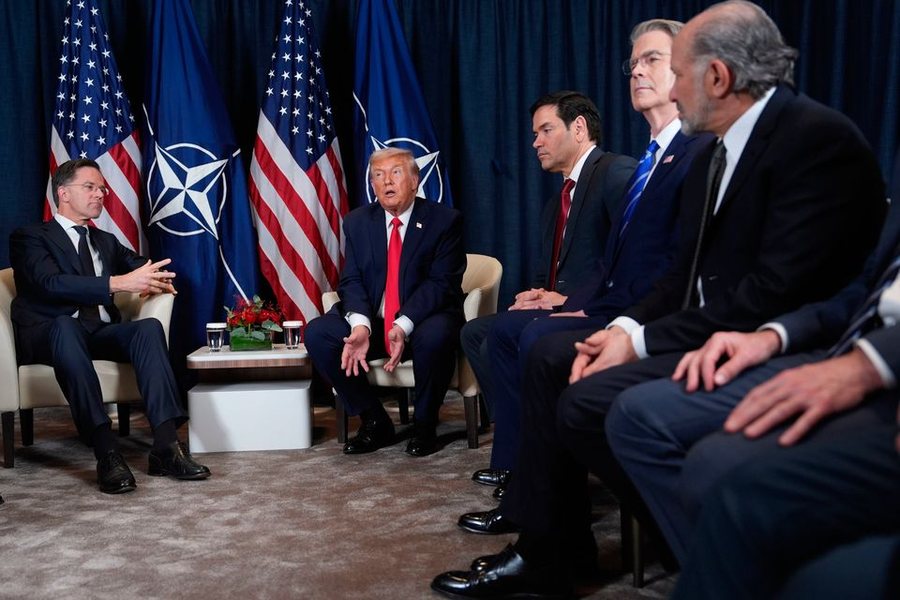
In the face of American protectionism and the NATO crisis, Europe cannot remain a spectator. Only a profound renewal, in security, economy and political culture, can turn the era of humiliation into an era of renewal.
Europe seems to be waking up to a new reality in the world. Neglected, insulted, and battered by its former protector, the United States, European leaders are asking: where do we go now?
Is the future a rapid decline, a “new era of humiliation,” as analyst Adrian Wooldridge puts it? Or will recent events prompt a profound, long-overdue renewal?
Over the next few years, the European Union will have to deal with President Donald Trump. But the bigger challenge is long-term: how to cope not only with this administration but also with its consequences, which are likely to change the global order.
To do this, the European Union must reconsider its own purpose, which affects everyone, current members, those who want to join, but also those who have left, like the United Kingdom.
Many Europeans see confronting Trump as a choice between two paths: submission or retaliation. But both approaches are illusory. Appeasement fails because Trump is never satisfied and sees no deal as binding. Retaliation also fails because the US has the advantage of escalation: if it starts an economic war, both sides lose, but Europe loses more. The wise choice, therefore, is neither submission nor confrontation, but a calm and measured disengagement from the United States.
In the area of trade, Europe can follow the classic principle of free trade: not to respond to American protectionism with European protectionism. EU markets should remain open, even if the US imposes tariffs.
This not only minimizes the damage to Europe, but also makes it clear that the blame for the consequences falls on Washington. On the other hand, in the security field, Europe cannot afford a breakup of NATO.
Trump's complaints about Europe's low defense spending are justified. Therefore, the EU urgently needs to increase defense investment, strengthen its own capabilities, and reduce its dependence on the US.
This does not mean submission, but neither does it mean provocation: cooperation where possible and clear refusal where necessary. But Europe has a deeper problem: a lack of geopolitical ambition.
Protected by the United States after 1945, it focused on internal harmonization, neglecting the building of a shared strategic vision. Now, with the global order shaken, this lack is dangerous.
In these conditions, a true renewal of Europe would first require a new focus on collective security. It is not enough to simply increase defense spending; a clear alliance within NATO is needed.
And European countries should commit to mutual defense, with the full participation of Britain and others. European armies should become stronger and more united.
Second, it is imperative to correct the accumulated errors in economic policy. The 2024 report by former European Central Bank president and former Italian Prime Minister Mario Draghi highlights them very clearly.
He cites excessive regulations that hinder innovation, the lack of a single capital market, a mismanaged transition to clean energy, and the lack of a common fiscal policy. Without addressing these weaknesses, Europe cannot compete with other global powers.
Third, a cultural change is required. The European Union must find a balance between unity and national sovereignty: as much unity as necessary, as little as possible.
A union focused on collective security is essential, but this cannot be achieved by erasing the national identities that citizens increasingly feel. Simply put, Brussels must abandon the mindset of excessive centralization.
The chances of such a reinvention? Small, but not impossible. Donald Trump has brought a shock that forces Europe to choose: either fail or reinvent itself. And this is a decisive moment. / Adapted from “Pamphlet”, from “Bloomberg”



Lini një Përgjigje