


 Shkruar nga Pamfleti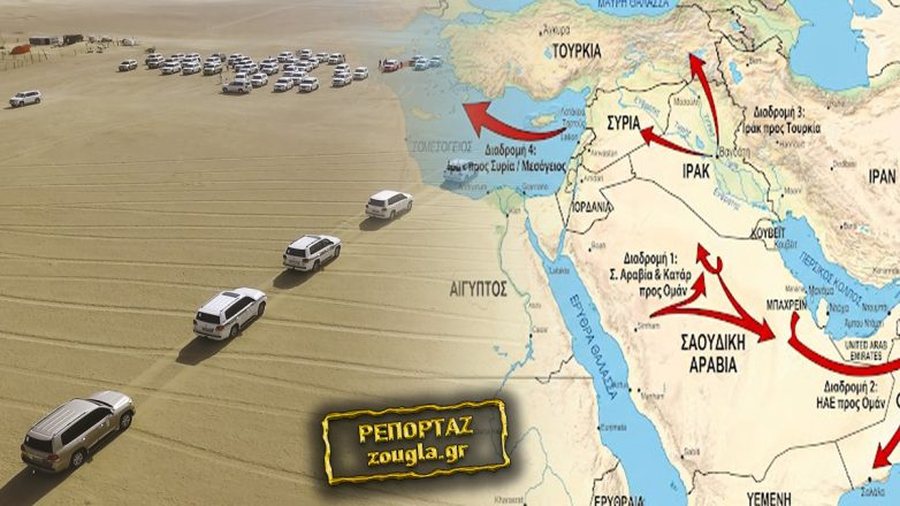
New strategic routes in the Arabian Peninsula, Iraq and Syria. Modern caravans for the transport of goods and oil
In the volatile geopolitical landscape of 2026, the global economy is experiencing one of the most profound reorganizations in the history of shipping and logistics. Continued tensions in the Persian Gulf have turned the Strait of Hormuz from a vital maritime artery into a major source of uncertainty, forcing countries and international trade giants to accelerate within months alternative plans that have remained on paper for decades.
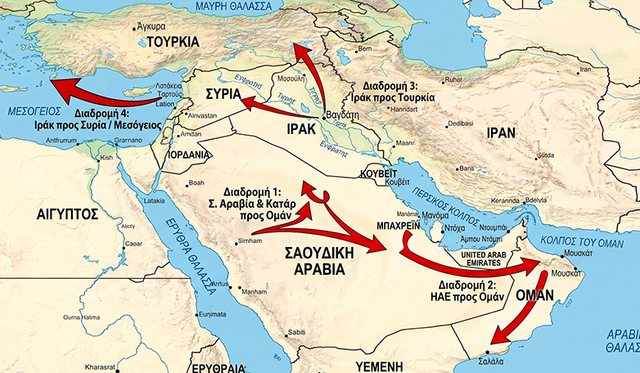
The need for safe passage of fuel and goods has revived ambitious projects that are redefining economic boundaries and regional alliances. From the construction of the Arabian Peninsula’s “Land Bridge” and the strategic role of Oman, to the “Development Road” in Iraq, the region is being transformed into a vast network of pipelines, railways, and ports that point toward the Mediterranean and Europe.
At the same time, the revival of historical infrastructures in Syria and the strategic promotion of the IMEC (India–Middle East–Europe) corridor are creating a new trade axis connecting the Indian Ocean with the Mediterranean, completely bypassing traditional maritime straits.
The main axes that are shaping the new trade map
Arabian Peninsula Land Bridge (Saudi Arabia – Oman – United Arab Emirates)
The most immediate solution, already being implemented by major shipping companies such as MSC and Hapag-Lloyd, is to unload goods at ports outside the Strait of Hormuz and then transport them by land or rail.

Road axis Route 95:
It connects the border between Saudi Arabia and Qatar with Oman, including the ports of Sohar, Duqm, and Salalah. Trucks completely bypass the Strait of Hormuz and transport goods from the Red Sea to the Indian Ocean.
Hafeet Rail:
The railway project connecting the United Arab Emirates with Oman is at an advanced stage. According to data from 2026, about 40 percent of the project has been completed, with the aim of connecting the Etihad Rail network to Omani ports.
Saudi Arabia's East-West Pipeline:
The pipeline that transports oil from the Eastern Province to the port of Yanbu on the Red Sea is now operating at maximum capacity and is considered the main artery for the export of crude oil out of Hormuz.
Evasion through Iraq – “Development Road”
Iraq is promoting the most ambitious project to become the main alternative corridor to Europe.
Grand Fay Port:
The new port in southern Iraq is designed to receive cargo that, rather than passing through the Suez Canal, will be transported by trains and trucks.
Basra–Turkey Railway:
The $17 billion "Development Road" project aims to connect Basra to the Turkish border, creating a land corridor that completely avoids sea straits.
Basra–Haditha Pipeline:
During 2026, Iraq activated plans for a new pipeline with a capacity of 2.25 million barrels per day, which will transport oil from the south to the north and allow export through Turkey or Jordan.
The corridor through Syria
Although Syria remains a territory with high geopolitical instability, during 2026, movements are being observed to restore the function of old strategic infrastructures.
Kirkuk–Baniyas pipeline:
Iraq has announced its intention to restore the pipeline to the Syrian port of Baniyas on the Mediterranean. This would give Iraqi oil direct access to the Mediterranean, bypassing both the Strait of Hormuz and the Suez Canal.
Land transport:
Despite the difficulties, efforts are underway to establish trade convoys that pass through Iraq and Syria towards Lebanon and the Mediterranean. However, this route is still considered high-risk due to the presence of armed groups.
IMEC Corridor (India–Middle East–Europe Corridor)
This project is considered a strategic counterweight to the Chinese "Silk Road".
The corridor connects India to the United Arab Emirates via sea routes and then uses the rail network through Saudi Arabia and Jordan to reach the port of Haifa in Israel.
From Haifa, goods are transported to Europe, mainly via Greece and the port of Piraeus.
This corridor completely avoids the Strait of Hormuz and the Suez Canal, reducing transport times by up to 40 percent. / Pamphlet /






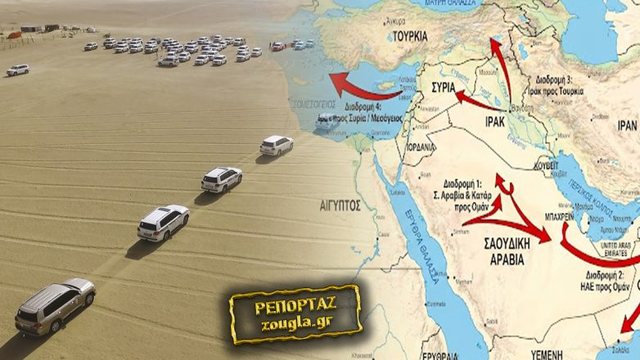
Ore Pamfleti po nuk gjenit dot nje harte me shkronja Angleze ose shqip po e keni vene me germa Greke. Meqe beni si Patriote.
Jane te shitur keta cifutet kot I quan. Patrioter