


 Shkruar nga Pamfleti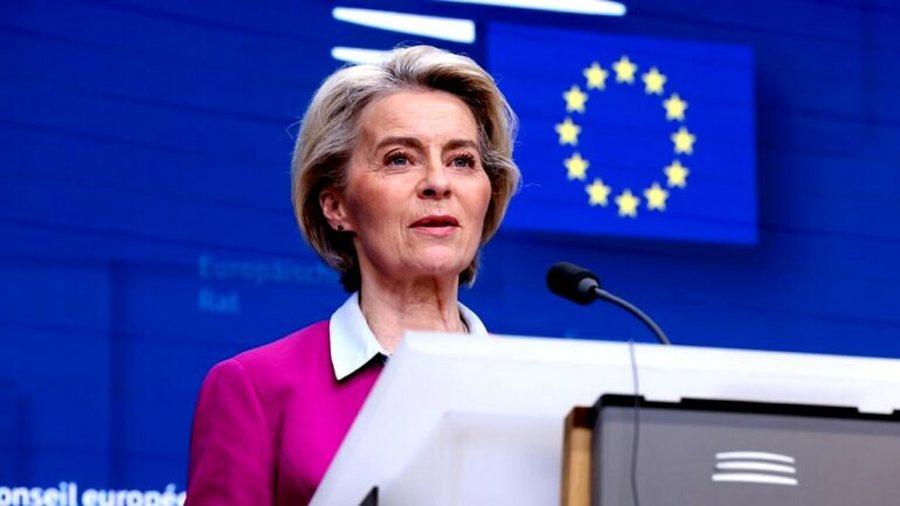
European Commission President Ursula von der Leyen has promised more power for EU regions in an attempt to quell a parliamentary revolt ahead of Thursday's no-confidence vote.
Socialists and liberals are threatening to abstain during the vote, in an attempt to force von der Leyen to make political commitments on the bloc's next 7-year budget, which she will unveil next Wednesday.
Von der Leyen extended an "olive branch" to critics on the eve of a crucial no-confidence vote in the European Parliament, which could severely damage her leadership.
During a high-level meeting with party leaders in Strasbourg, von der Leyen said that payments to regions, which currently make up a third of the EU's multi-year budget, would continue to be distributed to local authorities rather than national governments in the new budget, two people present at the meeting said.
However, Von der Leyen's offer was not enough to quell the concerns of socialists and democrats, who have been increasingly critical of her leadership in recent weeks.
“We lacked clarity and commitment. If nothing changes, it will be difficult for the S&D to decide not to abstain on Thursday,” a spokesperson for the group told POLITICO after Tuesday’s meeting.
Von der Leyen is expected to survive the vote even if the socialist and liberal parliamentary groups abstain, as the motion would need a two-thirds majority in Parliament to pass. But that would send a strong message that she cannot rely on Parliament unconditionally.
The Socialists, the second largest group in the European Parliament, are linking their support to preserving the European Social Fund, which is supposed to tackle poverty and support vulnerable groups.
The Commissioner for Social Rights, Roxana Mînzatu, is leading an effort within the EU executive to save the fund.
"If you remove this from the budget, you strike Europe at its heart and what will remain is a Europe without a soul," Socialist lawmaker Mohammed Chahim told the European Parliament.
Concession for the regions
Supporters say von der Leyen's change of stance is a "game changer" as it will make it harder for autocratic leaders, such as Hungary's Viktor Orbán, to cut EU funding for regions governed by political rivals.
Von der Leyen's plan to significantly increase the power of national governments in handling regional funds has been criticized by lawmakers from across the spectrum and by some of her commissioners.
They argue that this will undermine local democracy and widen the gap between the richest and poorest parts of Europe.
However, in a major concession, von der Leyen guaranteed that regions will continue to receive directly the amounts that are determined in Brussels.
According to someone who followed the discussions, she had previously announced the move in a private meeting with Polish Budget Commissioner Piotr Serafin, who is also campaigning for a stronger role for the regions.
After the publication of this article, Serafin himself denied that a discussion took place.
“This is an important request for the European Parliament,” said Siegfried Mureşan, budget negotiator for the center-right European People’s Party.
However, lawmakers and the Italian regions commissioner, Raffaele Fitto, are pressuring von der Leyen to go a step further.
They support maintaining a mechanism, known as the Berlin formula, that allocates a large portion of cohesion money to underdeveloped regions across the bloc.
Discussions on this sensitive issue are expected to be resolved over the weekend during high-profile talks between von der Leyen and several commissioners. / Adapted from Politico/




Lini një Përgjigje