


 Shkruar nga Pamfleti
Georgia's most powerful man won parliamentary elections on Saturday, according to early official results, a blow to those Georgians hoping for European Union integration.
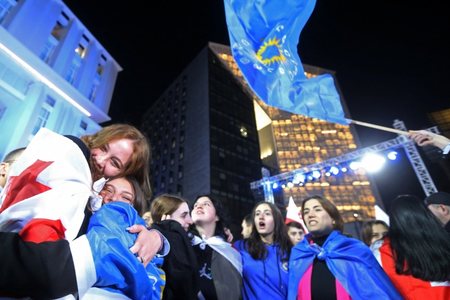
The founder of the Georgian Dream party, billionaire Bidzina Ivanishvili, the opposition and foreign diplomats had hailed the election as a watershed moment that would decide whether Georgia would move closer to the West or lean back towards Russia amid the war in Ukraine. .
Early official results with 70 percent of precincts counted, representing the majority of votes cast, showed the ruling party had won 53 percent of the vote, the Election Commission said. The results do not include the majority of votes cast by Georgians living abroad.
Polls conducted immediately after the end of the voting process offered different predictions on the outcome of the elections. According to a survey conducted by the TV channel 'Imedi' which supports the Georgian Dream, the ruling party has won the elections securing 56 percent of the votes.
But polls conducted by the pro-opposition channels 'Formula' and 'Mtavari Arkhi' showed that the pro-Western opposition parties had gained a lot of support, securing a combined 83 seats in the 150-member parliament.
Bidzina Ivanishvili, once prime minister of the ruling party, declared victory and praised the citizens of Georgia.
"It is a rare case in the world that the same party achieves such success in such a difficult situation. This is a good indicator of the talent of the Georgian people," Ivanishvili told cheering supporters.
Although Georgian Dream lost to the opposition in parts of the capital, Tbilisi, it won up to 90 percent in some rural areas.
The Georgian opposition also initially celebrated the victory, and some observers reported election violations. But a parallel count conducted by one of the opposition parties showed that Georgian Dream is in a strong position to win the majority.
Ivanishvili, who made his fortune in Russia in the 1990s, took power in 2012 advocating pro-Western views along with a pragmatic policy towards Russia.
Since then, he has been furious with the West, accusing it of seeking to drag Georgia into war with Russia, even as he insists Georgia is on track to join the EU.
If a victory for Ivanishvili's party is confirmed, it would be a blow to the EU's hopes of bringing more former Soviet republics into its orbit. Moldova on October 20 voted by a very narrow majority to support EU membership.
Russia had repeatedly signaled that it wanted the Georgian Dream to win, while accusing Western countries of unnecessary interference in Georgian politics.
"Georgians won. Good luck!” said Margarita Simonyan, editor of Russian state media RT, which the United States has accused of trying to influence the US election.
There was no immediate comment from the EU on Saturday's election.
Georgian President Salome Zourabichvili, a once ruling party ally turned outspoken critic, and independent domestic election observers alleged that Georgian Dream engaged in widespread vote-buying and other forms of electoral abuse in the run-up to the polls.
The International Society for Fair Elections and Democracy (ISFED), an independent Georgian monitoring group founded in 1995, said it had documented numerous violations and instances of violence outside many polling stations.
A video posted on social media showed a man stuffing a ballot box with many ballots in Marneuli, a town of about 25,000 south of Tbilisi. The votes were later declared invalid, a spokesman for the Central Election Commission said, according to the Interpress news agency.
Giorgi Kalandarishvili, chairman of the Election Commission, said the vote was peaceful and free and said the election was conducted in accordance with international standards.
Georgia was once one of the most pro-Western states to emerge from the chaos that followed the collapse of the Soviet Union. The road leading to Tbilisi Airport is named after former US President George W. Bush.
Since the Russian aggression in Ukraine in February 2022, Tbilisi's relations with the West have deteriorated. Unlike many Western allies, Georgia refused to impose sanctions on Moscow, while the rhetoric of the Georgian Dream has become increasingly pro-Russian.
The Georgian Dream has drawn the ire of Western allies for what they see as its increasingly authoritarian bent. Hungarian Prime Minister Viktor Orban congratulated Georgian Dream on the "profound victory".
Georgian Dream campaigned strongly to keep Georgia out of the war in Ukraine, with campaign images comparing pristine Georgian cities to devastated Ukrainian ones./VOA


Lini një Përgjigje