


 Shkruar nga Pamfleti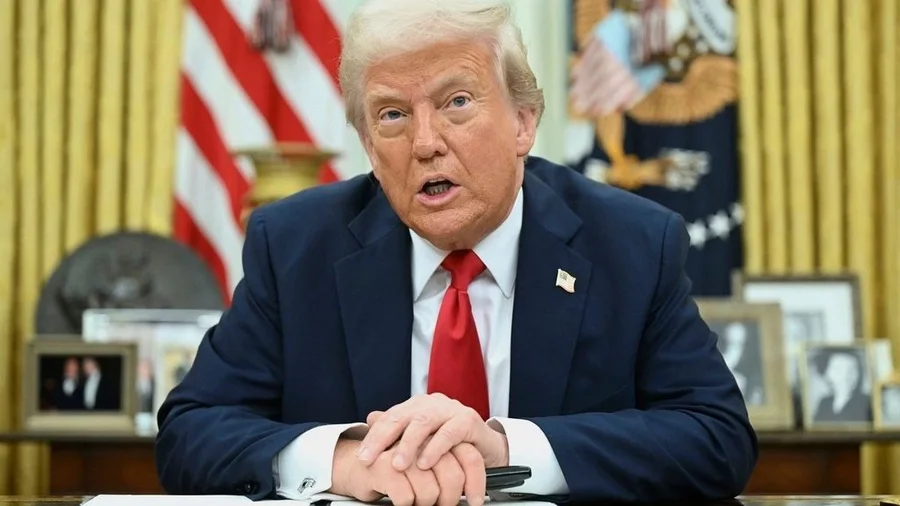
US President Donald Trump has caused turmoil in the global economy and markets by announcing tariffs on goods imported from the country's largest trading partners.
So far, the US has imposed 25% tariffs on most imports from Canada and Mexico, increased tariffs on China by 20%, and is expected to announce a new round of reciprocal tariffs and product tariffs tonight.
According to a Skynews report, citing a White House source, Donald Trump's tariffs will be divided into different rates by state and sector.
Plans under consideration included adjusting tariffs for each U.S. trading partner, imposing tariffs on some countries but not others, or imposing a flat rate of up to 20% on all imports. A White House official told CNN that he did not believe Trump would make a decision until shortly before the 4 p.m. ceremony announcing the tariffs in the Rose Garden on Wednesday.
However, these decisions bring U.S. import tariffs to their highest average since 1943, according to the Budget Lab at Yale University, and Trump has hinted that more increases could follow.
A warning from Lagarde
Trump’s tariffs will have “negative effects around the world,” European Central Bank President Christine Lagarde said on Wednesday, hours before the U.S. president announced the move. She added that the impacts depend on their scope, how long they last and whether they lead to successful negotiations. “There will be negative impacts around the world and the intensity and duration of the impact will vary depending on the scope, the products targeted, how long they last, whether there are negotiations or not,” she said in an interview with Ireland’s Newstalk radio. Lagarde added that “let’s not forget too often that these tariff escalations are harmful, even for those who impose them, they lead to negotiating tables where people sit down and talk and eventually remove some of these barriers.”
Europe is ready
European Commission President Ursula von der Leyen, in a speech on Tuesday at the European Parliament plenary in Strasbourg, declared that the European Union is open to negotiations with the US on tariffs, but also ready to take strong countermeasures if necessary. "We are open to negotiations and we will approach them from a position of strength. Europe holds many cards, from trade to technology. Our strength also lies in our readiness to take strong countermeasures if necessary. "All tools are on the table," she stressed.
For his part, French Industry Minister Marc Ferrazzi said Europe would respond proportionately to the possible application of tariffs, but would not escalate tensions under any circumstances. “Europe has always been on the side of negotiations and calm, because trade wars, you know, only produce losers,” he told RMC radio.
What are the fees and what are they for?
But how do the fees work, who pays them, and how are the revenues collected?
Tariffs are taxes imposed on imported goods and, like all taxes, are a source of government revenue, Bloomberg explains. Countries rely on tariffs to support domestic industries by making foreign products more expensive. U.S. President Donald Trump also uses them as leverage to achieve foreign policy goals.
How are they collected?
The U.S. Treasury Secretary is responsible for establishing regulations regarding the collection of duties, while U.S. Customs and Border Protection, or CBP, is the government agency charged with enforcing them at nearly 330 ports of entry across the country (road or rail border crossings, seaports, and airports). Agents examine documents, conduct inspections, and collect fees and fines. The money is collected during customs clearance and remitted to the Treasury Department. Some goods and components are imported multiple times before becoming a final product—such as a car with U.S.-made parts assembled in Mexico and reimported to the U.S. Under CBP rules, U.S.-made products that are reimported into the country without being improved or increased in value are duty-free. For example, if the U.S. exports gold to India, where it is used to make jewelry, the final product will be subject to duties upon re-entry into the U.S. In this case, the value of the gold would also be taxed.
While tariffs were the U.S. government’s primary source of revenue, for much of the past century they accounted for a small portion of government revenue. As of last year, they accounted for less than 3% of federal revenue, according to an analysis of data from the Federal Reserve Bank of St. Louis. The combined tariffs on Canada, Mexico and China could translate into $1.1 trillion in additional costs for U.S. importers over the next decade, according to estimates from the Tax Foundation, an independent think tank. By 2025 alone, Trump’s policies could increase tariffs by nearly $110 billion. The Tax Foundation estimates that tariffs imposed on China by Trump during his first term and expanded during Joe Biden’s presidency generated $77 billion in annual revenue.
Who pays?
The research concludes that American consumers and businesses are the ones who absorb the costs of higher tariffs. Foreign producers can lower their selling costs, or American importers can absorb some of the costs. To avoid lower profits, companies often choose to raise prices and pass some of those costs on to consumers. However, there are potential loopholes, such as an opt-out process that allows companies to seek exemptions from tariffs if paying them would unfairly harm their business and there were no other options to buy products from another country.
Consequences
The recent history of U.S.-China trade can explain what happens when tariffs are imposed. During his first term, Trump imposed a series of tariffs on Chinese products, including steel, aluminum and engines. U.S. imports from the Asian country have fallen from a fifth of what the U.S. imported before Trump’s first trade war in 2018 to just 14% of U.S. imports by 2023.
Furthermore, when taxes are increased, importers often resort to tax evasion. This can be done by shipping goods through a third country, underreporting the value of products, or mislabeling them as similar goods subject to lower tariff rates.
Goldman Sachs economists recently found that this tactic could save up to $90 billion from the estimated $240 billion hit to U.S. imports from China compared to pre-trade war levels.
What is the "Foreign Revenue Service" that Trump is proposing?
The Trump administration has proposed creating a separate foreign revenue service to collect tariffs as part of its “America First” trade policy. Analysts have noted that tariff revenue is not a “foreign” source because tariffs are paid by U.S.-based importers, who pass on at least some of the cost to American consumers. The idea underscores Trump’s desire to designate tariffs on foreign imports as a source of revenue that is not borne by taxpayers.
What does all this mean for the terms of trade?
The U.S. has free trade agreements with 20 trading partners around the world — including one with Mexico and Canada known as the USMCA, or the new NAFTA. In these agreements, countries commit to reducing tariffs to zero. Trump’s tariffs on Mexico and Canada run counter to the trade agreement between the three nations (which is due to be renegotiated in 2026). As a member of the World Trade Organization, the U.S. is bound by rules that include limits on the use of subsidies, as well as trade barriers, such as tariffs and quotas. / Adapt Pamphlet /






Lini një Përgjigje