


 Shkruar nga Mario Lavia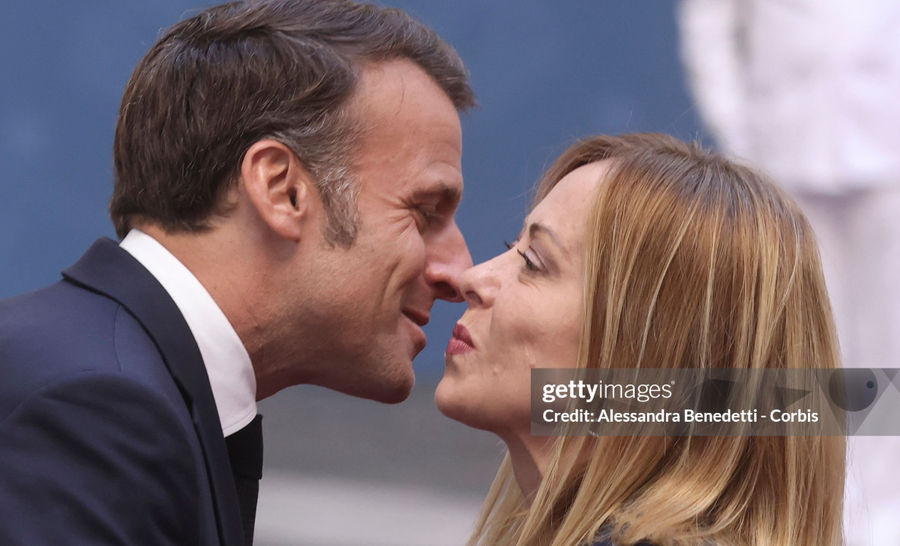
The rivalry between Rome and Paris has been reignited after the murder of right-wing activist Quentin Deranque, who became a symbol of a Europe caught in ideological war. The Italian prime minister positions herself as the guardian of a threatened order, while the head of the Élysée categorically rejects any external intervention. In the background, a European Union appears that increasingly resembles a symbolic battlefield rather than a shared space of values.
Giorgia Meloni feels a “growing climate of ideological hatred, which has engulfed several nations and which constitutes a plague for the whole of Europe.” This is what she said while commenting on the barbaric murder of Quentin Deranque, the right-wing militant who lost his life last week in Lyon at the hands of a gang of left-wing extremists, some of whom had direct links to the France Insoumise movement.
Dissociating herself from the brutal violence that took place in Minneapolis, USA, the Italian prime minister links the Lyon crime to a current of hatred that “is sweeping through several nations.” Although Meloni does not say openly whether this phenomenon has also affected Italy, it is likely that her mind is on the recent riots in Turin. So she is turning the Lyon incident into a metaphor for a pan-European conflict.
This reflects a tension that she personally experiences, especially in a very heated phase of internal political conflict, although the latter still remains within peaceful frameworks. In this tense and unstable landscape, Meloni plays her strategic move.
She transforms Lyon into a symbol, integrates France into the narrative of a Europe gripped by ideological war, and proclaims herself the defender of an endangered order. This strategy speaks directly to her electoral base and openly challenges her opponents.
However, there is a danger here: when European politics becomes a theater of permanent conflict, the consequences can be unpredictable. At the same time, this is a way to show solidarity with the French right, just as it did with the American right six months ago.
But the line between solidarity and political exploitation remains unclear. In fact, Meloni's statement caused a lot of anger in Emmanuel Macron. The tense relations between the leaders of France and Italy are already known, and the French president was ruthless.
"I am always impressed by nationalists who don't want anyone to disturb them in their own home, but are the first to comment on what happens in someone else's home," he said.
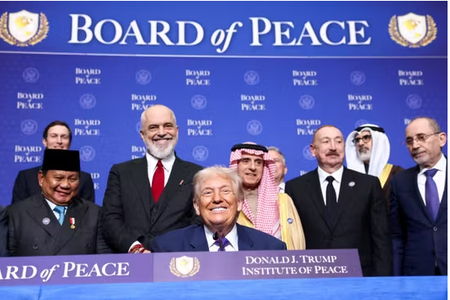
Perhaps an overreaction, considering the circumstances, but the context is clear. The Italian Prime Minister is paying the price of being “Trump’s representative in Europe.” Just yesterday, Antonio Tajani, Deputy Prime Minister and Foreign Minister,
appeared alongside the American tycoon to "observe" the tragicomic certification of the so-called Peace Board, positioning Meloni as Macron's main opponent.
Meloni is facing the consequences of this hostility, which, although emphatically articulated by the French president, is widely shared by the rest of Europe (with the exception of Viktor Orbán). It seems to have plunged into an unprecedented European isolation, in the name of loyalty to the Washington leader.
Of course, the Élysée's nervousness has a clear domestic political explanation. The murder of Quentin Deranque by members of Raphaël Arnault's circle - part of Jean-Luc Mélenchon's France Insoumise - has opened a new chapter in France.
The right has called for an anti-Mélenchon "cordon sanitaire", while former president François Hollande confirmed that relations between the Socialists and France Insoumise have been definitively severed.
It remains to be seen what the local elections in March will produce. Will Mélenchon's party be punished by voters, or will it serve as a support for the Socialists, perhaps even saving the Macronists from a predicted defeat?
Today, France Insoumise is perceived as a political force with ambiguous positions on violence, and is therefore unreliable. Perhaps now even Mélenchon supporters will understand why Macron did everything to exclude them from the government.
The possibility of a democratic alliance (without the involvement of the far left) blocking Jordan Bardella's coalition in next year's presidential elections is difficult, but it seems the only remaining path.
The rest is just propaganda. The question that remains is: Is Europe still a common project, or has it become a symbolic arena where each leader pursues his own national interests?
Meloni has chosen to navigate this dangerous turn. Macron, on the other hand, is reminding them that the room for maneuver is extremely narrow. The final decision will be given by the voters, both in France and in Italy./ Adapted Pamphlet from “Linkiesta”


Lini një Përgjigje