


 Shkruar nga Pamfleti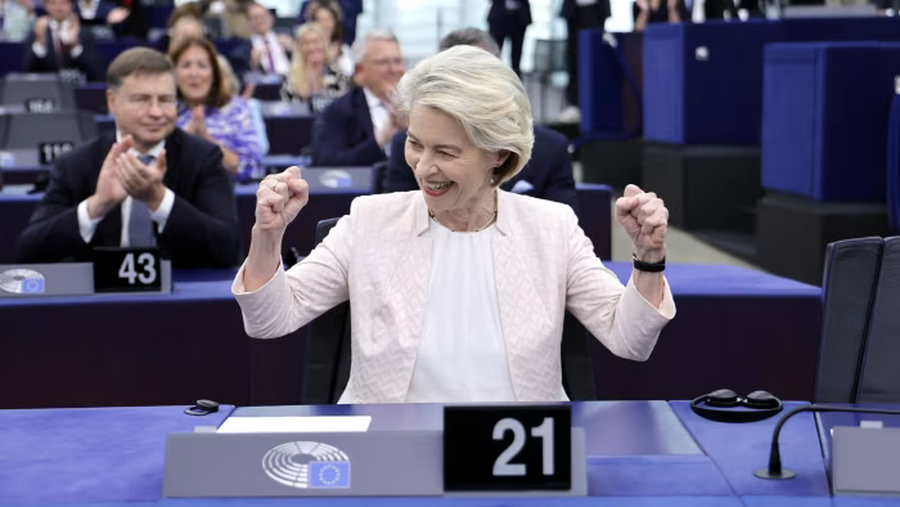
But to secure enough support in the European parliament on Thursday, she has expanded her executive to-do list and raised expectations across the EU political spectrum on a host of issues that have long frustrated Brussels officials.
Ursula von der Leyen won a second term as president of the European Commission with an ambitious list of promises for the next five years.
But to secure enough support in the European parliament on Thursday, she has expanded her executive to-do list and raised expectations across the EU political spectrum on a host of issues that have long frustrated Brussels officials.
Mujtaba Rahman, of consultancy Eurasia Group, warned that von der Leyen may have set herself up for failure by offering commitments "that are not particularly coherent" to secure the support of a broad coalition.
Here we assess her boldest promises and most daunting political challenges for her 2024-2029 term:
Is a merger of capital markets possible?
Von der Leyen on Thursday rebranded a long-promised push to create a capital markets union as the "European Savings and Investments Union", but a new name does not remove old obstacles.
The arguments in favor are great. The integration of EU capital markets, a ten-year project, could free up up to 470 billion euros of private investment a year, von der Leyen estimated. This would create much-needed private sector money to help finance sectors such as defence, technology and the green transition. But resistance to merging national powers such as market supervision and corporate tax and bankruptcy rules has so far proved steadfast.
There have been recent attempts to revive political appetite, but it is unclear how she plans to break out of the deadlock. Softer measures, such as a pan-European investment product, may advance, while core issues such as further centralized EU banking supervision will remain controversial.
Can it build a defense EU?
As well as creating a dedicated defense commissioner, von der Leyen also pledged to create "a single market for defence" and joint projects such as the "European Air Shield".
Few member states disagree with the need to pool resources given the huge investment required after decades of spending cuts and threats from Russia. But hardly anyone is willing to delegate the choice of what devices to buy, where to manufacture them or how to pay for them.
France and Germany have rival ideas for pan-European air defense projects; countries want to protect their domestic arms producers for reasons of national security; and interoperability has long been a focus of NATO, with mixed results.
Will competition rules be eased?
Von der Leyen has said a revamp of competition enforcement should focus on "innovation and resilience", comments that revived a long-running debate over whether Europe should ease merger controls to allow bigger companies to thrive.
Its policy guidelines called for a "new approach to competition policy" that was "more supportive of companies growing in global markets, always ensuring a level playing field".
This could mark a major policy shift from the commission's oft-cited 2019 ban on the merger between Siemens and Alstom, which the German and French companies pitched as a way to create a European champion in the rail market.
But officials in Brussels are skeptical that the remarks, which did not include any commitment to legislation, will lead to a general change in approach. Any significant move to ease restrictions would face strong opposition from pro-competitive capitals seeking to protect small business.
Major member states, including France, Germany, Poland and Italy, sought to revise the rules early in von der Leyen's first term, only to face opposition from 16 other capitals.
Should the EU budget be linked to the rule of law?
The president of the commission has pledged to condition national disbursements from the EU budget on respect for the rule of law and structural reforms, extending conditions such as respect for democratic norms and fundamental rights to all EU funds.
" We will keep a very clear principle in our budget: respecting the rule of law is a must for EU funds. In this budget and in the future" , she said.
The Commission currently has the power to freeze some EU money for breaches of the rule of law. This caused confrontations with Poland and Hungary, but was seen as an effective means of halting the democratic slide.
Applying more conditions to EU funding will win support from richer countries that want tighter control over the common currency, but is likely to be opposed by countries that see such moves as political blackmail and a overreach from Brussels in domestic affairs.
Can Brussels help with housing and mental health?
In June's European elections, voters, including many young people, turned to far-right parties. They won about 30 percent of support and topped the polls in Italy, France and other countries.
Centrist lawmakers, including those from von der Leyen's own European People's Party, believe the far-right has successfully linked homelessness to increased migration, appealing to 20-year-olds who can't afford to leave their parents' homes. .
Iratxe García Pérez, the Socialist leader in parliament, said "access to housing is a vital need of our citizens" and called for 50 billion euros in annual EU investment. But housing remains under the control of national or even regional governments and analysts question how Brussels can unblock planning procedures in 27 countries.
Von der Leyen also highlighted how excessive use of social media was exacerbating a "youth mental health crisis", saying she would tackle excessive screen time and addictive practices and take action against the design of depending on some platforms./ Adapted "Pamphlet" from "Financial Times"



Lini një Përgjigje