


 Shkruar nga Pamfleti
Think back to the recent past. Nothing has affected businesses and consumers more since the pandemic than the explosion of inflation. Whatever you choose to cite as the culprit—the war in Ukraine, loose monetary policy, the damage to supply chains from lockdowns—was political. That experience should have reminded us of the primacy of the public sphere. Instead, the fascination with technology as a shaper of reality has only grown during this period.
A person born on the day Apple launched the first iPhone can now vote. After 18 years, we might expect the newest version that came out last month to be negligible compared to the original. Whatever improvements it has accumulated, it is not. But even a car produced that year would not look out of place on today's roads.
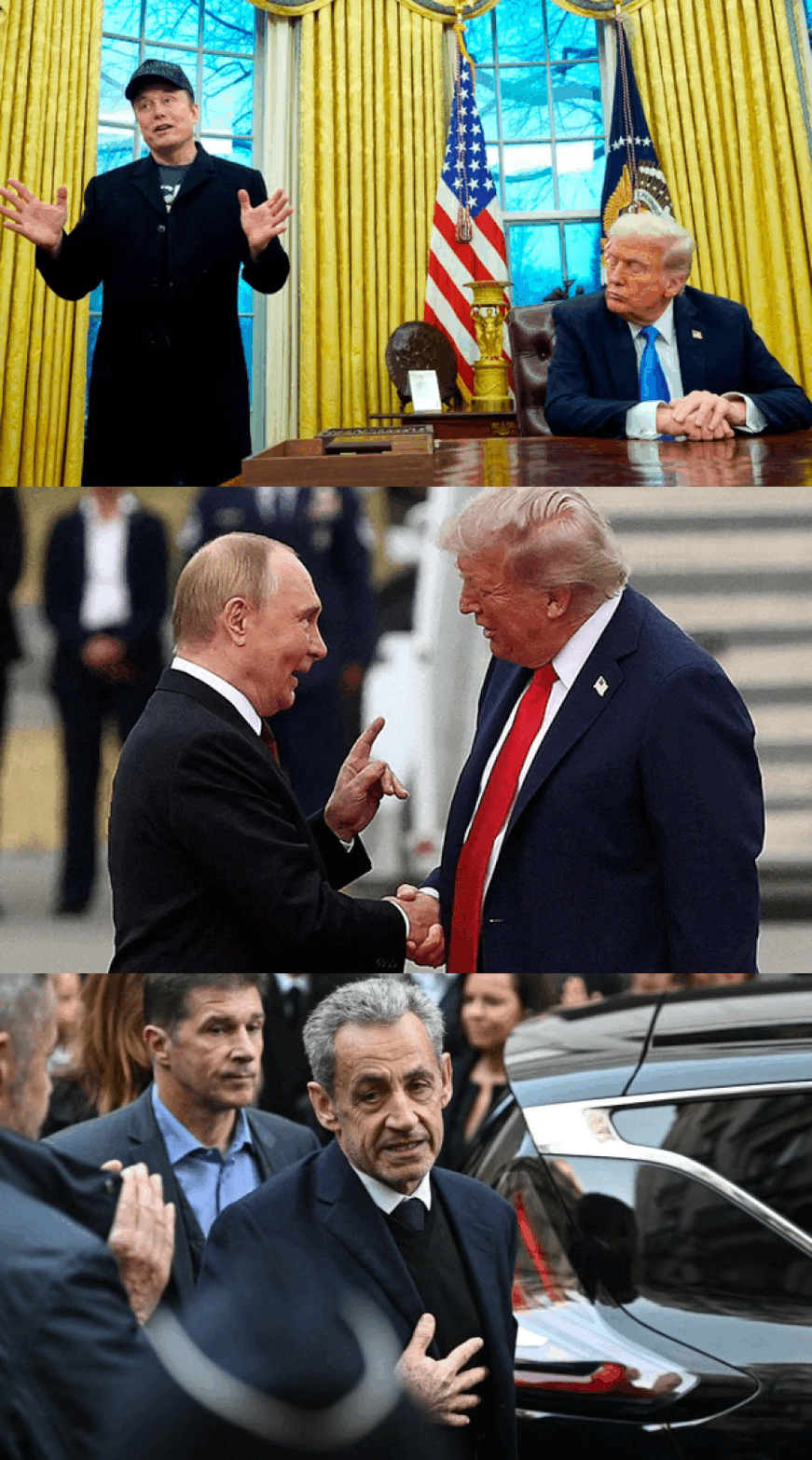
Also, look at the images of Nicolas Sarkozy's election as president of France and then the images of his journey to prison this week. Aside from the man's own gray hair, can you easily tell the two eras apart? I don't think so, no more than you could tell 1989 from 2007, which is an equal leap in time.
Now, let’s make that comparison again, but this time tracking political rather than technological changes. When the iPhone came out, there was relative peace in the world, a strong political center in almost all Western democracies, a close US-China relationship, and a pro-trade consensus. Today, we have a ground war in Europe with primitive ferocity, the far right is in or near national power across the West, US-China relations are fluctuating from tense to hostile, and David Ricardo is in the trash.
Public life, not private innovation, has provided the drama of our time. You won't always understand this from the "discourse."
I may have attended too many conferences and dinners this year, but I get the impression that people, even, or especially, smart people, are thinking too much about technology and too little about politics. The endless predictions about artificial intelligence are one thing, but they don’t stop there. Jeff Bezos predicts “millions of people living in space” within the “next two decades.”
Well, Earthlings, here are some perfectly realistic political scenarios in a shorter time frame: France elects a far-right president who, without leaving the European Union, cripples it from within until it ceases to function. Russia does something to a NATO member state that appears to constitute an “armed attack” under Articles 5 and 6 of the Treaty. The Sahel, where more than half of all terrorist deaths on Earth now occur, compared to almost none in 2007, becomes a base for attacks on the West. (Think of Afghanistan at the turn of the millennium, but much closer to Europe and America.) Britain or France, or both, face a debt crisis that causes, at best, a necessary change in economic policy, and at worst, civil unrest.
These topics are not entirely uncontroversial, of course, but the amount of attention they receive compared to conversations about technology is disproportionate. As a general rule, be suspicious of any “forecaster” who doesn’t focus on politics.
The grandest visions of AI, massive consumer surplus, and massive job losses could also occur. Meanwhile, the departures from power of Xi Jinping (72) and Vladimir Putin (73) will occur, with consequences for many people outside their two countries. The spectrum of possible outcomes is wide: from a détente between the West and Eurasian autocracies under a new generation of leaders, to an even higher escalation of conflict that is terrifying to contemplate.
So, feel free to speculate about the potential of technology. But understand that one or two entirely possible political developments would trump any effect that technology is likely to have on everyday life. Even a modest trend, such as the projected increase in defense spending in Europe, has consequences for taxes and therefore private consumption that would require major innovation to equalize or undo.
Think back to the recent past. Nothing has affected businesses and consumers more since the pandemic than the explosion of inflation. Whatever you choose to blame—the war in Ukraine, loose monetary policy, the damage to supply chains from lockdowns—it was all political. That experience should have reminded us of the primacy of the public sphere. Instead, the fascination with technology as a shaper of reality has only grown during this period.
Why?
Some of it is a generational habit. In the 18 years before the iPhone, the technological changes were staggering: from little or no internet to ubiquitous connectivity, from dirty and polluting machines to clean, if monotonous, cars. The difference between George HW Bush and George W Bush was less profound. People who grew up in that era, and therefore almost everyone who has influence today, tend to emphasize technology over politics as the engine of history. Hence the widespread belief that social media brought about populism. (But not in Australia or Denmark, surprisingly.)
Another reason for the emphasis on technology is that it is a coping mechanism. Technological trends are less scary to examine than political ones. Better a conversation about deepfakes than a pan-European war. It's a way of being serious without actually being serious.
Look at what people who can do whatever they want choose to do. When Elon Musk and other tech barons intervened in public life, it was interpreted as an attempt for personal gain: to influence regulations and even public contracts in their favor. To some extent, it probably was. But don’t doubt their sincerity as individuals who want to leave their mark.
The shift to politics was a tacit admission that that was where the action was. Almost nothing in commerce could compare with affairs of state as a source of intellectual stimulation and a means of historical influence. Those who reach the pinnacles of technology seem more acutely aware of its limitations./ Financial Times







Lini një Përgjigje