


 Shkruar nga Pamfleti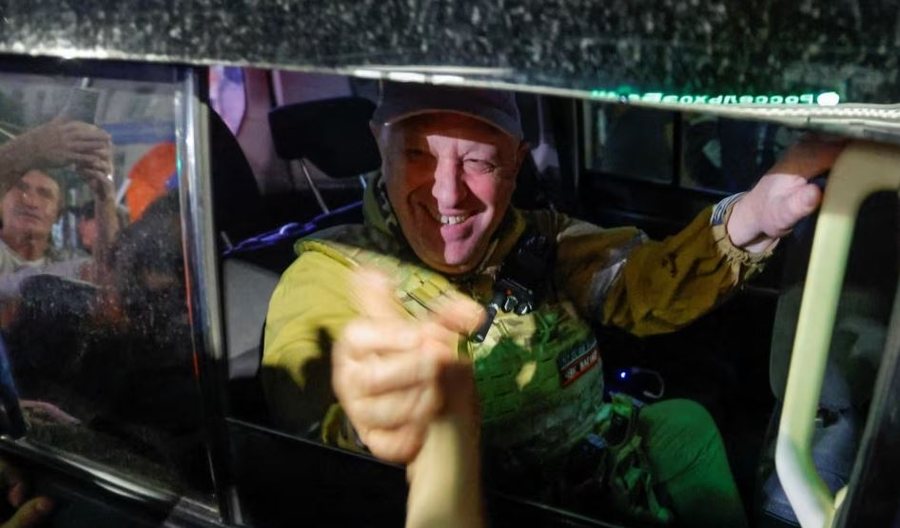
Many analysts say Saturday's march on Moscow by forces under the command of Yevgeny Prigozhin exposed the weaknesses of Russian government forces.
The Russian army has withdrawn troops deployed to protect the capital after the forces of the Wagner mercenary group fled the city of Rostov-on-Don.
The Kremlin said a deal had been reached with the mercenary group's commander, but analysts say the revolt could have long-term consequences for President Vladimir Putin's rule and his war in Ukraine. Putin's image as a tough leader has already been badly damaged by the war in Ukraine. Many analysts say Saturday's march on Moscow by forces under the command of Yevgeny Prigozhin exposed the weaknesses of Russian government forces.
In the Russian city of Rostov-on-Don, calm seems to have fallen this Sunday, while the tracks of tanks of the fighters of the mercenary group Wagner are clearly visible on the streets, which were withdrawn from the city.
Russian President Vladimir Putin's biggest challenge in his more than two decades in power has been extinguished after the mercenary commander of the Wagner Group, who ordered his troops to march on Moscow, suddenly struck a deal with the Kremlin and ordered troops his to withdraw.
The brief uprising exposed the weaknesses of Russian government forces, analysts say, while fighters of the Wagner Group under the command of Yevgeny Prigozhin were able to move unhindered into the Russian city of Rostov-on-Don and advance hundreds of kilometers toward Moscow. The Russian army was mobilized to defend the capital of Russia.
Under the deal announced Saturday by Kremlin spokesman Dmitry Peskov, Prigozhin will go to neighboring Belarus, which has supported Russia's aggression in Ukraine. Charges against him for armed insurrection will be dropped.
The government also said it would not prosecute Wagner group fighters who took part in the uprising, while those who did not join the uprising would be offered contracts by the defense ministry. Prigozhin ordered his troops back to their field camps in Ukraine, where they have been fighting alongside regular Russian soldiers.
"The fact is that this agreement seems to have given Prigozhin some kind of freedom to leave for Belarus. It is perhaps a surprise that some of the mercenaries of the Wagner Group will be inducted into the regular Russian army. But I also think that this saga is not over. Because I find it very difficult to believe that Prigozhin will have a quiet life in Belarus", says Mark Lyall Grant, former ambassador of the United Kingdom to the UN.
Despite the created situation, expert Marina Miron, from the Department of Defense Studies at "King's" College in London, thinks that the end has not yet come for the leader of the Wagner mercenary group.
"I think Putin may not try to get rid of Prigozhin right away, because someone will have to take command of his troops in Africa, so the part of the troops that are in Russia can be sent back to Ukraine and those that are in Africa and Syria will need a leader. Prigozhin's immediate elimination would not have favored Putin in the long run. So maybe for these purposes Prigozhin will be kept in the shadows so that he can control the troops until a better alternative comes out", says the expert.
Moscow prepared to confront the forces of the Wagner group by setting up checkpoints with armored vehicles and troops in the southern part of the city. About 3,000 Chechen soldiers were withdrawn from fighting in Ukraine and rushed there early Saturday, state television in Chechnya reported. Russian troops armed with machine guns set up checkpoints on the southern outskirts of Moscow, while sections of highways were dug up to slow the march.
Prigozhin had called for the dismissal of Defense Minister Sergei Shoigu, whom he has long criticized with disdain for leading the 16-month war in Ukraine. On Friday, he accused forces under the command of Minister Shoigu of attacking the camps of the Wagner group.
"What happened is an impetus for Putin to think about a restructuring, perhaps of the defense ministry and putting in someone much more capable with military experience than Russian Defense Minister Sergei Shoigu. But it's hard to find loyal people who won't backstab you, especially in a country like Russia. So it can happen, but it will take time because at the moment there is no sustainable alternative if you remove Mr. Shoigu," says Dr Marina Miron, from King's College London.
American intelligence services had information that Prigozhin had long been massing his forces near the border with Russia. Congressional leaders were informed of the Wagner group's troop buildup early last week, a person familiar with the matter told The Associated Press on condition of anonymity.
A possible motive for Prigozhin's rebellion was the defense ministry's demand, which President Putin supported, that private companies sign contracts with it by July 1. Prigozhin had refused to do so.
The former chief of the general staff of the British armed forces, Richard Dannatt, thinks that despite this created situation, Ukraine still needs to be careful.
"The power of Putin and the Russian army has declined a lot and this is important as far as Ukraine is concerned. But the fact that Prigozhin and the Wagner group are going to Belarus on the other hand is disturbing. Because if he has gone to Belarus together with his forces, this again poses a threat to the Ukrainian forces near Kiev, where everything started on February 24 of last year," he says.
Wagner's troops have played a decisive role in the Ukrainian war, capturing the eastern city of Bakhmut, an area where the bloodiest and longest battles have taken place./ VOA


Lini një Përgjigje