


 Shkruar nga Gideon Rachman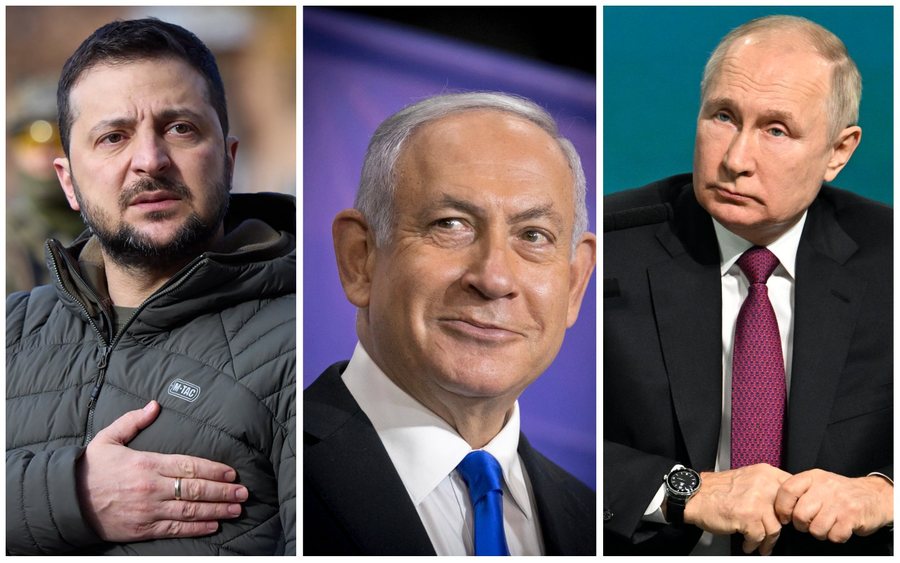
Often, divisions between the "pro" and "con" camps are expressed as arguments about Western foreign policy.
Among commentators, and even governments, you can find groups that are pro-Israel and pro-Ukraine; pro-Ukraine and pro-Palestine; pro-Russia and pro-Israel; and pro-Russia and pro-Palestine.
Of course, terms like “pro-Palestine” or “pro-Russia” are highly inaccurate. They cover a wide range of positions. But they remain a useful shorthand for real political divisions.
Often, the divisions between the "pro" and "con" camps are expressed as arguments about Western foreign policy. Those in the "pro-Palestine" camp are keen to raise war crimes charges against Israeli leaders and increase pressure on the country. The "pro-Israel" group broadly supports giving the Netanyahu government complete freedom and dismisses accusations that Israel is committing genocide.
When it comes to the war in Ukraine, "pro-Russians" tend to argue that Moscow has legitimate grievances that should be recognized. The "pro-Ukraine" position is to demand greater support for Kiev and much more pressure on Putin.
So why has the ideological map become so complicated since the outbreak of wars in Ukraine and Gaza?
The “pro-Ukraine, pro-Israel” crowd is closely associated with the group once known as neoconservatives. They see both Ukraine and Israel as democracies under attack that deserve support. Bernard Henri-Lévy, the French philosopher, is a passionate supporter of Ukraine and recently defended Israel against accusations of genocide, arguing: “A genocidal army does not need two years to win a war on a territory the size of Las Vegas... To talk about genocide in Israel is an insult to common sense.”
Others I would place in the pro-Ukraine, pro-Israel camp are historian Niall Ferguson and journalist Bari Weiss. The pro-Ukraine and pro-Palestine crowd is more focused on human rights and war crimes than on issues of democracy and who shot first. Seen through the lens of human rights, Russia and Israel are placed in the same camp, accused of mass murder of innocent civilians and violations of international law. It is this logic that has led the International Criminal Court to issue arrest warrants for both Vladimir Putin and Benjamin Netanyahu.
Pedro Sánchez, the Spanish prime minister, who recently accused Israel of genocide, argues that it is hypocritical for the West to condemn Russia but support Israel. Then there is the pro-Russia and pro-Israel stance common among admirers of strongman rule. Viktor Orbán, the prime minister of Hungary, exemplifies this stance. He has often supported EU sanctions on Russia, and has warned that Western support for Ukraine could lead to a world war.
Orbán is also the only EU leader to welcome Netanyahu to his country since the ICC indictment. Variants of Orbán’s stance can be found on the European far right, where hostility to Muslim immigrants can translate into support for Israel; and nationalism, social conservatism, and suspicion of NATO can create sympathy for Russia. Pro-Russia and pro-Israel stances have often seemed to best describe Trump’s views.
But there is also a current of far-right isolationist thinking in America that is pro-Russia and increasingly pro-Palestine. The influential news anchor, Tucker Carlson, listened to Putin with sympathy and made laudatory television reports from Russia. Critics of Israel are regulars on his show. They include Congresswoman Marjorie Taylor Greene, once considered one of Trump’s most loyal supporters, but who became the first elected Republican to accuse Israel of genocide. Both Carlson and Greene have been accused of anti-Semitism. But their positions on Israel and Ukraine can be seen as expressions of an uncompromising form of “America First” nationalism. They see both as countries that are trying to draw the United States into wars.
So where do I fit into this spectrum? First, let me give myself a courtesy I've denied others and say that terms like "pro-Israel" and "pro-Palestine" are too crude to describe my views.
But, using my flawed categories, I would say that, over the past two years, my sympathies have shifted from the “pro-Ukraine, pro-Israel camp” to the “pro-Ukraine, pro-Palestine camp.” This is because, at the beginning of the most recent wars, both Israel and Ukraine were clearly victims of aggression and war crimes against civilians.
But in the last two years, things have changed. Israel's mass killings of Palestinian civilians and its use of starvation as a weapon of war cannot be justified as a legitimate form of self-defense.
Ukraine is still really fighting for its existence, and it is generally doing so with restraint and respect for civilian life. In contrast, for all the Netanyahu government’s insistence that Israel faces an existential threat, there is no chance that the last vestiges of Hamas can extinguish Israel’s existence as a state. The brutality of Netanyahu’s tactics cannot even be justified as an attempt to save Israeli hostages. In fact, it is putting them at risk. For me, at least, Ukraine and Israel are now on different sides of the moral book. / Adapted from “Pamphlet” from “Financial Times”


Lini një Përgjigje