


 Shkruar nga Federico Fubini
It is no coincidence that Putin demands the surrender of all of Donbas (theoretically Russian according to his constitution) to show something that could be defined as victory. But the dictator is betraying the pressure he feels: for example, he has stopped claiming the Zaporizhia and Kherson oblasts, even though they are also “Russian” according to the constitution.
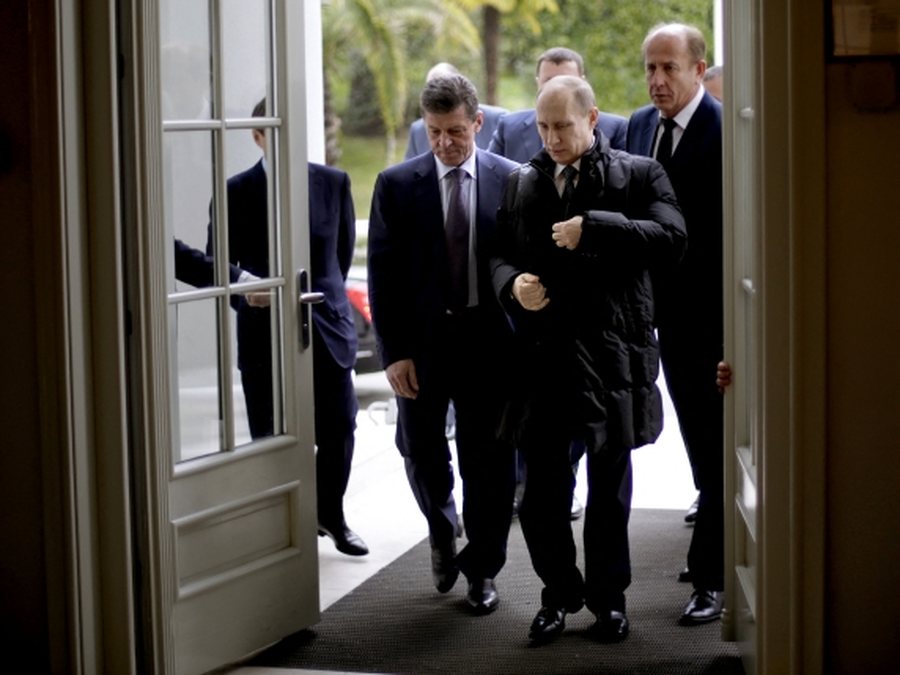
When the resignation was already decided, last September, Dmitry Kozak went to see his boss for the last time and asked him a simple question: why had he done all this?
It is not known what Vladimir Putin's exact response was, but the meaning was clear.
If the Ukrainian adventure were to end badly, the leader said, according to an informed person, not only would his life as president of Russia be at risk, but Kozak would also have a very bad end.
However, the latter, alongside Putin since the time of St. Petersburg in the 90s, had been practically out of the game for more than three years. At least since February 21, 2022, two days before the aggression against Ukraine. On that day, the dictator convened the Security Council in the Kremlin. The discussion was about recognizing the pseudo-republics of Donetsk and Luhansk, already partially occupied by Russia. In essence, it was about the attack on Ukraine. Kozak was then almost 70 years old and for three decades one of the boss's closest people.
He was the deputy chief of staff of the president, responsible for relations with the former Soviet republics. Essentially, he was part of Putin's inner circle of loyalists, along with Igor Sechin (head of oil giant Rosneft), Nikolai Patrushev (Putin's former superior in the KGB), Sergei Chemezov (Putin's KGB partner in Germany and now head of defense giant Rostec), and a few others.
But on that February 21, 2022, Kozak speaks for forty minutes against the annexation of the Donbas republics and against the invasion of Ukraine. He is the only one. His intervention will be cut from the Security Council video that was broadcast a little later on television.
According to a New York Times reconstruction, two days after the 2022 aggression, Kozak had replied to Putin that he had no intention of carrying out his orders and would not ask the Ukrainian government to sign the capitulation. He had reportedly told the leader that he was ready to be arrested or killed, but not to do so.
Since then, he has not appeared in public, but out of respect for the old relationship, Putin has never punished or dismissed him. Until his "voluntary" resignation on September 18, after which the former deputy chief of staff continues to hold an office in the presidential administration, just a few steps from the Kremlin.
Kozak is not a liberal dissident. He was the one who took on the integration of Crimea into Russia after the 2014 invasion. But his opposition to the war and Putin's reaction at the moment of his departure that if things went badly in Ukraine, both of them could be killed, according to words attributed to him, open a window on the doubts and dilemmas circulating in and around the Kremlin. Putin himself understands that he has very little in his hand after the aggression he chose and that has already lasted as long as World War II: destroyed parts of Donbas 12.7% of Ukrainian territory as of 2022, but less than 1% over the last year at the cost of hundreds of thousands of Russian lives and hundreds of billions of euros spent.
Meanwhile, the military effort is accelerating the contraction of the Russian economy. In recent weeks, waves of layoffs have hit petrochemical giant Sibur, banking giant Sberbank, the construction sector, and civilian industry in general. Putin certainly does not forget that during Sergei Prigozhin's rebellion and his march on Moscow in May 2023, his loyalists fell silent and the security apparatus suddenly became paralyzed. No one protected him.
It is no coincidence that Putin is demanding the surrender of all of Donbas (theoretically Russian according to his constitution) to show something that could be defined as victory. But the dictator is betraying the pressure he feels: for example, he has stopped claiming the Zaporizhia and Kherson oblasts, even though they are also “Russian” according to the constitution. With the economy deteriorating further, perhaps the next step backwards will be Donbas./ Corriere della Sera



He se do i marre se shpejti me ndihmen e Trapit.