


 Shkruar nga Pamfleti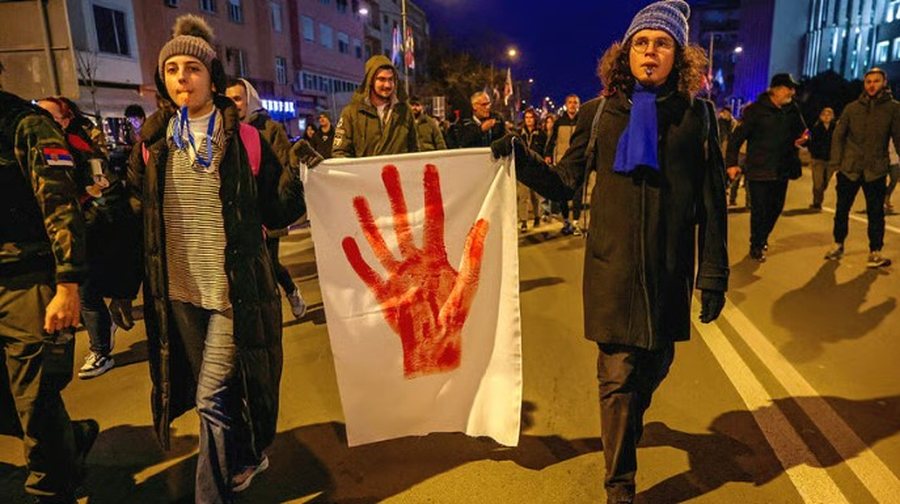
The president has significant advantages. Most of the media is under his influence. Universities have reopened and protests are rarer, although students occasionally clash with police and supporters of the president. Several academics, teachers, and officials have been dismissed for their support for the movement.
"Pump, pump" - "Keep the pressure up," chant thousands of protesters in Serbia, as part of a student-led movement that has been opposing President Aleksandar Vučić for 15 months.
However, organizers are finding it increasingly difficult to maintain the pace and numbers of participants. A year ago, many Serbs thought Vučić’s downfall was a matter of time. Today, the country appears to be entering a “political war of attrition,” according to analyst Ivan Vejvoda.
The protests began in November 2024, when a shelter collapsed at the newly renovated train station in Novi Sad, Serbia’s second largest city, killing 16 people. Many citizens blamed corruption and substandard construction. The anger quickly turned into widespread opposition to the president. Universities were closed and hundreds of thousands of people took to the streets.
The most recent demonstration, held on February 15 in Kragujevac, about 115 kilometers south of Belgrade, was significantly smaller. It coincided with the anniversary of the adoption of the first Serbian Constitution in 1835. A 67-year-old man, Slobodan, carried a flag with the Ferrari symbol, which was also used for symbolic reasons during the 1990s protests that led to the overthrow of Slobodan Milosevic. “When we protested against him, I carried the boy on my shoulder. Now he tells me: ‘I have to carry you,’” he said.
From Kragujevac, a convoy of cars headed to Orashac to continue the rally. Activist Kristina Draganovic stressed that the students are not worried about the drop in turnout, as their focus is on the elections. Ten local elections are scheduled this year, while Vučić has also announced early parliamentary elections. The students, however, refuse to cooperate with traditional opposition parties and are discussing the creation of their own electoral list.
The movement is united primarily by opposition to Vučić. There are different political orientations within it: some are pro-European, others pro-Russian. Religious flags and banners demanding the restoration of Serbian control over Kosovo are seen at the protests. Internal divisions, once insignificant, are becoming more visible.
The president has significant advantages. Most of the media is under his influence. Universities have reopened and protests are rarer, although students occasionally clash with police and supporters of the president. Several academics, teachers, and officials have been dismissed for their support for the movement.
However, Vučić's system is showing signs of weakness. A large part of the academic, cultural and sports elite has openly opposed him, including tennis player Novak Djokovic. Recently, the president has appointed figures considered very loyal to key positions in the security services, at a time when some observers believe his control is being tested.
Protesters have welcomed the start of the trial of Culture Minister Nikola Selakovic on February 4. He and three others are accused of illegally changing the historic protection status of the former army headquarters in Belgrade, which has been damaged since NATO bombing in 1999. The change of status would allow its development as a luxury hotel. The project had also attracted international investors, including Jared Kushner, who pulled out in December. The defendants deny the charges. Historian Slobodan Markovic calls the fact that the case reached court an important development, saying that “pockets of courage are appearing everywhere.”
On the other hand, the speaker of the Serbian Parliament, Ana Brnabić, calls the protests a “color revolution,” suggesting that they may be instigated by external actors, whether from the West or Russia. According to her, the great powers prefer countries with obedient leaders, while Vučić is too independent. Activists reject these claims and say that accusations of foreign funding are constantly used to discredit the movement.
Local election results in some areas that traditionally supported the president showed a decline in support for his coalition. Some analysts see this as “the calm before the storm.” However, Serbia’s political history shows that protests often intensify and then fade. Whether Vučić will weather this wave of discontent remains to be seen. / Adapted from “The Economist”


Lini një Përgjigje