


 Shkruar nga Jonathan Spyer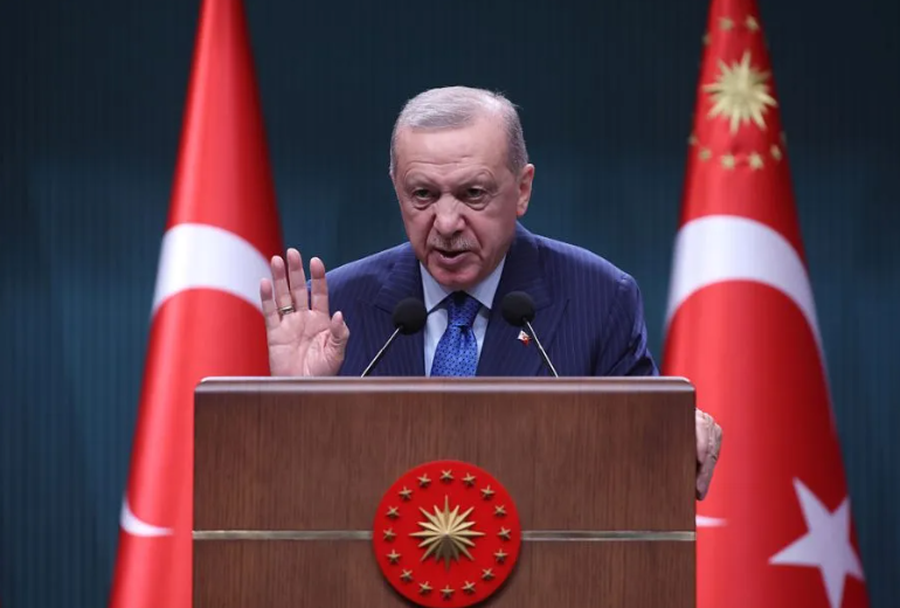
The Turkish leader is somewhat less complimentary in his view of Israel's leaders. A few days ago, Ankara issued arrest warrants on 'genocide' charges against Israeli Prime Minister Benjamin Netanyahu and 36 other Israeli officials...
A significant shift in the stance of Israel and its main ally, the United States, on the way forward. This shift reflects larger gaps in perception in Jerusalem and Washington about the nature and motivations of the forces currently engaged in the Middle East. The subject of this shift is Turkey.
The Turks have expressed a desire to play a role in the ‘international stabilization force’, which, under President Trump’s 20-point plan, is supposed to take over control of Gaza’s ground security from the IDF (and Hamas) as part of the plan’s implementation. Ankara appears to have played a significant role in securing the October 10 ceasefire between Israel and Gaza’s Islamists. Now, Turkey wants a major role in future agreements on the ground in Gaza, in both the military and civilian sectors.
This is because Israel identifies Turkey in its current form as something very similar to an enemy state. The reasons are not mysterious. Jerusalem has alleged that Ankara allows Hamas to maintain a large office in Istanbul, from which they allege the organization plans military and terrorist activities, as well as political and media campaigns.
Israel has also alleged that Turkey facilitates the unhindered travel of Hamas officials across the Middle East by providing them with Turkish passports. Turkish President Recep Tayyip Erdogan has never condemned the October 7, 2023 massacre. On the contrary, the Turkish leader describes Hamas not "as a terrorist organization, but as a liberation group, the 'mujahideen' who are waging a battle to protect their lands and people."
The Turkish leader is somewhat less complimentary in his view of Israel's leaders. A few days ago, Ankara issued arrest warrants on 'genocide' charges against Israeli Prime Minister Benjamin Netanyahu and 36 other Israeli officials.
In May 2024, against the backdrop of the war in Gaza, Erdogan announced that “relations with Israel have been severed.” Later, it became clear that he was referring specifically to trade relations. However, the statement reflected that the situation between Jerusalem and Ankara had reached its lowest point.
The Israeli establishment views Turkey’s ongoing pattern of anti-Israel activities as part of a broader, more determined, and broader regional strategy. It fits easily with Turkey’s military interventions in Iraq and Syria over the past half decade, its deployment of drones and proxy fighters in Azerbaijan and Libya in support of allied wars, its efforts to build influence in Lebanon, the West Bank, and Jerusalem, its burgeoning alliance with Qatar, and its ‘mavi vatan’ (blue homeland) strategy in the Mediterranean, in which it seeks to claim expanded exclusive economic zones (EEZs) in the eastern Mediterranean, the Aegean, and the Black Sea.
In all of this, Israel sees a combination of political Islam and neo-Ottoman revanchism, illustrated by a statement by Erdogan earlier this year that Turkey’s “spiritual geography” extends “from Syria to Gaza, from Aleppo to Tabriz, from Mosul to Jerusalem.”
Israel suspects that Turkey wants to use the Indian Security Forces (ISF) in Gaza as a platform through which it can redeploy Turkish troops into the Israeli-Palestinian context and use their presence in turn to exert influence, perhaps through tacit cooperation with its ally, Hamas.
The current US administration of Donald Trump shares little or no of Israel’s perception of Turkey. On the contrary, it sees Ankara as a strong, stable and welcome partner, capable and willing to play an important role in securing the region. President Trump describes Erdogan as a “great leader.” The White House has been quick to embrace Syria’s new Sunni Islamist president. As Trump has noted, the victory of Ahmed Sharaa and Hayat Tahrir al Sham in the Syrian civil war was as much an achievement for Turkey as it was for the Sunni Islamist fighters to prepare before marching on Damascus late last year.
The administration appears to have taken Turkey as a kind of guide for regional affairs, embracing the idea that Turkish power can secure Syria and continue to prevent an ISIS resurgence. At a recent meeting for the Middle East Forum think tank, Turkish scholar Sinan Ciddi also noted that during his September visit to the White House, Erdogan pledged to give the U.S. access to Turkey’s lithium deposits and other critical mineral deposits in the country.
The combination of strong authoritarian rule, a demonstrated ability to achieve goals, and a willingness to make natural resources available seems to have won Trump’s support. Turkey’s close alliance with Qatar, which similarly supports Sunni political Islam throughout the region, is part of the same general orientation.
The US envoy for the Middle East, Tom Barrack, on Thursday paid tribute to the Turkish role in Syria, describing “Turkey’s tireless role as a testament to the quiet, unwavering diplomacy that builds bridges where walls once stood.” In all of this, one can discern Trump’s famously transactional view of relations with foreign powers. These are forces with power and money who can do things. They claim to want stability. They offer tempting material incentives. What’s not to like?
At this point, there is a key difference between the US and its allies in Jerusalem. The view of Middle East diplomacy as a real estate deal, so prevalent in the Trump White House, is programmed to regard elements such as politicized religion or nationalist revanchism as certainly just empty words, perhaps to be used to inflame the base, but unlikely to motivate or guide state-level behavior. Herein lies the gap in understanding. Before October 7, many in Israel also dismissed these elements, convinced that the shared motivation of self-interest would underpin the relationship and that, for this reason, Hamas leaders in Gaza, for example, could be bought with money and material incentives.
For now, at least, in Israel, no one believes this anymore. But it is the principle that seems to underlie much of the current US orientation in the key Middle East region. The problem is that the Middle East is markedly different from the real estate world in a number of key details. Recent experience suggests that those who try to ignore this may eventually learn it the hard way. /Adapted from The Spectator/



Lini një Përgjigje