


 Shkruar nga Alfonso Bianchi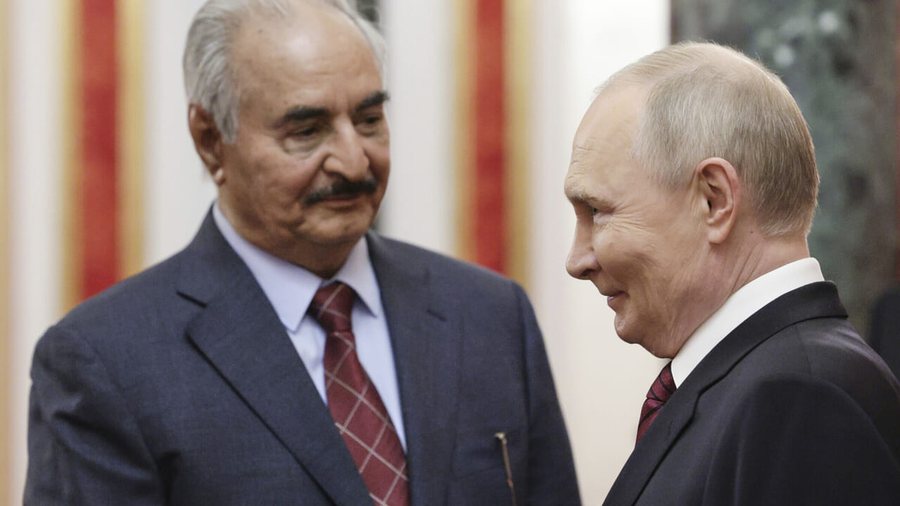
Putin is said to be planning the operation together with General Khalifa Haftar, who controls the east of the country and is marching towards Tripoli...
Russia is reportedly planning to install missiles in Libya, with the aim of targeting them towards Europe. Moscow would like to use the military base in Sebha, the capital of Fezzan, a region controlled by General Khalifa Haftar, an ally of Vladimir Putin. This is claimed by the Nova Agency, which quotes a person close to the file, according to whom the plan is already at an advanced stage.
Sebha, located in southern Libya about 900 kilometers from Tripoli and just over 1,000 kilometers from Lampedusa, would be an ideal strategic point to strike European targets with medium- and long-range missiles, missiles that can easily hit targets up to 5,000 kilometers away.
The place is divided into two parts.
Putin is said to be exploiting divisions in a country torn apart by years of civil war. The nation is divided into two parts, with an internationally recognized Government of National Unity in Tripoli, led by Abdulhamid Dbeibah, and the Government of Eastern Libya in Benghazi, led by powerful General Haftar.
In recent months, the political situation has become even more volatile, and this month there were violent clashes in Tripoli between rival militias despite being nominally loyal to the government, culminating in the killing of the leader of one of the most controversial groups, Abdel Ghani al-Kikli, and the deaths of several civilians. These events sparked popular protests against Dbeibah's government, which has been in power since 2021, with demonstrators demanding his resignation and accusing the executive of delaying the elections and failing to ensure security.
Chaos benefits Putin
Haftar has taken advantage of this chaos and continues to advance towards Tripoli, aiming to take control of the entire country. And Putin is also taking advantage of this, by supporting the rebel general, he would be allowed to install his missile base with the support of Belarus.
If Russia does indeed deploy medium-range missiles in Fezzan, the launch pads could be protected by air defense systems already in use by Haftar’s forces, such as the Russian Tor-M1 system, recently displayed during a military parade in Benghazi. The Tor-M1 is a highly advanced surface-to-air missile system capable of intercepting and neutralizing low-flying enemy missiles, drones, and aircraft, thus providing effective defensive coverage of strategic locations.
The US is 'ok'
The agency's source even claims that both Donald Trump's US and Recep Tayyip Erdogan's Turkey would be willing to accept the plan, but in return they would demand the transfer of 1 million Palestinians from Gaza to Libya. A circumstance that is quite difficult to believe, also because beyond political and geopolitical issues, the nation has around 7.3 million inhabitants and is already hosting, according to IOM data, more than 800,000 migrants.
A similar story was recently published by NBC and denied by Tripoli. In this case, however, the pact would have been made with Haftar, who according to the source "has already indicated his willingness to grant citizenship to deported Palestinians, thus guaranteeing himself a free hand in managing oil resources and power."
Oil
The eastern Libyan government announced on Wednesday that it could declare force majeure on oil fields and ports, thus blocking their production, denouncing "repeated attacks on the National Oil Corporation (NOC)."
The eastern government controls most of the country's oil fields and is also said to be considering temporarily relocating the headquarters of the national oil company to one of the "safe cities", such as Ras Lanuf and Brega, both under Eastern control, in a kind of oilfield coup.
The KOK is currently located in Tripoli, under the authority of the Government of National Unity, and has categorically denied that its headquarters was attacked by force, calling the information "completely false."
Turkey's role
And taking control of the oil could also serve to strengthen what appears to be Haftar's new alliance with Turkish President Erdogan, who previously supported the Tripoli government but now apparently seeks to expand his influence in eastern Libya, as well as to unlock access to energy exploration in waters and territories controlled by eastern authorities, which have so far been reluctant to implement the protocols of the maritime agreement signed with Tripoli in 2019.
Another sign of rapprochement is the fact that Saddam Haftar, son of General Khalifa and commander of the ground forces of the Libyan National Army (LNA), paid an official visit to Ankara on April 4 and was received with military honors by the commander of the Turkish ground forces, General Selçuk Bayraktaroğlu, and also met with the Turkish Minister of Defense, Yaşar Güler. /Adapted from Pamphlet/






Lini një Përgjigje