


 Shkruar nga Pamfleti
The bill faced opposition from both the opposition and some majority MPs. Criticism focused on the impact that the construction required to install the batteries and wind turbines could have on agricultural land.
Today, the Deputy Minister of Agriculture, Fatmir Guri, presented to the Laws Committee the draft law "On the Protection of Agricultural Land", which provides that agrophotovoltaic farms will be allowed not only to produce energy from the sun and wind, but also to install batteries for its storage.
The changes foresee that up to 40% of the surface area of agrophotovoltaic farms will be used for energy production, while a limited part will also be used for storage batteries. The opposition and Socialist MP Damian Gjiknuri raised concerns about the impact on agricultural land.
In agrophotovoltaic farms, not only will the production of energy from solar panels or wind turbines be allowed, but also the installation of batteries for storing the energy produced.
This is one of the innovations of the draft law "On the Protection of Agricultural Land", which was discussed in the Laws Committee and was accompanied by debates among deputies.
During the presentation of the draft law, Deputy Minister of Agriculture, Fatmir Guri, explained that agrophotovoltaic farms will have combined use, where most of the surface will continue to be used for agriculture, while the rest for energy production and storage.
"We are talking about farms that have a common use that is agricultural and that of energy production, in which 60% of the surface is for agricultural activities and 40% of the surface is for energy absorption activities. The storage is precisely about using a relatively very limited surface for the location where the batteries of that agrophotovoltaic farm will be placed. What we have added here is the fact that in addition to placing the panels, we have also decided that a very limited part of the land will be used for placing the battery for storing this energy. The license to use or certify such a farm is under the jurisdiction of the Ministry of Infrastructure", said Guri.
The bill faced opposition from both the opposition and some majority MPs. Criticism focused on the impact that the construction required to install the batteries and wind turbines could have on agricultural land.
Socialist MP Damian Gjiknuri opposed the inclusion of wind energy in this scheme, arguing that the construction of turbines requires large concrete foundations.
"Putting a tower for a Wind Farm and today the minimum production is 6 megawatts, means it is 100 meters high and there is no chance of not having a large concrete foundation there. Because it is produced differently, there is no possibility. It means that we are talking about massive wind towers. For me, this wind should not be included here at all because we are talking about agrophotovoltaics, then wind is included. They get confused with the terms and think that they are all the same ," said Gjiknuri.
Democratic MP Oerd Bylykbashi also raised concerns about the impact that batteries will have on the structure of the soil.
"To install a 5,000-liter water tank, you have to make a concrete platform, not to put batteries that can be as big as a container to serve these photovoltaic farms, which means that the investment that will be made there will destroy that soil structure there," said Bylykbashi.
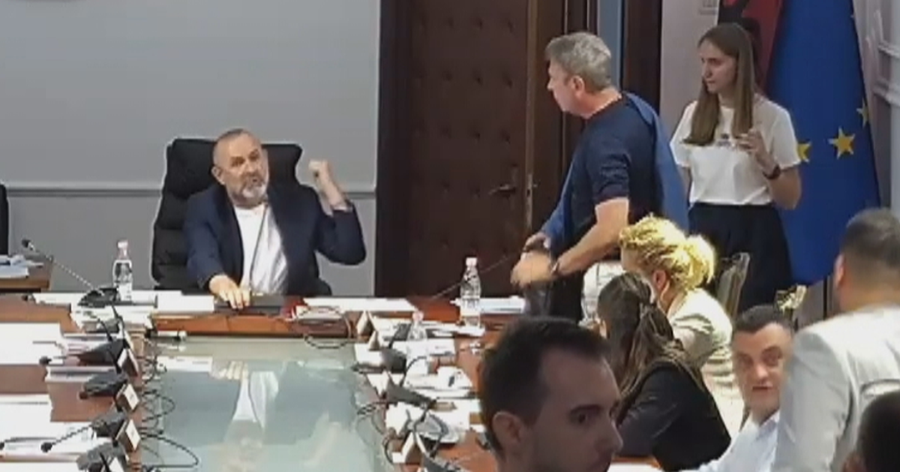
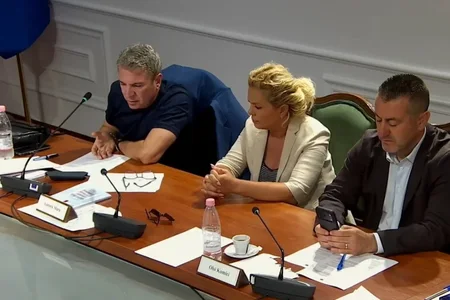
The debates did not stop at the content of the draft law. During the meeting, there was also a clash between Damian Gjiknuri and the chairman of the Laws Committee, Ulsi Manja.
In the vote in principle, Gjiknuri voted against the draft law, while during the article-by-article review he abstained. He then asked to take the floor to explain his position, but was faced with Manja's refusal, which led to tension in the hall and the deputy's removal from the meeting.
Manja: Leave the shame to us, you three found the rabbit in the bramble bush today (Gjiknuri, Bylykbashi and Strazimir) who agrees with the draft law...?"
Gjiknuri: "Let me explain.
Manja: "No, no, you stay with abstention.
Gjiknuri: "Are you going to give me your word or leave altogether?
Manja: Yes, leave...
Gjiknuri : You're talking nonsense.
Manja: Deal with Oerdi.
Because he was not allowed to speak, Gjiknuri decided to leave the commission, while there was no shortage of replies with Ulsi Manja.
Despite the situation, the Laws Committee continued discussions with the participation of other members of the socialist majority.


KETO SPO GJEJNE SA SIPERFAQE PLAZHI ESHTE PUBLIKE DO MASIN TOKEN BUJQESORE, PO LESH ARAPI DO BEHET
PO KY ISH DREJTORI HIPATEKES ANI DIRMISHI CDO KETE KATRANOSUR ATJE SE AI KSHU NEPER KAFENE E MBAN VETE SI FILO ZOF