


 Shkruar nga Alfonso Bianchi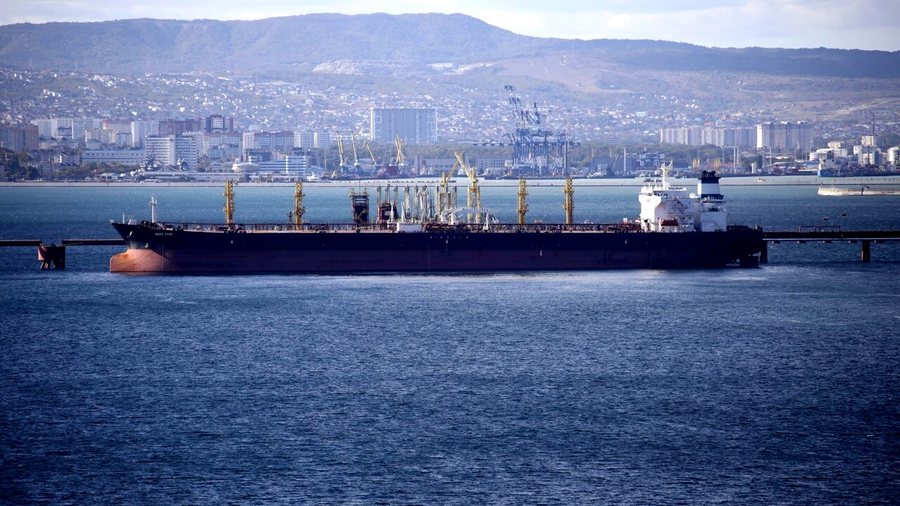
How Putin's "phantom fleet" circumvents sanctions
It seems that Russian oil continues to arrive in Europe (almost) without problems, despite the fact that imports are officially banned, as a result of the sanctions imposed by the European Union. And this happens because of a fraud: Moscow hydrocarbons pass through Turkish ports, where they are then transferred to Turkish ships, and resold in Europe as if they were Turkish products.
It is said that Russian President Vladimir Putin is using a serious loophole in the Brussels sanctions, which allows "mixed" fuels to enter the EU, if they are labeled as non-Russian. Of course, this happens with the cooperation of the country governed by Recep Tayyip Erdogan.
The denunciation follows research by the Center for Research on Energy and Clean Air (CREA) and the Center for the Study of Democracy (CSD), which found Ankara is helping the Kremlin protect its fossil fuel trade, which constitutes almost half of its budget, and consequently it is very important to bear the costs of the occupation of Ukraine.
How Putin's "phantom fleet" circumvents sanctions
The figures included in the study of the two research centers show an increase in Turkey's imports from Russia, as well as a simultaneous increase in its exports to Europe. From the entry into force of oil sanctions against Moscow on February 5, 2023, and until the end of February this year, it is reported that the European Union has imported 5.16 million tons of oil products worth 3.1 billion euros from 3 Turkish ports without refining centers, Ceyhan , Marmara Ereğlisi and Mersin.
Of course, this does not mean that every shipment of fuel arriving in the EU from Turkey has been Russian. Ankara has refineries that can process nearly 1 million barrels of oil per day, and the country's companies can also sell non-Russian fuel to Europe. But the geographical position of some ports on the Anatolian peninsula, combined with import-export data, raises many doubts.
Strange movements
Based on the complaint of two groups of experts, in May 2023 alone, the "Toros Ceyhan" oil terminal in the Turkish port of Ceyhan received 26,923 tons of oil from Novorossiysk in Russia. And just 10 days after the import, the terminal sent a similar volume of oil to the Moh refinery in Corinth, Greece.
Logistically, a Russian ship departing from Novorossiysk, a city on the Black Sea, only needs to pass the latter. Then between the two straits of the Dardanelles and the Bosphorus, there is the port of Ereğlisi on the Sea of Marmara. After crossing the straits in the Mediterranean, there are those of Mersin and Ceyhan. From there, arriving in Greece is very easy.
A strategic position
Turkey's strategic position in the Black Sea has always allowed "black gold" traders to do business by importing oil products, which can then be easily stored in terminals
located in various ports of the country.
These storage facilities have become key points for the trade of Russian oil products at the global level, including the sanctioned regions such as Great Britain, the United States and the European Union, especially for its main buyers in Greece, Italy, Spain, Romania and the Netherlands.
But this road to Putin's oil must be blocked. In June 2022, the EU adopted a package of six sanctions, which, among other things, prohibits the purchase, import or transfer of crude oil and various oil products transported by sea from Russia to the European Union.
Bypassed sanctions
The restrictions came into force from December 5, 2022 for crude oil and from February 5, 2023 for refined oil. Since that period, purchases of Russian crude oil in Turkey began to increase more and more. From February 5, 2023 to the end of February 2024, Turkey imported 17.6 billion euros of Russian oil products, an increase of 105 percent compared to the same period last year.
However, Turkey's domestic consumption of petroleum products grew by just 8 percent in 2023, a clear sign that most of Moscow's hydrocarbons were transported elsewhere. In 2023, Turkey became the world's largest buyer of Russian oil products, and imported 18 percent of Moscow's total exports.
Ankara's import boom followed an emerging global trend where non-sanctioned countries such as India and China have stepped up purchases, taking advantage of the Federation's availability of lower-priced hydrocarbons as the Kremlin is desperate for find new markets.
But in Turkey, a fundamental change has been the increase in refined oil products instead of crude oil. In the same period, 11 percent (13 million tons) of total EU oil product imports came from Turkey: a 107 percent increase in volume compared to the previous year, the study noted. Another clue, which shows that Turkey may not only import Russian oil for domestic consumption, but may act as a springboard for Russian oil to EU and G7 countries. /Taken from "Europa Today", adapted by 'Pamphlet'






Lini një Përgjigje