


 Shkruar nga Pamfleti
Trump claims internal strife in Iran; regime responds by emphasizing unity
US President Donald Trump claims that there are internal conflicts in Iran and that it is not clear who is currently running the country. The regime in Tehran has responded by emphasizing its unity.
The Tasnim news agency, considered a mouthpiece for the Revolutionary Guards, published unusual praise on Friday for Iran’s chief negotiator, Mohammad Bagher Ghalibaf. “Different political factions and components of the system have confidence in him,” the statement said. Ghalibaf was described as a “symbol of religious democracy” and a figure who served the country during the Iran-Iraq war. Although the statements came from a Foreign Ministry spokesman, the agency, which usually takes a more confrontational stance, strongly echoed the diplomatic message.
This report was part of a communications campaign to emphasize the unity of the leadership. Coordinated messages were published on the social network X: Ghalibaf and President Massoud Peseschkian shared identical statements, denying the division between “radicals” and “moderates”. They emphasized that everyone is committed to the revolution and the supreme leader. “One God, one leader, one people and one path”, this is, according to them, the path to victory, more important than individual life. Similar messages came from the chief justice and other figures of the Revolutionary Guard.
The campaign came in response to Trump, who the day before had said that Iran was having trouble determining who its leader was. He alleged factional clashes and shared a comment suggesting eliminating opponents of a deal with the US.
According to a government source quoted by CNN, the Pentagon is also considering options that include eliminating several military leaders or actors who could hinder the negotiations. These scenarios are related to the commander of the Revolutionary Guard, Ahmad Vahidi, who has been presented by some media and institutes as an opponent of Ghalibaf.
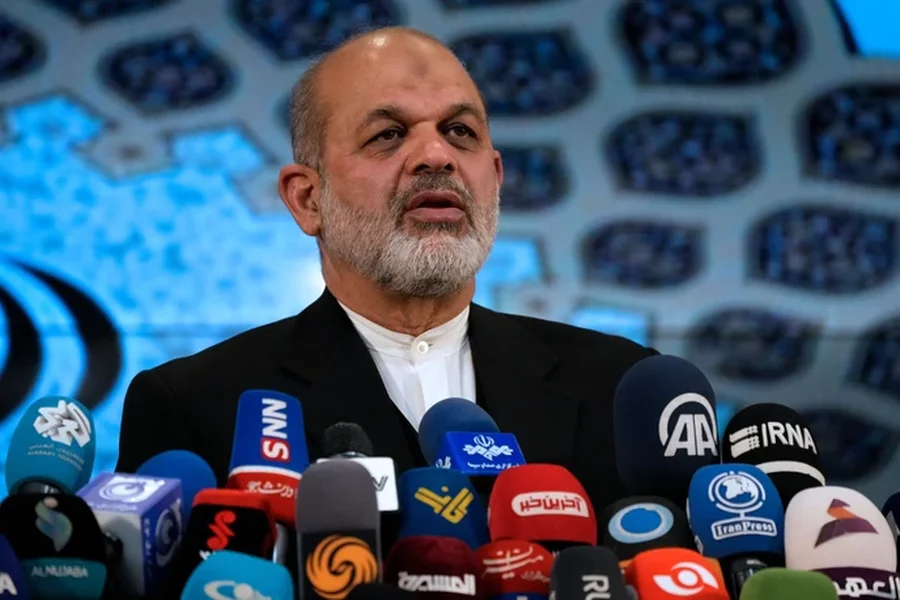
Iran expert Hamidreza Aziz believes that many Iranian commentators see this as a disinformation campaign by Israel, aimed at inciting Trump to escalate the conflict and attack the Iranian leadership. Another interpretation is that it is intended to create the perception of the regime's weakening in order to encourage internal resistance.
A similar interpretation was also spread on Supreme Leader Modschtaba Khamenei's Telegram channel, describing the situation as an "enemy media operation" to weaken the unity of Iranians.
Externally, the split in the Iranian leadership cannot be confirmed. However, it is clear that there is strong criticism of the negotiations among conservatives, especially against Foreign Minister Abbas Araghchi. This criticism is also reinforced by the influence that these groups have in state media and in mobilizing supporters in the streets.
In a recent speech, Ghalibaf attempted to respond to critics, arguing that a military victory against the US is unrealistic and that achievements should be consolidated through diplomacy.
Ideological clashes between factions over negotiations with the US are not new. In the past, Supreme Leader Ali Khamenei has played the role of arbiter, setting the mandate for negotiators.
The current situation is more complex, as the new supreme leader, Modschtaba Khamenei, is reported to be injured and isolated for security reasons. According to the New York Times, he has suffered serious injuries and communicates through written instructions, delegating authority to generals.
These generals, who have influenced his rise to power, have also increased their influence in the negotiations. They were part of the first delegations and are not completely opposed to the talks. However, after recent developments, some of them have spoken out against the continuation of the negotiations, while political figures such as Peseschkian and Araghchi have taken the opposite position.
Given the balance of power within the system, it remains clear that decision-making in Iran is influenced by the balance between political and military structures, while the image of unity serves as a key element of public communication. / Adapted from FAZ /


Lini një Përgjigje