


 Shkruar nga Pamfleti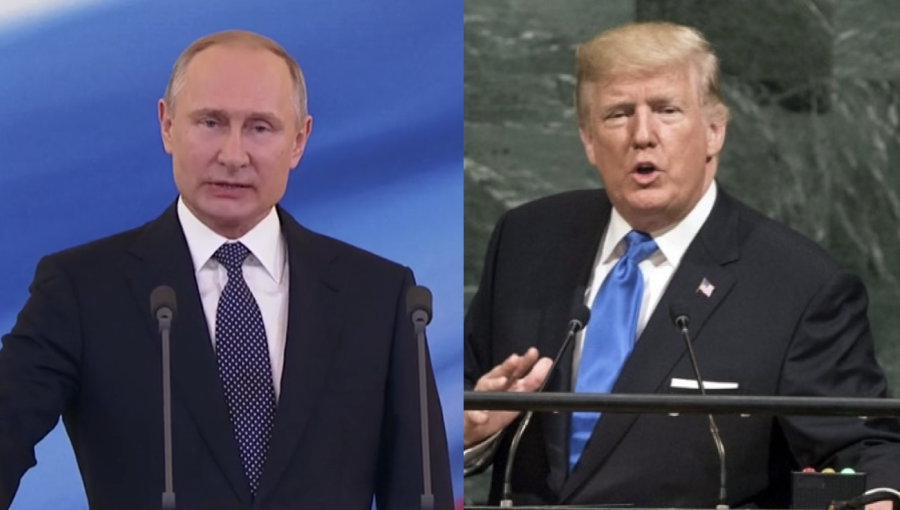
"There is a lot of talk today about a possible meeting between Putin and Trump, with various proposals circulating. If this happens, it will only happen after Trump is inaugurated and takes office. As for the venue, many options have been mentioned.
Serbian President Aleksandar Vučić said on January 12 that Serbia is eager to host a meeting between US President-elect Donald Trump and Russian President Vladimir Putin, citing the country's neutrality as a key advantage for potential peace talks.
The Serbian leader's comments come after Trump announced on January 9 that plans for a meeting with Putin were in place, although no specific details were given. Switzerland has put forward a similar proposal to host the talks, but there are practical obstacles to holding the talks in either country, leading to speculation that the two leaders could meet in another country outside Europe.
In an interview with state broadcaster RTS, Vučić said Serbia could guarantee full security for both leaders and stressed that Belgrade's independence from military alliances made it an ideal location. Serbia is not a member of NATO or any other military bloc, positioning it as a neutral ground for high-profile talks.
Vučić noted Serbia's unique position in the context of US-Russia relations, explaining that Trump had enjoyed the highest level of support in Serbia compared to any other European country.
"There is no country that can compare to Serbia in terms of the level of support for President Trump. And on the other hand, it is a country where President Putin is still very, very popular. So I think it is a place on Earth that would be extremely suitable for both of them."
Serbia has maintained strong ties with Russia, particularly opposing sanctions imposed on Moscow after its invasion of Ukraine. However, Vučić has also stressed that Serbia sees Ukraine as a "friendly country" and reaffirmed that Crimea and Donbas remain sovereign territories of Ukraine.
The framework for the meeting between Trump and Putin is still being developed, with incoming US National Security Advisor Mike Waltz indicating that a phone call between the two leaders is likely to take place in the coming weeks to finalize the details.
Kremlin spokesman Dmitry Peskov affirmed the political desire for such a meeting, but noted that no significant preparations had been made by January 13. “Such contacts are very necessary and advisable,” Peskov told RIA Novosti.
Serbia, which traces its geopolitical identity to its role as a non-aligned nation during the Cold War, is seeking to capitalize on its historical role as a diplomatic crossroads.
During the Cold War, Yugoslavia played a unique role in bridging the divide between East and West as part of the non-aligned movement. Today, Serbia preserves that legacy by balancing relations with global powers such as the EU, the US, China, Turkey and the UAE.
Despite its relatively marginal position as a landlocked country with fewer than 7 million inhabitants, Serbia believes, rightly or wrongly, that it can exert influence on the world stage, much like its Cold War predecessor.
By offering itself as a neutral venue for the Trump-Putin summit, Serbia aims to carve out a role for itself in international diplomacy, leveraging its unique geopolitical position and historical legacy as a bridge between East and West.
Vučić's offer adds to the growing list of countries that have expressed interest in hosting the historic summit, with Switzerland also coming forward.
Turkey, which has already acted as a mediator in the Russia-Ukraine conflict, is also seen as a possible location.
A potential challenge to such a meeting, which would take place in either Serbia or Switzerland, is the International Criminal Court's arrest warrant for Putin, issued on charges of his involvement in the illegal deportation of Ukrainian children to Russia.
However, while both countries would be legally obligated to arrest Putin if he enters the country, Nicolas Bideau, head of communications for the Swiss Department of Foreign Affairs, said, as quoted by Euronews, that exceptions could be made for peace negotiations.
Meanwhile, Oleg Barabanov, program director of the Valdai International Club, a Moscow-based think tank, told TASS that the talks are unlikely to take place in Europe.
"Today there is a lot of talk about a possible meeting between Putin and Trump, with various proposals circulating. If this happens, it will only happen after Trump is inaugurated and takes office. As for the venue, many options have been mentioned," Barabanov said, according to TASS.
"As I see it, it will not be held in Europe. It is clear that Switzerland can be excluded. Serbia is also not a good option. In all likelihood, it will be in some developing country of the world. Perhaps, on the outskirts of some international forum. In the case of Serbia, there is also a technical aspect involved: the Russian presidential plane will have to fly over European Union countries. Serbia is unrealistic for this reason alone." / Adapted Pamphlet by Intellinews /



Lini një Përgjigje