


 Shkruar nga Pamfleti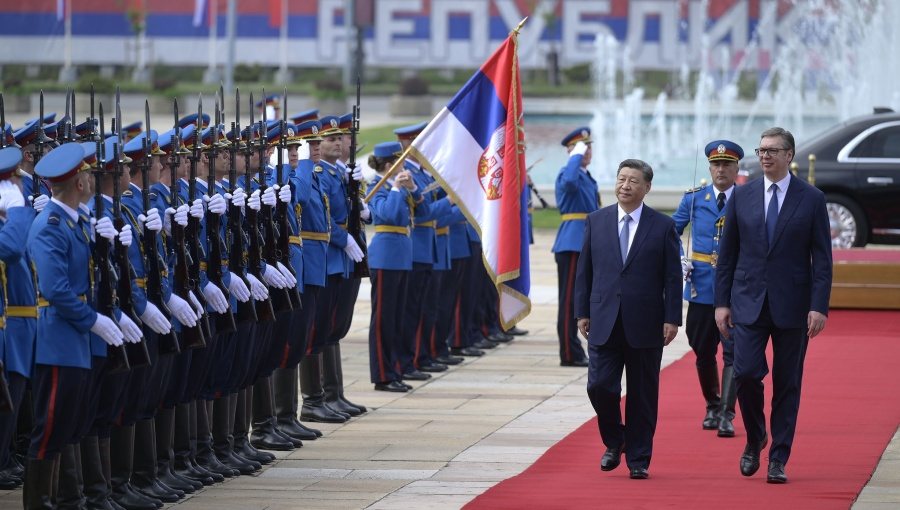
Serbia is China's closest European partner, a relationship forged in part by shared historical grievances, particularly the 1999 NATO bombing of the Chinese embassy in Belgrade during the Kosovo War, which remains a sensitive issue in Sino-American relations...
Serbia seems to have found China as a military partner, without excluding Russia.
Serbian President Aleksandar Vučić has stressed the importance of strengthening military capabilities amid what he sees as regional tensions following a trilateral defense pact signed in March by neighboring countries Albania, Croatia and Kosovo. Vučić called the pact provocative and accused the countries of starting an “arms race” in the Balkans.
"The Serbian army will show what it has at the big parade," Vucic said last month, referring to a military parade planned in Belgrade in mid-September, where new weapons and systems will be displayed.
China's Ministry of Defense announced two days ago about the joint Chinese-Serbian military exercise this month in northern China's Hebei province,
This joint military exercise signals an intensifying strategic partnership between Beijing and Belgrade, with implications for the broader geopolitical landscape in the Balkans and Europe.
Senior Colonel Jiang Bin, spokesman for China's Ministry of National Defense, announced that the exercise, called Peace Defenders-2025, will take place in the second half of July and will involve special operations troops from both countries.
"This will be the first joint exercise between the Chinese and Serbian armies. It will help strengthen the combat capabilities of the participating troops and deepen cooperation between the two armies," Jiang said at a press conference.
This is China's first military exercise with a European country since it held a joint counter-terrorism drill with Belarus near the Polish-Ukrainian border last July. It also underscores the increasingly close ties between Beijing and Belgrade, amid Serbia's unique geopolitical position in Europe.
Serbia is China's closest European partner, a relationship forged in part by shared historical grievances, particularly the 1999 NATO bombing of the Chinese embassy in Belgrade during the Kosovo War, which remains a sensitive issue in Sino-American relations.
Chinese President Xi Jinping visited Serbia in May 2024 on the anniversary of the bombings, describing the relationship between the two countries as an “iron friendship.” During that visit, Beijing and Belgrade signed agreements to deepen their comprehensive strategic partnership and “build a community with a shared future.”
In recent years, China has invested billions of dollars in Serbia, financing infrastructure projects including highways, railways, factories and mines. Serbia's integration into China's "One Belt, One Road" Initiative has made it a key gateway for Chinese influence in Europe, writes Intellinea.
China is the largest foreign investor in Serbia from a single country, with Chinese companies playing a leading role in sectors such as mining and manufacturing.
Notably, the Serbian armed forces have also purchased Chinese military technology, including the FK-3 medium-range air defense missile system, often compared to the American Patriot system and Russia's S-300, as well as various unmanned aerial vehicles.
In February 2024, Serbia announced plans to further expand its fleet of Chinese drones, building on previous purchases dating back to 2020.
Despite close ties with China and Russia, Serbia maintains military cooperation with the West, including NATO. In June, Serbia conducted joint exercises with the United States and other NATO countries, underscoring Belgrade's balancing act between East and West. /Adapted from Pamphlet/





Lini një Përgjigje