


 Shkruar nga Pamfleti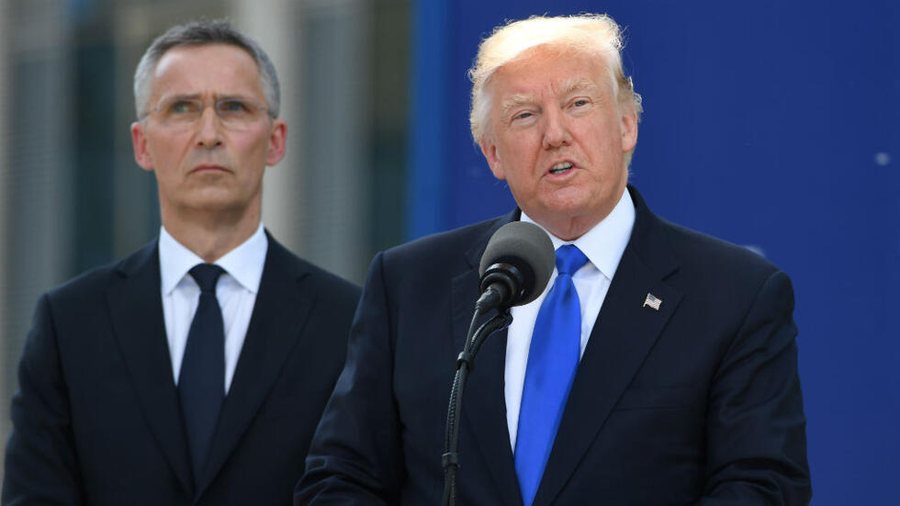
What would European defense look like without being under the American umbrella? Until recently, the question was academic in nature. But it takes a realistic view to the extent that the geopolitical slogans of Donald Trump, who is working to return to the White House with the ambition of not being limited by the checks of a first term, are taken seriously.
The Republican candidate has made no secret of his disdain for NATO, an institution that manages affairs thousands of miles away from Trump's hometown of Queens, New York. He is even said to have manifested it in the most characteristic way, telling the president of the European Commission, Ursula von der Leyen, at the Davos Forum in 2020 that if Europe is attacked, we will never help you and we will not we support. According to him, NATO is dead and the US will leave the Alliance. He said in Davos that Germany owes the US $400 billion because they didn't pay what they should have paid for defense.
The truth is that the "brain death" of NATO was also diagnosed by Emmanuel Macron, in a much praised interview with the Economist in 2019. He warned then that Europe can no longer rely on the US for its protection. The French president had already spoken in 2017 about a "Europe that defends" and that must "recreate its sovereignty".
Since then, Paris did not abandon the goal of strategic autonomy for Europe, an idea that was not so popular among the Atlanticists of the old continent, especially in the countries of Central Europe. But now it is becoming more and more attractive in Brussels for understandable reasons, which were clearly strengthened after Russia's invasion of Ukraine. Characteristic was the change in Germany's foreign policy doctrine, as marked by Scholz's historic speech to the Bundestag in March 2022, where he predicted, among other things, the strengthening of the German budget for defense spending.
The rationale that has taken shape in recent years in Europe is about strengthening the European arm in NATO: "autonomous action as an addition to NATO". As the narrative of American separatism unfolds, and regardless of the form it takes, the view that Europe must move on three levels is gaining ground:
· Improve its military capabilities and invest in its defense industry
· To move forward with European integration and to make the decision-making process more efficient
· To deepen relations with the governments of countries such as Canada, Japan and Australia
In this context, France is considered capable of playing a leading role, as it has the strongest European military, has developed a clearly measurable defense industry and has nuclear capabilities.
Incidentally, officials such as the president of the European People's Party Manfred Weber have expressed the position that Europe must strengthen its deterrent power, stressing that the nuclear option is crucial in this regard.
The concept of Europe's strategic autonomy does not contradict the spirit of the Euro-Atlantic alliance. As the director general of the European Defense Agency - EDA, Jiri Sediví, told "Kathimerini", the common European defense project is complementary to NATO and a collective defense clause in the EU would not be realistic, as provided by the article 5 in NATO. But lawyers for the project are now making urgent appeals.
Donald Trump wanted to withdraw the US from NATO during his first term, but was persuaded by senior administration officials not to do so, according to information that has come to light. But it is not certain that the same will happen in his second term, in which it is estimated that he will already be surrounded by his most radical people.
When Americans go to the polls in November 2024, NATO will already be 75 years old. If Trump is eventually nominated and wins re-election, the US-Europe defense alliance could be called upon to manage the biggest crisis it has faced since the signing of the North Atlantic Treaty in April 1949.
Therefore, on the Old Continent, discussions are intensifying with an eye on the scenario of the US leaving Ukraine. In such a case, Europe will have to increase the production of weapons and ammunition to replenish supplies. It will also be forced to increase military training and increase investment in areas such as drones and satellites, through a combination of resources and investment for economies of scale and efficiency gains. And it may have to revive its defense cooperation with the United Kingdom. In particular, the crisis with Russia has nevertheless provided examples that the powers will go in this direction, as Europe currently provides almost twice the sums in total, more than 85 billion euros, of US military and economic aid to Ukraine.
So what would European defense look like without the American umbrella? Perhaps we will find out soon if Donald Trump wins the presidential election and if he succeeds in turning his intentions into action. /Adapted "Pamphlet" from "Ekathemirini"




Lini një Përgjigje