


 Shkruar nga Pamfleti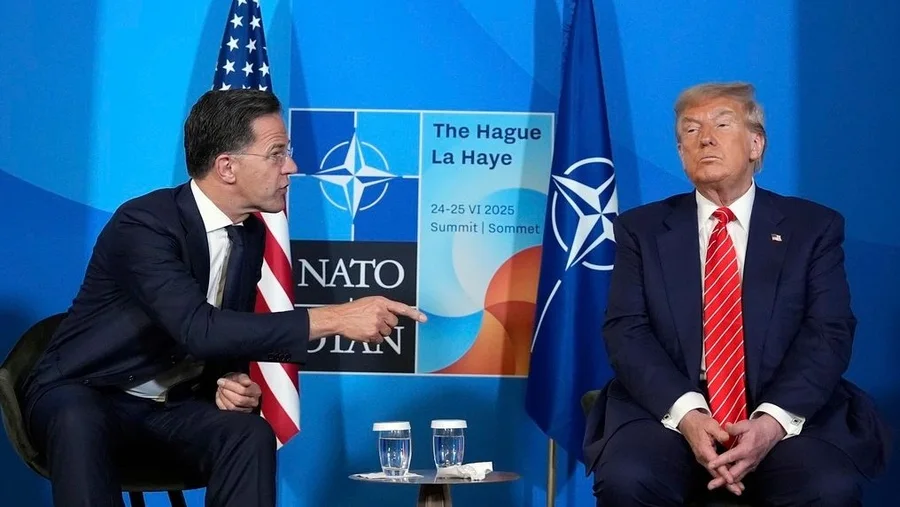
The same Rutte, last June, a few hours before NATO countries set the target of increasing military spending to 5% of GDP by 2035, sent Trump a message that speaks for itself about his positioning: he congratulated him on "decisive action in Iran"...
Europe, this “Sleeping Beauty”, has received another kiss, but the awakening has not been pleasant at all. It happened last Monday, when NATO Secretary General Mark Rutte spoke in the European Parliament and declared without any diplomacy: “If anyone here thinks that the European Union, or Europe as a whole, can defend itself without the United States, let him continue to dream. It is not possible.” The reactions were immediate, both in European capitals and among MEPs. French Foreign Minister Jean-Noël Barrot responded on social networks: “No, dear Mark Rutte, Europeans can and must take charge of their own security. This is the European pillar of NATO.”
While Spanish MEP Nacho Sánchez Amor (PSOE) directly attacked him: "Are you the United States ambassador to NATO or the secretary general representing the Alliance and all its members?"
A reaction that for many finally marked a European awareness of Rutte's real role. In essence, he did nothing more than repeat what Donald Trump had said a few weeks earlier: "NATO without the US doesn't impress anyone. Russia doesn't care at all. Neither does China." In the same vein, Trump had also repeated one of his most recent mantras: "If we don't take Greenland, Russia or China will take it, and I will not allow that." A claim that, at this stage, turns out to be untrue, as Danish General Soren Andersen, head of the Joint Arctic Command, has also confirmed: "I've been here for two and a half years and I haven't seen a single Russian or Chinese warship." The real strategic problem of the Arctic, the retreat of glaciers, the opening of new sea routes and the preparation of Russia and China to exploit them, does not at all imply the need to appropriate a piece of Danish territory, that is, a piece of Europe. Otherwise, by the same logic, Canada would also have to be "taken into account", as Russian and Chinese ships have also been seen near its coasts.
A big and complex issue, which cannot be addressed with slogans. However, Rutte was quick to side with Trump, stating that "all allies agree on the importance of the Arctic and Arctic security, because with the opening of sea routes there is a risk that the Russians and the Chinese will become more active". He appeared again as a supporter of the American president in Davos, in an awkward scene in the face of European reactions, with that farce of "negotiations" for Greenland within the UN, of which no one knew either the content, or whether there really was any content. An episode that served only for official photos and was forgotten just as quickly.
The same Rutte, last June, a few hours before NATO countries set a target of increasing military spending to 5% of GDP by 2035, sent Trump a message that speaks for itself about his positioning: he congratulated him on the “decisive action in Iran”, which according to him “makes us all safer”, and assured him that Europe “will pay in a BIG way” and that this would be Trump’s “victory”. Beyond the servile tone, the message clearly shows two things: a problematic perception of geopolitical reality and an open alignment with the White House.
The Greenland farce makes this alignment even clearer. The only meaning of that “treatment” was to impose the idea that Greenland is a NATO issue. In fact, it is not. It is about a state outside Europe, the USA, claiming, with reasons or justifications, to take control of part of an EU member state, Denmark. The only legitimate actors for dialogue are Denmark and the European Union. NATO can only come into play if it is about increased military presence or security measures, not sovereignty. If Trump were to claim Scotland tomorrow, would Rutte or the British prime minister negotiate?
That Rutte plays on Trump's team, or whoever is in the White House, is not only obvious, but also understandable. The US is NATO's main shareholder. Just look at the figures: NATO's budget for organizational expenses is relatively modest, but real military spending shows a deep disparity. In 2024, the Alliance's total military spending was over $1.5 trillion, of which the US covered almost two-thirds. Without the American contribution, NATO would lose political weight and global influence, and the post of secretary general would be much less important. With the US at his back, Rutte can dictate the line to the Europeans; without them, his authority would be minimal.
The real problem, however, is not just Rutte. It is the fact that even within Europe there are “fifth columns” that push the narrative that Greenland is a NATO issue and not an EU one. While Ursula von der Leyen and Antonio Costa have come out with a clear European position, the EU’s foreign policy representative, Kaja Kallas, has hinted that the issue could be resolved within NATO. Polish Prime Minister Donald Tusk has also insisted more on the Alliance dimension than the EU one.
This is an old story, dating back to the EU enlargement of 2004–2005, when countries joined that, for historical and security reasons, see the US, rather than the EU, as the main guarantee for their protection. This is precisely the thesis that Rutte defends, and this approach cuts short any real possibility for European political and strategic autonomy. A reality that suits Washington, while the European Union, although an economic giant, remains a political dwarf. /Adapted from “Inside Over”



Lini një Përgjigje