


 Shkruar nga Diplomatico | Pamfleti.net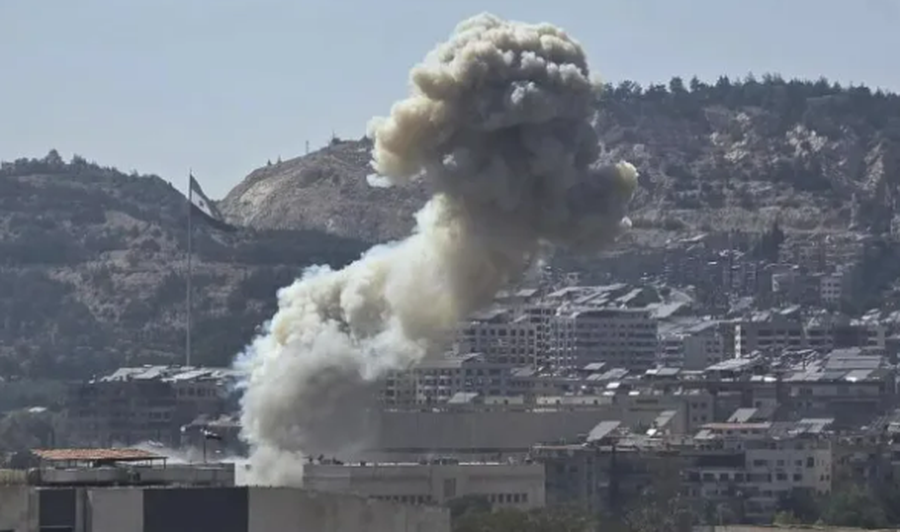
Tel Aviv's maximum policy, with Washington's tacit support, is turning the region into zones of chaos and failed states.
For decades, the Middle East has been defined by state failure. From Iraq, devastated by US intervention, to Syria and depraved Libya, to Saudi Arabia’s devastating war in Yemen, the region has experienced a chain of disasters. But recently, some Arab states have begun a slow process of reconstruction and stabilization.
This fragile but important process is being seriously jeopardized by Israel's borderless regional war, openly or tacitly supported by the US. Tel Aviv's aggressive policies - attacks on Syria, Lebanon, Yemen, Iraq and even Iran - no longer have even the cover of a clear strategy: they have become instruments to keep its neighbors in a permanent state of chaos.
What is Israel aiming for?
According to American sources cited by Axios, Netanyahu is acting like a "crazy man," bombing everything at any moment, regardless of whether it's civilian or military. Washington has often expressed dissatisfaction with Israel's actions, but has taken no concrete steps to stop them. Even the most skeptical administrations, like the current Trump administration, have ended up cooperating in bombing Iran and Yemen.
This aggression is not simply a war against Israel's enemies; it is a strategy to undermine the region's state structures themselves – a logic similar to that of the US after 9/11, which brought destruction to Iraq but not security.
States as the foundations of stability
While Israel strikes, several countries in the region – such as Iraq, Iran, Turkey, and even Syria after the fall of Assad – are trying to build functional state structures. Even the Gulf monarchies, for all their authoritarianism, have begun to create regional cooperation and modern bureaucracies.
But any progress can be undone by perpetual war and indiscriminate attacks. Israel seems to prefer a Middle East of ungoverned areas, weak governments, and paralyzed institutions—an environment where no state can challenge it militarily or diplomatically.
Impact on the US and the region
American policy is contradictory: on the one hand, it invests in state-building (e.g., support for the Lebanese army, efforts to stabilize Iraq, aid to Jordan and Egypt), on the other hand, it tolerates or supports Israel's destructiveness.
This lack of coherence risks turning the region back into a permanent war zone. And if post-2003 history teaches us anything, it is this: it is much easier to destroy a state than to build one. Without functioning states, the US and the West will continue to face the consequences: terrorism, waves of refugees, endless wars.
The conclusion?
Israel is playing with fire. And instead of increasing its own security, it risks becoming the catalyst for a new era of state collapse in the Middle East. This is not just a humanitarian or political crisis, but an existential threat to the international order that depends on the functioning of states. And in this tragic reckoning, everyone will pay: the Arabs, the Americans, and the Israelis themselves./ Pamphlet







Lini një Përgjigje