


 Shkruar nga Pamfleti
On December 25, an electricity cable running from Finland to Estonia snapped in the Baltic Sea, while four other undersea cables carrying data were damaged. Finnish authorities found an anchor mark at the bottom of the sea and seized a tanker believed to be part of the "shadow fleet" that Russia uses to export oil and gas in violation of Western sanctions.
This is just the latest act of sabotage in Europe attributed to the Kremlin. Just a month earlier, a Chinese ship is believed to have cut two more data cables in Swedish waters on Moscow's orders. Over the past year, Russian operatives allegedly tried to plant explosive devices on a cargo plane in Germany; they are suspected of planning the assassination of the head of a large German company that produces weapons for Ukraine; for arson attacks in Poland, Britain and Germany; and for election interference in Romania and Moldova, among other countries.
Russia is waging "a campaign of hybrid attacks on all our allied territories, directly interfering with our democracies, sabotaging industry and committing acts of violence," NATO Secretary General Mark Rutte said last November. But what exactly is a "hybrid war" and what should the West do?
The term "hybrid warfare" is often attributed to retired colonel Frank Hoffman in 2007, but Hoffman tells me the term originated with Jim Mattis, the retired general and former secretary of defense. Mattis gave a speech on the subject in 2005, and he and Hoffman co-authored an article in the journal Proceedings of the US Naval Institute titled "Future Wars: The Rise of Hybrid Warfare."
Their article warned that future "hybrid wars" would force the US to face "the consequences of a failed state" that had "lost control over some biological agents or missiles"; with "acts of violence" by "non-state actors against our critical infrastructure"; or with "other forms of economic warfare" or "attacks on computer networks against military or financial targets."
Mattis tells me that he adopted the term "hybrid warfare" to "break out" of the conventional mindset that America is at peace except when US military forces are engaged in an armed conflict. This binary logic does not cover smaller threats like cyberattacks on the US domestically – or cutting cables in the Baltic Sea. "If we are waiting for the 'real war' by the classic definition, we may not realize that the enemy is already fighting us," Mattis wrote to me in an email last week. "The term 'hybrid' was used as a push for a broader view of warfare."
It is imperative that the United States adopt a broader vision of the conflict because that is what our adversaries think. In fact, two colonels of the People's Liberation Army of China, Qiao Liang and Wang Xiangsui, published a book entitled "Unlimited War" in 1999, where they presented a vision of what can be called hybrid war with Chinese characteristics.
These Chinese officers reacted to the prowess shown by the US military in the Persian Gulf War of 1991. Realizing that weaker countries like China could not compete in conventional military terms in the short term, they argued for broadening the concept of conflict. , including covert measures such as buying off opposition lawmakers and media, assassinating financial executives, inciting environmental disasters, and launching of cyber attacks. "The first rule of unlimited warfare is that there are no rules, nothing is forbidden," they wrote.
Fourteen years later, a 2013 US Department of Defense report identified the "three wars" strategy in Chinese military doctrine: psychological warfare ("to influence and/or disrupt an adversary's decision-making ability ”), media warfare (“which aims for long-term influence”) and legal warfare (“which exploits the legal system to achieve political or commercial objectives”). China has used a "three wars" approach to illegally take control of the South China Sea, including by inventing baseless historical arguments, building artificial reefs, and sending armed "fishing" vessels to harass and away the sailors of other countries.
Iran is another country that has invested heavily in hybrid warfare in recent decades. He has tried to tighten control along the "Shiite crescent" of the Middle East by supporting militias such as Hezbollah in Lebanon and the Houthis in Yemen, while also interfering in US elections and paying criminals to kill regime opponents abroad. The fall of Bashar al-Assad's regime in Syria is a major loss for Iran (and Russia), but Tehran is likely to redouble efforts on its hybrid strategy. Even the "reclusive kingdom" of North Korea is engaged in hybrid warfare, including cyber attacks and the supply of ammunition and troops for use by Russia in Ukraine.
However, Russia remains the leading practitioner of hybrid warfare. Its tactics range from conventional combat operations in Ukraine, to sabotage and political influence operations in Europe, as well as sending mercenaries to Africa and the Middle East to plunder natural resources and support warlords there. All this is intended to restore the power that Russia lost after the dissolution of the Soviet Union.
How should the West respond?
The Center for European Policy Analysis recently published a helpful article on making Russia pay for hybrid attacks. The author, Lithuanian diplomat Eitvydas Bajarunas, argued that the West should develop its own hybrid war that is "devastating enough to bring tears to the eyes of the Russians and prevent the continuation of this behavior."
His recommendations included: increasing economic sanctions against "Russian decision-makers"; pursuing legal actions against individuals "involved in hybrid actions"; using cyber attacks to disable "Russian-controlled botnets and servers"; deleting social media accounts that "spread false information"; and increasing military efforts to counter Russian sabotage. Other ideas could be added, such as attempts to circumvent Russian censorship and sabotage of the shadow fleet of Russian tankers – operations that could be carried out by Western intelligence agencies.
Mattis tells me he agrees that the United States should actively pursue hybrid warfare. He suggests the need for a classified presidential memo, after consultation with key members of Congress, to "frame action." The retired general supports a strategy to "expand the competitive space," with a "commitment to make it hurt," adding that "the indirect approach would allow us to take the operational initiative while remaining in retaliation mode [versus] mode of escalation.”
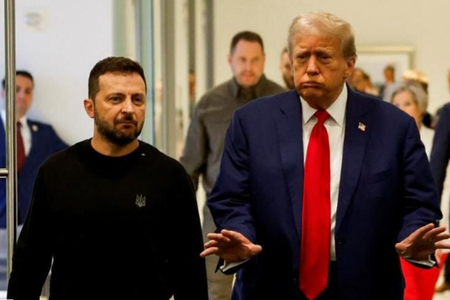
Unfortunately, it is hard to imagine Donald Trump, the most Russia-loving and NATO-skeptic president of modern times, pursuing such an agenda. With the Trump administration at the helm, continuing current efforts to counter Russian hybrid operations, let alone strengthening them, will be a major challenge.
On December 23, Republicans in Congress succeeded in shutting down the State Department's Center for Global Engagement, which was designed to monitor and counter disinformation campaigns by Russia, China and other US adversaries. MAGA Republicans wrongly accused the center of censorship. This constitutes a unilateral act of disarmament in the multifaceted hybrid war in which, against our will, the United States is engaged against an established (and increasingly united) axis of adversaries./The Washington Post – Bota.al







Lini një Përgjigje