


 Shkruar nga Pamfleti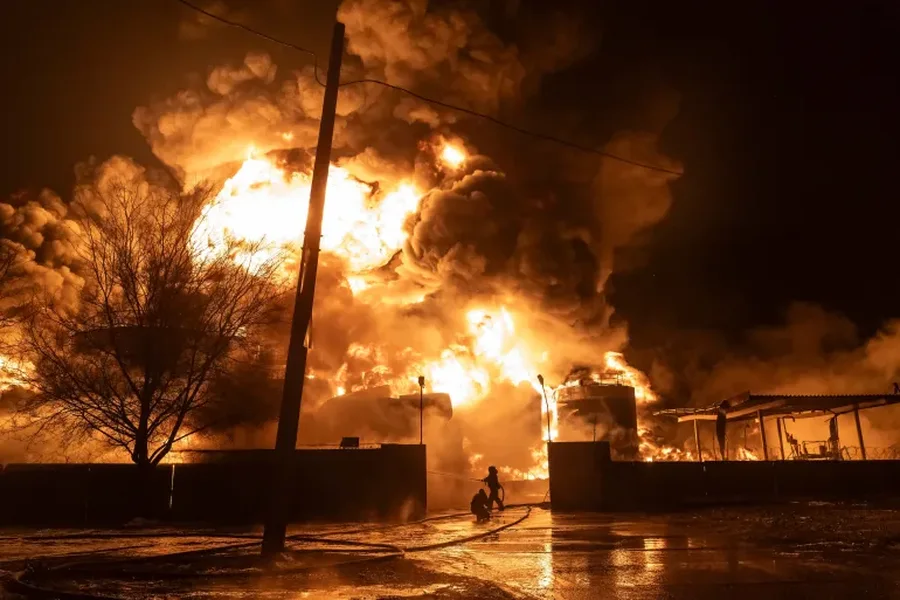
As fear simmers on the border near Ukraine, life goes on as usual in much of Russia and Putin prepares for elections.
On December 30, a barrage of rockets hit the Russian city of Belgorod near the border with Ukraine.
" I live downtown and three or four things fell outside my house. I don't know if it was a shell or shrapnel or what," said 21-year-old Yuliya, a journalist from Belgorod said.
Belgorod has been bombed several times since Russia's full-scale invasion of Ukraine began in February 2022, but the December barrage was the deadliest.
At least 25 civilians, including five children, were killed in the attack, which was blamed on the Ukrainian armed forces.
For the residents of the Russian border town, the war had come home.
" The atmosphere in the city shifted dramatically from December 30, because people in Belgorod finally felt what the war is, that it is close and that it is not as safe in the city as it seemed. Life has changed a lot, "said Yuliya.
She said that children now know what it's like to be bombed, know the sound of air raid sirens and know how to tie a knot.
" Now the council is not discussing how many tulips to plant for the summer festivals, but how to paint the inside of the bomb shelters. I think life in Belgorod will never be the same again. "
The economy
In the weeks following the invasion on February 24, 2022, the picture looked bleak for Russia as the ruble collapsed and foreign investors fled. But the economy has resisted the sanctions.
" The Russian economy went through numerous stress tests ," said economist Artem Kochnev.
" The first was in 2014 when the first round of sanctions was introduced and Russia learned some lessons from that, especially building a national financial infrastructure and tightening control over the financial sector. The second was the COVID crisis and how they tried to manage logistics in rapidly changing circumstances. So they had an experience you could rely on," he added.
Kochnev added that the gradual implementation of sanctions gave Russia time to readjust its oil exports.
The European Union banned its imports from Russia, so Russia turned to China and India instead, using a "shadow fleet" of barges registered to shell companies in third countries such as Cameroon.
Russia also had large cash reserves from its oil sales, which were initially set aside to offset the shock of any drop in oil prices.
" Now this money has been used for a completely different purpose, financing the war. This is a fiscal stimulus that is actually larger than what the government has pumped into the economy during the COVID crisis. ", Kochnev said.
Big global brands such as McDonalds and Starbucks have left Russia, forced to sell their assets well below market value to buyers approved by a government committee before they can be rebranded. For example, Starbucks has become Stars Coffee.
Some firms are effectively nationalized. According to Kochnev, the fortunes went mainly to powerful and well-connected individuals, which may have created some friction between the elites.
Putin's attitude
Despite a dramatic rebellion by Wagner's mercenaries last year, Putin's position appears to be stable. He is expected to win a fifth six-year presidential term in the upcoming March elections.
Assuming he lasts until the end of his term, he would be the longest-serving Russian leader since the tsars, passing even Joseph Stalin.
Two candidates running on an anti-war platform, Yekaterina Duntsova and Boris Nadezhdin, were disqualified by the Central Election Commission despite neither being considered a serious contender against Putin.
The war has certainly left an impact on society: After a decade of decline, problem drinking is said to have become more common, which some health experts attribute to geopolitical confrontations.
But in general, life goes on.
There are still concerts and music exhibitions, and customers can still buy foreign goods, such as Coca-Cola, which have been diverted through third countries such as Uzbekistan. Some Russians are even optimistic.
" I have heard a lot about propaganda in the West. It makes people idiots. But absolutely everything is still here. Think people don't want to make money? Nothing has changed but the psychopathic liberals are gone. Like it or not, Russia has started a great game and it is very interesting to watch. You have to be here to understand ," said 51-year-old Alec from St. Petersburg.
The first lines
On the front line in Ukraine, nearly 45,000 Russians have been killed in action since February 2022, independent media outlet MediaZona has reported. This is three times the losses of the Red Army during the ten-year occupation of Afghanistan.
However, Russia has greater resources in terms of manpower than Ukraine. Since Ukraine's failed counteroffensive over the summer, Russian forces have slowly advanced, capturing the town of Avdiivka this month after months of fierce fighting.
" Russia's covert mobilization has continued ," said Oleg Ignatov, senior Russia analyst for the International Crisis Group.
" Regions are given the number of contract soldiers they must call up. As a result, regional officials convince anyone who can to register. This includes debtors, people with financial and lifestyle problems, singles, ex-criminals and so on as well as [government employees. The military, on the other hand, convinces recruits to sign a contract. Also, more foreigners are coming to the front. But apparently, such methods work. The Russian army manages to fill its ranks faster than the Ukrainian army.
The Russian defense industry appears to be still operating at full capacity, pumping out shells to fire at Ukrainian positions. Russian military production has increased significantly, including the restoration of production at old Soviet factories.
Russia has been able to exceed Western ammunition supplies and maintain its advantage in long-range equipment and weapons. Sanctions, of course, raise the price of production and create logistical problems, but they do not hinder the production of shells and hardly prevent Russia from modernizing old Soviet equipment and sending them to the front. Russia's industrial capability to produce weapons is very large, but not enough to create a decisive advantage, so Russia buys ammunition from North Korea ," added Ignatov.
In addition to the Belgorod shelling, there have been several cross-border raids by the Russian Volunteer Corps, a far-right nationalist militia of Russian citizens fighting for Ukraine, engaging in brief skirmishes with Russian forces and border guards before withdrawing.
Their strategic influence in the war has been limited, but it has undermined Russia's sense of security. Meanwhile, drones have targeted Russian oil infrastructure, spectacularly blowing up a fuel export terminal near St. Petersburg in January.
" Ukraine has carried out a series of successful attacks on Russian infrastructure and apparently managed to destroy several units of valuable and expensive equipment, but in general, these attacks do not change the overall picture, which is still in favor of Russia ," said Ignatov.
This will bring some comfort to Yuliya, whose heart still beats every time she goes outside.
" Some of my friends who have left Russia and have seen the shelling of our city say: "Well, what are you waiting for? People are dying in Ukraine too, and rockets are flying from Belgorod to Kharkiv,' she said. "But I live here and no matter what I do, I can't stop these rockets. No one in our town can. So I don't know how you can say we had it coming. It is very disturbing. "-she said./ Adapted from "Pamphlet", taken from "Aljazeera"


Lini një Përgjigje