


 Shkruar nga Pamfleti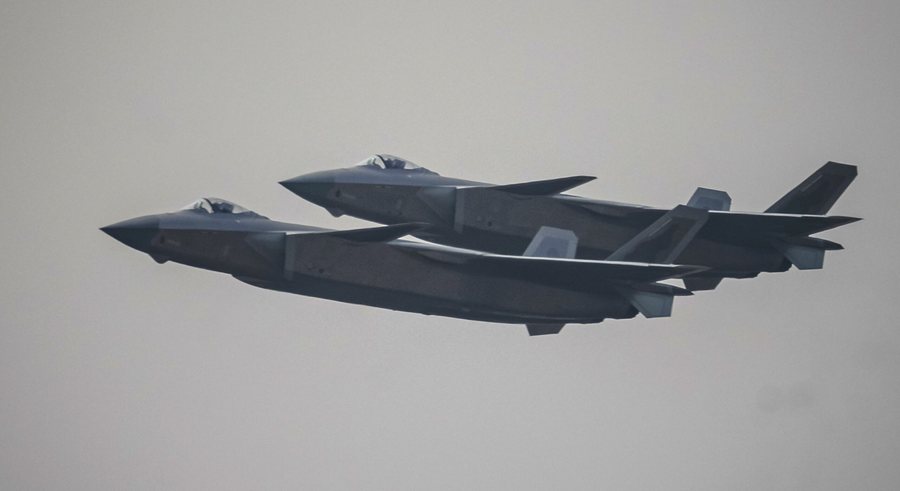
Major changes have also been made to the way pilots are trained. Until 2020, Chinese pilots followed a rigid regime, with programmed maneuvers and heavy reliance on ground control, a Soviet legacy. But in recent years there has been a transition towards more realistic and flexible training...
An article published on January 8 by RUSI (Royal United Services Institute) comparatively analyzes the air power of Russia and the People's Republic of China, with a particular focus on the production capacity of fighter aircraft.
While the Russian air force, despite losses in the early stages of the war in Ukraine, has shown some adaptation and continues to pose a threat to NATO, the most attention is drawn to the dizzying development of the Chinese air force.
Over the past five years, China has made remarkable progress in building a modern air force. Hundreds of fourth- and fifth-generation aircraft have been produced, as well as a large number of support aircraft for aerial surveillance, electronic warfare, and advanced reconnaissance. Along with them, the latest generation of air-to-air missiles, surface-to-air missile (SAM) systems, and high-tech sensors have been put into large-scale production.
According to RUSI data, in 2020 China had about 50 J-20 fifth-generation aircraft, still technologically immature, and about 90–100 J-16 Flanker-N aircraft. At that time, about 20 J-20s and 40 J-16s were produced annually. But by the end of 2025, the annual production capacity for the J-20A and the two-seat J-20S variant had reached about 120 aircraft.

Open source estimates indicate that by mid-2025, about 300 J-20s will have entered service in at least 13 regiments, although the actual number may be higher due to the number of aircraft still in the process of being delivered. For the J-16, about 450 aircraft are believed to have entered service by the end of 2025, based on a number of 350 in 2024 and a production rate of 100 aircraft per year. If this trend continues, the PLAAF could have about 1,000 J-20s and 900 J-16s in active service by 2030.
In addition to heavy aircraft, China has significantly increased the number of fourth-generation aircraft such as the J-10C, with over 300 units in service by 2025. Meanwhile, the older J-10A and J-10B variants are still in service in numbers of around 250 units. The J-10C is much more advanced than its predecessors, equipped with AESA radar, datalink, satellite communications and the ability to use the PL-15 missile for beyond-visual-range (BVR) combat.
China has also accelerated production of the J-16 in electronic warfare variants, both for land and carrier use. Both versions are based on the Russian “Flanker” design and are equipped with internal equipment and external pods that closely resemble the American EA-18G Growler, demonstrating the advanced level that the Chinese defense industry has reached.
Another aircraft in development is the J-35, a fifth-generation fighter, available in land and naval versions. As of late 2025, it was still in the initial phase of low-rate production, but is expected to follow a similar acceleration pattern to the J-20 and J-16.
In the area of new research, China has conducted test flights with two new experimental aircraft, known as the J-36 (or JH-36) and the J-50. The J-36 is a three-engine aircraft with a “flying wing” design and characteristics of a medium bomber, while the J-50 is seen as a technology demonstrator aimed at developing a sixth-generation aircraft, with a shape similar to the American F-22, but without vertical stabilizers.
Major changes have also been made to the way pilots are trained. Until 2020, Chinese pilots followed a rigid regime, with programmed maneuvers and heavy reliance on ground control – a Soviet legacy. But in recent years there has been a transition towards more realistic and flexible training, thanks in part to the involvement of experienced Western instructors and participation in advanced air combat simulators.
All this air power is supported by a sophisticated long-range reconnaissance and communications infrastructure. China operates AEW&C aircraft such as the KJ-500 on land and the KJ-600 on aircraft carriers, uses space-based ISR systems, and has significantly increased its fleet of electronic warfare aircraft. This multidimensional structure makes Chinese air power today a much more powerful and sophisticated tool than it was five years ago. In theory, it can confront US air and naval power even in areas far from the Asian mainland, such as the island of Guam. However, a major gap still remains: the lack of real combat experience, a factor that remains crucial for a fully effective air power. / Adapted from "Inside Over"








Rrangalla ruse, me forma te reja..