


 Shkruar nga Edward Luttwak
A targeted US airstrike on the Revolutionary Guard could serve as the spark for the overthrow of the clerical dictatorship in Iran. Through the support of the opposition and the regular army, Trump has the opportunity to transform the Middle East, despite isolationist skeptics in Washington…
Visitors to the giant and extremely luxurious Iran Mall in Tehran in January 2024 were surely surprised who could invest so much money for such an extravagance in a country so beset by hardship.
This is the largest shopping and entertainment center in the world, with over 3 million square meters for its stores alone, plus giant decorative fountains in a city that is running out of drinking water.
At the time, Iran was exchanging missile attacks with Pakistan due to each country's war with their Baloch population.
It would soon escalate its occasional war with Israel and suffer a catastrophic defeat.
The bold investor was Ali Ansari, an ardent supporter of Ayatollah Khamenei's dictatorship and proud owner of a £33 million mansion in London. He did not bother much to obtain a bank loan from the Ayandeh Bank, which he owned entirely.
It offered high interest rates to attract as many deposits as possible. Since everyone knew that Ansari was close to the regime, depositors were confident that their money would be returned, and they were absolutely right.
When the bank, whose largest client was Ansari himself, went bankrupt in October 2025, it was taken over by the old state-owned Melli Bank, which immediately paid depositors with banknotes printed by the central bank of Iran.
But this was too much for the merchants of Tehran's Bazaar, who could not turn a blind eye to the open corruption at the heart of the regime that the Ayandeh Bank scandal had exposed.
To make matters worse, the bank's depositors were paid with newly printed banknotes, which could only produce more inflation, on top of all that ocean of money printed for the Revolutionary Guard and their now-defeated appendages: Hamas, Hezbollah, and the Houthis.
Traditionally religious, the Pashtuns continued to support the regime until its costly and unstoppable extremism eventually led to direct war with Israel itself.
Twelve days and nights of unrelenting Israeli airstrikes, from June 13 to 25, 2025, destroyed nuclear facilities and military bases, as well as the regime's military reputation.
Even before Donald Trump's B-2 bombers dropped their 14 heavy bombs on nuclear installations worth billions of dollars as a final blow, the Revolutionary Guard, which boasted of its strength at every opportunity, had been exposed as a group of incompetent clowns who could not even protect their top generals and nuclear engineers from attacks in their homes.
When the value of the Iranian rial suffered a sharp drop, below 1 million rials per dollar in October 2025, bazaars could not be supplied with any goods, imported or not, thanks to the continuous increase in prices.
They closed their doors on December 28, declaring a strike and starting protests that have since spread across the country. Unable to find food, would-be shoppers were the first to demonstrate, quickly drawing others in to generate ever-larger protests.
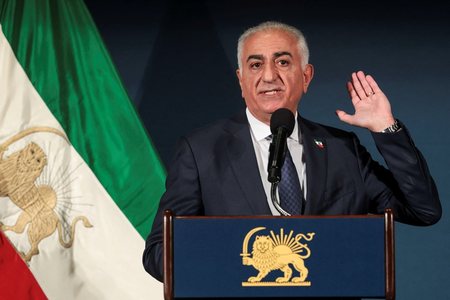
On January 8, Reza Pahlavi, the son of the last Shah, called on residents of Iranian cities to come out to "occupy and control the city centers," setting a starting time of 8:00 p.m.
When many thousands of people heard his call, Reza gained credibility with Washington officials and Arab rulers, who had long ignored his claim that he could call Iranians en masse to challenge the Ayatollahs' regime.
The fact that Trump mocked this claim even after the massive demonstration is a mistake fueled by the isolationists hiding in the White House, who are contradicted by photos and film footage of tens of thousands of people marching under the Iranian royal flag.
Reza also called on the “Artesh,” the regular army, to assert its authority. Long overshadowed by the much better-funded but now discredited Revolutionary Guard, its 300,000 soldiers could step in and take control if, and only if, the Revolutionary Guard is targeted first by the US.
This is how a Trump airstrike could change the course of events. His targets are clear: the two Revolutionary Guard headquarters in Tehran, Nasser-e and Quds-e, each housed in buildings well separated from civilian housing; and their equally distinct buildings in other Iranian cities, starting with Mashhad, Isfahan, and Shiraz.
The argument for the airstrike is that it could topple the already hated regime, but also make Trump a man of his word. He explicitly threatened strikes if the regime started killing people, as it has done with thousands of people.
So far, however, Trump says the regime has assured him that there will be no more executions, much to the delight of JD Vance and his isolationist friends. The argument of the latter is that things could go wrong even if US action is limited to a few airstrikes over a single day.
Of course, that's perfectly true of any military action. But that wasn't the case on June 22 of last year, when the nuclear targets were destroyed without incident. And it wasn't the case when Mr. and Mrs. Maduro were removed from Caracas without a single American being killed.
In addition to Vance and his friends, our dear Saudi friends are also very much against any US intervention that could free 90 million Iranians from the cage of clerical dictatorship.
No matter how hostile they are to the current regime that has attacked them more than once with missiles that destroyed oil refineries, the Saudi monarchy and the smaller principalities would be much more threatened by their proximity to a democratic Iran, which would be further liberalized socially and culturally by a flood of exiles returning from Hollywood, Stockholm, etc.
For others around Trump, there is another reason to oppose any U.S. action against the murderous Ayatollah regime. In addition to the Iranians and many people from Yemen, Iraq, Syria, and key U.S. interests throughout the Middle East, Israel could also benefit from the fall of its most implacable enemy.
That's reason enough for Tucker Carlson and other vocal critics of Israel to oppose any military action against the failed and murderous regime. So the decision remains in the hands of Trump and his loyal and highly effective Secretary of State, Marco Rubio.
The same one who argued that Maduro could be overthrown quickly and without much collateral damage. Fortunately, Rubio paid no attention to Carlson's predictions about Iran last year when he said it would "kill thousands of Americans" and "which we would lose."/ Adapted from "Pamphlet", from "UnHerd"
Note: Edward Luttwak, strategist and historian known for his works on grand strategy, geoeconomics, military history, and international relations.




Lini një Përgjigje