


 Shkruar nga Pamfleti
The contrast with the countries of the former Soviet bloc at the forefront of the Ukrainian conflict is truly striking. Poland and the Baltic states see Putin unadorned: a bloodthirsty revanchist who invades neighboring countries, undermines infrastructure across Europe and interferes in democratic elections around the world. Those who stand apart are willing to silence his atrocities and instead applaud him as a defender of "traditional" values and a fighter against unsavory Western institutions. For example, the Kikl Freedom Party is an official partner of Putin's United Russia.
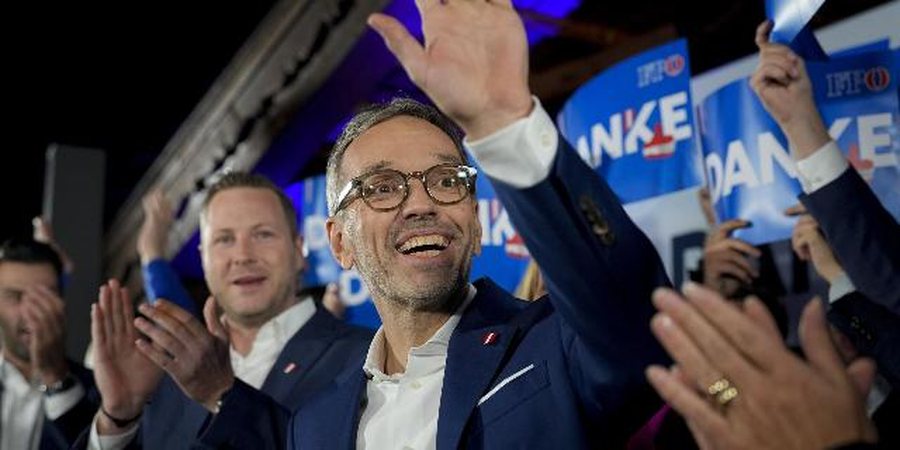
Austria may soon be led by the leader of the right-wing Austrian Freedom Party, Herbert Kickl, writes The Economist.
The West is seriously alarmed: politicians sympathetic to Russia are gaining popularity across Central Europe.
How worried should Europe be about the rise of far-right Austrian Freedom Party leader Herbert Kickl?
Attempts by the center to block his path to power after his party won first place in last September's election with 29% of the vote failed, and Kickl appears to be aiming for the chancellor's chair.
The Freedom Party has already been in the government as a junior partner. Kickl is clearly aiming for a boost this time. And that's bad news for the country: He called for Austria to be turned into a "fortress" where asylum seekers will be detained, and he doesn't shy away from Nazi-inspired rhetoric. Finally, it reinforces an alarming trend: Russian sympathizers are gaining strength across Central Europe.
Of course, Kickl won't get everything right away in the negotiations. With just 31% of the seats in parliament, he hopes to form a government with the support of the centre-right People's Party, which initially rejected a coalition under his leadership before efforts to form an alternative failed. Now the People's Party must find out whether it will be possible to reach an acceptable coalition agreement. It is hoped that at least some of Kickl's more radical positions will be revised during the negotiations. If not, the People's Party should leave the alliance. This is likely to lead to new elections, in which the Freedom Party, as polls show, will perform even better. On the other hand, this could be quite a shock for the center parties, which will get even more votes together and force them to try once again to form a moderate coalition.
Another conclusion seems to suggest itself: Kickl's rise could be a harbinger of far-right successes in neighboring Germany, where elections are scheduled for February. But in fact, these countries are very different. The Freedom Party has participated in 5 national governments, starting in 1983, and has also participated in local government. The far-right Alternative for Germany, which is predicted to have the best result in national elections in its history with around 20%, has never been part of national or local government. Yes, Alternativa won first place in the Thuringian elections last year, but the other parties did not leave it in power.
The main reason for concern lies in the fact that Austria is another example of the "Putinization" of Central Europe. The first swallow was Viktor Orban, the authoritarian ruler of Hungary. Orban has repeatedly pushed for European sanctions against Russia, refuses to allow weapons to enter Ukraine through Hungary and condemns Brussels and liberal democratic organizations such as the George Soros Open Society Foundation. He has like-minded neighbors, such as Slovak Prime Minister Robert Fico. And later this year, elections in the Czech Republic could return Andrei Babis, another pro-Russian Eurosceptic, to power. Central Europe's far right is already discussing how to consolidate its influence and make the most of it.
The contrast with the countries of the former Soviet bloc at the forefront of the Ukrainian conflict is truly striking. Poland and the Baltic states see Putin unadorned: a bloodthirsty revanchist who invades neighboring countries, undermines infrastructure across Europe and interferes in democratic elections around the world. Those who stand apart are willing to silence his atrocities and instead applaud him as a defender of "traditional" values and a fighter against unsavory Western institutions. For example, the Freedom Party is an official partner of Putin's United Russia.
Austria is a small country with a population of 9 million. It is not a member of NATO. Its far-right leanings will be much less significant than in France or Germany. However, they will not go unnoticed. As Donald Trump prepares to take office and the conflict in Ukraine soon passes its three-year milestone, European unity is needed more than ever. Another leader who is determined to fight Brussels and is against collective steps against autocracy will only please despots. / Adapt Pamphlet /



Lini një Përgjigje