


 Shkruar nga Pamfleti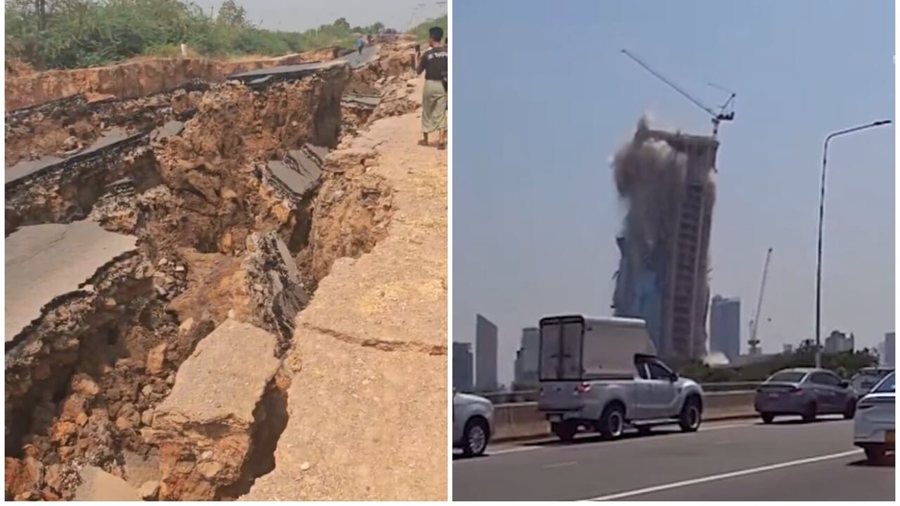
The ground turns to sand, causing any buildings or infrastructure above it to collapse. As the death toll from the 7.7-magnitude earthquake - followed 12 minutes later by a second 6.4-magnitude quake - hits Myanmar with devastating force, experts are speaking of a "risk of liquefaction".
"Even if there were collapses in Bangkok, which is several hundred kilometers away, within the epicentral area there would certainly be major destruction, many landslides and liquefaction phenomena," explains the president of the National Institute of Geophysics and Volcanology, Carlo Doglioni.
In this context, he explains that as a result of strong tremors, the ground liquefies and if there are houses on it, they collapse and there may be other damage.
What is soil liquefaction and why can it have a devastating impact?
Liquefaction is a phenomenon that occurs in conjunction with seismic events of a certain intensity, with a magnitude generally greater than 5.5-6.0. It occurs due to an increase in pore pressure, or the pressure that water normally exerts in the ground.
Under normal conditions, this pressure does not exceed the resistance to deformation of the soil, but in the event of powerful seismic shocks, the sediment grains that make up the soil can begin to move, causing the soil to lose cohesion and behave like a fluid.
This has a major impact on the infrastructures above it, explains Salvatore Stramondo, research director at INGV. The soil begins to behave "similarly to sand", putting the stability of structures on the surface at risk, significantly changing the landscape. The liquefaction phenomenon was also recorded after the seismic events that hit Emilia-Romagna in 2012.
What could happen in the next few hours?
Professor Doglioni explained the reason for the earthquake's destructive power. This is "an area of the world where the Indian plate is moving north-northeast under Asia and in that area of Burma there is an oblique component, these are earthquakes that are thrust, but also lateral movement between the plates, what we call dextral transpression".
Therefore, "the effect of this steep convergence between India and Asia of about 4 cm per year, a speed 10 times greater than those we have in Italy where deformation is of the order of millimeters per year: this explains why there are much more energetic earthquakes there than here", explains Doglioni.
There are no indications of a tsunami risk regarding the evolution of the phenomenon in the coming hours, given that the earthquake was recorded approximately 300 kilometers from the coast. What happened is considered a "main shock", explains the president of INGV, and it may happen that the main shocks are accompanied by others of similar magnitude within a few hours. "There is a sequence that fades over the days in terms of the number of shocks with magnitudes that become increasingly smaller and rarer. But we do not know if the decline has begun because if there is a further renewal, with another main shock, the clock is reset".




Lini një Përgjigje