


 Shkruar nga Giannis Kimpuropoulos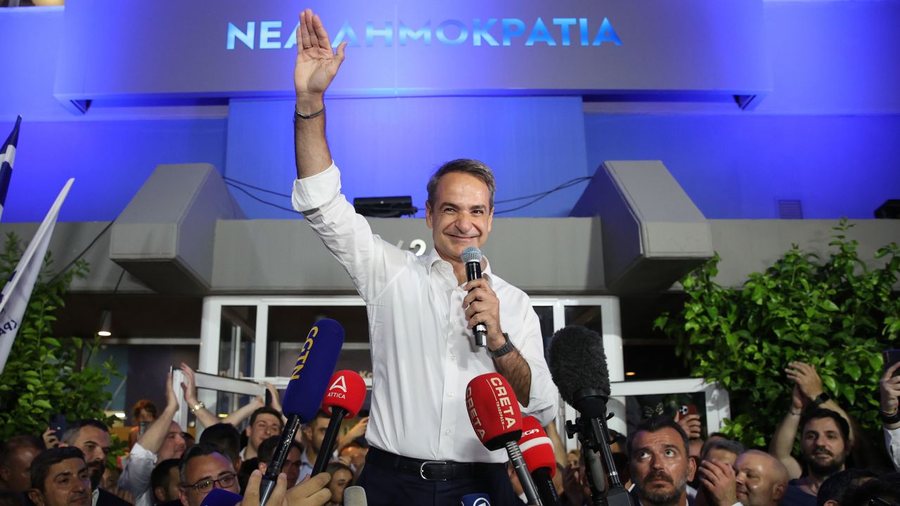
Basically, June's European elections will give Greeks the chance to find out whether Mitsotakis's rule will end or continue, and whether the expected defeat of New Democracy will favor the right or the left.
In the 5 years since the last European elections, the 27 countries of the European Union have experienced several consecutive and interconnected traumas: the Covid-19 pandemic, the energy crisis and the Russian occupation of Ukraine, which has now turned into a war long in the heart of the continent.
These crises have prompted a collective European response that was unprecedented. Regardless of the judgment on their effectiveness, it is undeniable that the measures taken have brought community politics into the daily life of citizens, although with great differences and not always with positive consequences.
Vaccines, the economic recovery and sustainability plan, the joint purchase of liquefied natural gas (LNG), electricity subsidies, and investment in Ukraine's arms supply are the most visible signs of a trend that has introduced the concept "more Europe" in the lives of 450 million people.
However, some aspects of this approach have generated new problems. Above all, they have highlighted the institutional contradictions that characterize the European Union. None of the innovative measures with which Europe responded to the 3 major crises during the last 5 years would have been possible without the activation of the general vigilance clause, the instrument that allowed the release for a period of 4 years of the "shirt of strength" of the stability pact (which, among other things, provides for very clear limits on the increase in spending).
Taking into account all these factors, it can be assumed that the majority of European citizens, including Greek ones, will vote on June 9 based on purely European criteria. In fact, this is not going to happen again, at least in Greece.
Even if in the programs of the parties competing for the vote of 9 million Greek voters (or rather half, since the expected turnout is around 50 percent), there are some references to European politics, the truth is that the elections will be dictated by domestic political issues.
For the center-right New Democracy (ND) party led by Prime Minister Kyriakos Mitsotakis, this will be the first test after the double electoral triumph in May and June last year, which apart from establishing his party's political hegemony , caused a series of divisions in the ranks of the opposition, especially on the left.
The fall of Syriza, which until the summer of last year was the most stable left-wing party in Europe (also thanks to the experience of governing between 2015-2019), has brought the appearance on the stage of 3 new parties that today compete for it won the vote of the progressives: Syriza itself, with the new leader Stefanos Kasselakis; the New Left; and the ecological force Cosmos, led by MEP Petros Kokkalis.
The PASOK Socialists, once the dominant center-left force, are trying to wrest second place from Syriza, while the Communist Party (KKE) aims to take a large share of the anti-European vote. On the extreme right, the contest seems to favor the most reactionary political formation, the Greek Solution.
Basically, June's European elections will give Greeks the chance to find out whether Mitsotakis's rule will end or continue, and whether the expected defeat of New Democracy will favor the right or the left.
Therefore, on the eve of these elections, the political dynamics seem completely disconnected from European issues. However, it is interesting to note that the difficulties of the governing party are fueled by three events that have taken on a clear European dimension.
The first concerns the scandal of the wiretapping of some journalists and political opponents of Mitsotakis through the illegal Predator software. This scandal came to light also thanks to the work of our newspaper, Efimerida ton Syntakton. The episode marks the culmination of a series of abuses committed by the current government.
For this reason, the European Parliament adopted a resolution, which puts Greece and Viktor Orban's Hungary on the same level. According to the assessments of European institutions and various NGOs, media freedom in Greece is at risk. It is becoming more and more common for government officials to sue journalists just to silence them or hurt them financially.
According to the analyzes of the European Parliament, the rapid deterioration of the image of Greek democracy coincided with the 5 years of Mitsotakis' government. It remains to be seen what impact all this will have on the voters' decision in the June elections.
The second crisis is related to the railway accident of March 2023, which caused the death of 57 people (mostly young people), evoking great anger and indignation in public opinion. From the dynamics of the accident, it was understood that for years the government had managed in a completely reckless way the large European and national funds intended for the modernization of the railway network, leaving the latter in backward and dangerous conditions for the lives of passengers.
While the government and the parliamentary majority tried in every way to hide their responsibilities, the European Prosecutor's Office opened a criminal proceeding against the railway managers for the scandalous delay in the implementation of infrastructure modernization projects (also financed by European funds), which certainty that they would have prevented a head-on collision of two trains, something unimaginable by today's European standards.
Finally, the revolt in the agricultural sector, which in recent years has voted en masse for the New Democracy, is to be taken into consideration. The discontent, which is also seen in other European countries, concerns one of the most important issues for Brussels: the Common Agricultural Policy (CAP) and its relationship with the European Green Deal.
But although the Greek farmers' protests (and those of other countries) have scared the leaders in Brussels quite a bit, it is not clear whether the government in Athens (as well as others in Europe) is ready to negotiate again on the most discussed aspects of CAP to meet the demands of farmers. In any case, it is now clear to all that farmers represent an unpredictable, impatient, mistrustful and unstable electorate. /Adapted from Pamphlet, received by Internazionale



Lini një Përgjigje