


 Shkruar nga Sabbir Hossain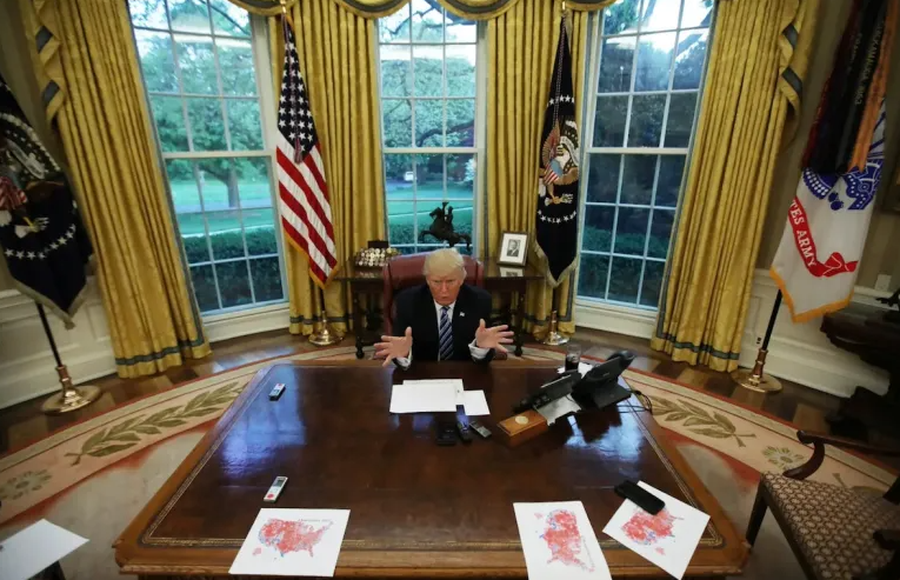
The conflict is not about war and peace, but about who controls American power, how it is justified, and whose interests it ultimately serves...
The current global chaos, characterized by the war in Ukraine, the devastation in Gaza, the new wave of instability across the Middle East, the growing rivalry between great powers, and now the unilateral actions of the US in Venezuela, along with the strategic pressure on Greenland, cannot be explained solely by regional dynamics or the ambitions of rival states.
These crises are also the result of a deeper and longer-running battle within the United States over the direction of its foreign policy and the nature of its global leadership. At the center of this battle is the confrontation between Donald Trump and an alliance
powerful unelected institutions, entrenched interests, and ideological networks commonly described as the American Deep State.
This conflict is not about peace versus war, but about who controls American power, how it is justified, and whose interests it ultimately serves.
Historically, US foreign policy has not always been structured around permanent global engagement.
Before World War II, American strategy was shaped by containment and selective engagement. George Washington's warning against permanent alliances reflected fears that foreign intervention would undermine republican rule.
The Monroe Doctrine of 1823 institutionalized this logic by asserting US dominance in the Western Hemisphere while avoiding involvement in wars.
for power in Europe. American power was real, but geographically limited and strategically cautious.
World War II and the rise of the Soviet Union imposed a fundamental change. The United States embraced global leadership through institutions such as NATO and policies such as the Marshall Plan. But early Cold War strategy remained grounded in realism.
President Dwight Eisenhower opposed the military-industrial complex, recognizing that constant mobilization could distort democratic control. President Ronald Reagan, despite ideological rhetoric, combined pressure with negotiation and ultimately pursued appeasement.
Power was exercised with clearer objectives and defined boundaries. The end of the Cold War removed many of these constraints. Without equal competitors, liberal internationalism transformed American power into a moral project.
The intervention was normalized through the language of democracy, human rights, and a
rules-based order. Iraq, Afghanistan, Libya, and Syria revealed a consistent pattern: overwhelming force followed by prolonged instability, delays in
mission and lack of strategic coherence.
War ceased to be a mere instrument of politics and became a condition of governance. From this environment emerged the American Deep State, not as a conspiracy, but as a functioning ecosystem.
Defense contractors, intelligence agencies, bureaucratic institutions, think tanks, media organizations, and academic elites formed a self-reinforcing structure whose legitimacy depended on constant crises.
Elections changed leaders, but the policy direction remained remarkably consistent. Failure was reframed as necessity and accountability were dispersed across institutions. The Biden administration’s return to aggressive liberal internationalism exposed the fatigue of this system.
In Ukraine, the US encouraged confrontation with Russia through NATO expansion and strategic signaling while refusing to pursue a credible diplomatic exit. What was framed as a moral defense of sovereignty evolved into a protracted proxy war that devastated Ukraine, severely strained European economies, entrenched Russian militarization, and deepened global polarization.
In Gaza, American instability and selective morality emboldened non-state actors while producing much civilian suffering. The United States appeared neither restrained nor decisive, but reactive and stuck between rhetoric and reality.
Trump’s rise to power represented a break from this post-Cold War orthodoxy. The “America First” doctrine rejected permanent wars, questioned alliance structures that extracted U.S. resources without reciprocal commitments, and treated diplomacy as leverage rather than moral support.
Trump avoided escalation with Iran, resisted direct confrontation with Russia, scaled back the American presence in Syria and Afghanistan, and pursued dialogue with adversaries long considered untouchable.
His presidency coincided with a lack of new major wars—an anomaly that directly threatened a system dependent on constant engagement. Yet Trump has never been against American dominance itself. Venezuela and Greenland should be understood in this context.
Trump’s willingness to use force or pressure does not contradict his conflict with the Deep State. Rather, he does not oppose the use of power, but its institutional capture. Because he prefers short, transactional, and interest-driven actions, controlled by the executive branch, to prolonged interventions managed by unelected networks.
The American operation in Venezuela reflects this logic. While sold to the public in terms of stability and rule of law, it aligns with traditional concerns of hemispheric dominance and energy security. Venezuela’s oil and regional influence evoke an extended logic of the Monroe Doctrine.
This approach may be coercive and imperialistic, but it differs fundamentally from the Deep State’s preference for prolonged sanctions regimes, humanitarian narratives, and managed instability that sustain bureaucratic relevance but fail to resolve crises.
Trump's approach to Greenland follows the same pattern. By openly pressuring Denmark and speaking directly about the island's strategic value in terms of minerals, Arctic positioning, and security infrastructure, Trump has abandoned the moral language that often masks geopolitical ambition.
Instead of entrenching competition within NATO committees and institutional consensus, it exposed the raw calculations of power. This transparency destabilizes a system that depends on moral abstraction and procedural legitimacy.
The Deep State’s resistance to Trump stems from this exposure. His authority rests on the portrayal of American power as altruistic, inevitable, and rules-based. Trump disrupts this by centralizing decision-making, rejecting bureaucratic continuity, and restoring elected authority over foreign policy.
Intelligence leaks, legal resistance, media outreach, and diplomatic response reflect not only opposition to Trump's personality, but also his challenge to institutional supremacy.
Trump's confrontation with the US deep state is therefore not a struggle between peace and militarism, but between two models of empire. One is technocratic, moralized and permanent. The other is nationalist, transactional and open.
Of course, both carry risks. The Trump model threatens alliance norms, sovereignty, and global stability. The Deep State model has already produced endless wars, moral hypocrisy, and systemic fatigue.
The contradiction remains unresolved because it reflects a deeper crisis within American leadership itself. Trump positions himself as a challenger to a system that has greatly weakened democratic control over foreign policy, even as his methods test the limits of the strategy of restraint.
Whether his vision represents renewal or simply another form of dominance remains uncertain. What is clear is that the struggle between Trump and the Deep State in the US is not a personal feud, but a structural battle over the future of American power and the global order it supports./ Adapted from "Pamphlet", from "Asia Times"




There is no such thing as the, "Deep State" in America. That's just a right-wing trope made up by America's neo-Nazis.