


 Shkruar nga Pamfleti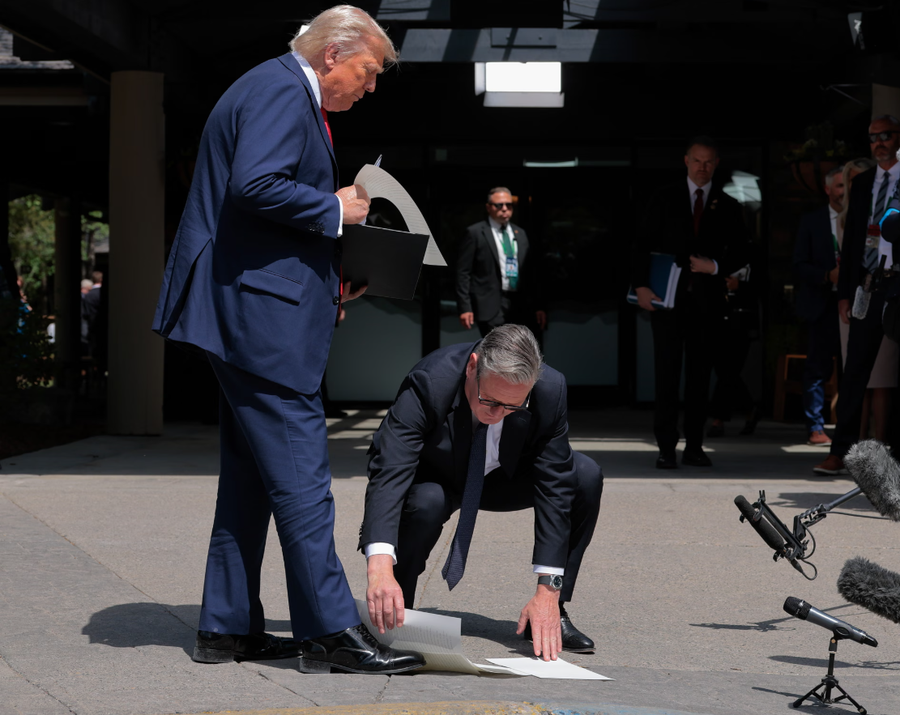
From Trump's threats to Starmer's cold diplomacy, the historic US-UK alliance is being tested by ego, tariffs and a "special relationship" that seems less and less special today...
The clash between Donald Trump and Keir Starmer is one of those episodes that strips diplomacy of its soft vocabulary and turns it into a theater of characters.
What was once solemnly called the "special relationship" between the United States and the United Kingdom is now looking more like a relationship where one side demands unconditional obedience, while the other tries to maintain dignity without overturning the tables.
According to GB News reports, Trump has never hidden his dissatisfaction with Starmer's Labour government, accusing it of "weakening" Western interests and moving Britain away from the hard line with which he claims to guarantee global security.
Essentially, Trump's problem is not just Starmer, but the idea that London dares to think for itself. Issues such as security policies, relations with Europe, trade tariffs or the management of strategic territories have been approached by Trump with a proprietary logic: either you're with me or you're against me.
In this scheme, the “special relationship” is seen as a loyalty contract, where Britain must automatically align itself with Washington, regardless of the political or economic cost. When Starmer rejects this role and speaks of dialogue, rules and multilateral coordination, the reaction from Trump is predictable: public criticism, labels and a dose of the usual American sarcasm about “European weakness”.
The irony is that Starmer is not doing anything revolutionary; he is simply behaving like the prime minister of a sovereign state that does not want to become an extension of the American presidential mood. But for Trump, this is enough to see London as a problematic partner. Thus, what was once an alliance based on strategic trust, today risks being reduced to a transactional relationship, where friendship is measured by the level of obedience.
In this sense, the clash with Starmer is a continuation of Trump's clashes with Europe, with NATO, and with any actor that does not immediately respond to his call.
The great irony lies in the fact that Trump constantly talks about strength and respect, but in practice he is leading Britain and other allies to think that the “special relationship” has become conditional and unstable. An alliance that depends on the temperament of a president is no longer an alliance, but a political gamble.
Starmer, despite his efforts not to escalate the conflict, has understood that the era of automatic politeness towards Washington is over and that London must speak with a more independent voice, even when this upsets the White House.
In the end, this clash is not just about Trump and Starmer as individuals, but about the crisis of the very concept of the “special relationship”. If this relationship means unconditional obedience, then it has ceased to be special and has turned into a hierarchy. If, on the contrary, it means mutual respect even in disagreement, then Trump’s behavior is eroding it from within. And herein lies the paradox: by demanding more control over allies, Trump is pushing them to seek more distance. A “special relationship” that is kept alive with threats and sarcasm, in the end remains just an old slogan that no longer convinces anyone./ Pamphlet



Lini një Përgjigje