


 Shkruar nga Pamfleti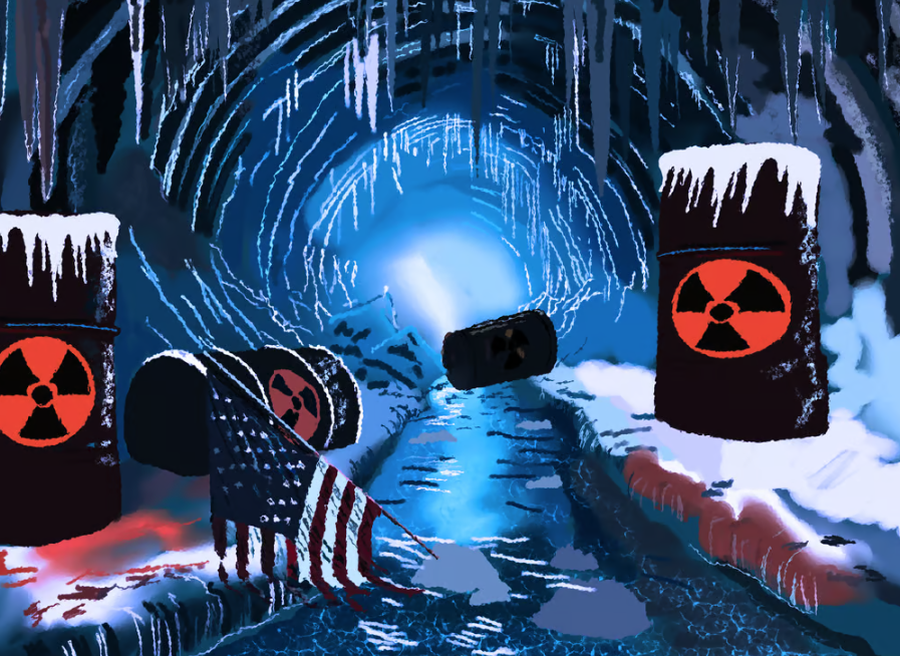
As the world warms, Camp Century — which sits on one of the most remote points on Earth, about 1,500 kilometers north of Nuuk, Greenland’s capital — has been the focus of renewed interest and anxiety about how long it will remain buried. A historical study published in 2016 found that the remains of the abandoned base could be exposed by melting ice and snow in the late 21st century.
Deep in the frozen wilderness of Greenland, a radioactive secret sleeps beneath the ice - and it could be a headache for Donald Trump if the US president-elect follows through on his threat to take control of the vast Arctic island.
Its name is Camp Century, a US military base built in 1959 during the Cold War in an effort to develop nuclear defense sites that could survive a Russian attack.
The project, which involved carving a network of tunnels through the Greenland ice sheet and powered by a small nuclear reactor, was deemed impossible due to the constant movement of the ice and was abandoned in 1967.
Although the Americans dismantled the reactor and took its nuclear reaction chamber when they left in '67, they left behind thousands of tons of waste - including radioactive waste - to be buried forever under the ice sheet.
As the world warms, Camp Century — which sits on one of the most remote points on Earth, about 1,500 kilometers north of Nuuk, Greenland’s capital — has been the focus of renewed interest and anxiety about how long it will remain buried. A historical study published in 2016 found that the remains of the abandoned base could be exposed by melting ice and snow in the late 21st century.
“Our study highlights that Camp Century now has unforeseen political significance in light of anthropogenic climate change,” the researchers write (although they later revised their findings in 2021 to rule out the base’s reappearance from the ice until at least 2100).
The discovery caused a political storm in Greenland, a Danish territory which has been self-governing since 1979.
Greenland's Foreign Minister Vittus Qujaukitsoq has demanded that Denmark take responsibility for cleaning up the debris from abandoned U.S. military installations in Greenland, of which there are 20 to 30 mostly unused sites. Greenland, once a colony of Denmark, has never agreed to clean them up.
Nuuk and Copenhagen signed an agreement in 2017 allocating about $30 million for waste and debris cleanup – but Camp Century was not included in the deal.
Greenlanders are "concerned that Camp Century will be polluted as the ice melts," said Pipaluk Lynge, an MP from Greenland's largest party and chair of the parliamentary foreign policy committee.
But it's not just Camp Century, she added, referring to other abandoned bases. "There are many places where [they] have left tons of waste," she told POLITICO, adding that "the US has military waste all over the Arctic."
So far there has been "no attempt" to clean up Camp Century's radioactive and toxic waste, said William Colgan, a professor of glaciology and climate at the Geological Survey of Denmark, who led the 2016 study of the ice surrounding Camp Century.
While Colgan once drilled deep into the site to test its radioactivity at the request of the Danish health ministry, he said there is "a conscious effort not to drill into the waste field." "We don't actually know the full nature of what's down there," Colgan said.
Camp Century has been described as an underground city, complete with a chapel, a barbershop, and dormitories that once housed hundreds of people. To build it, equipment and supplies were transported across the ice by tractor-trailer from nearby Pituffik Space Base, the northernmost U.S. military installation in the world, which is still active today.
In a 1961 report for American broadcaster CBS, TV legend Walter Cronkite visited the military base. His program filmed Camp Century's massive ice tunnels being dug and showed US Army engineers relaxing in their underground, nuclear-powered barracks, reading and listening to recordings.
All of this is now buried under thick layers of ice. Colgan said he and his team of researchers had been unable to find any parts of Camp Century. "It's cold, it's deep, don't drill into it," he said.
There are several ways Camp Century could contaminate the environment. One is if melting ice and snow releases toxic waste — such as 200,000 liters of oil under the ice, according to Colgan. Another is if the ice that contains the base breaks off and forms an iceberg. Neither of these is likely this century; the latter is likely to take thousands of years.
But the timeline varies slightly depending on how much the world warms in the coming decades. While there are varying projections, a United Nations report released last October found that the planet will warm by 2.6 to 3.1 degrees Celsius this century, with no chance of limiting temperature increases to the totemic 1.5 C target agreed in Paris in 2015.
Climate change in microcosm
Camp Century itself was central to climate change. In the 1960s, scientists extracted an ice core there, a sample of frozen soil that is still studied today for insights into climate patterns hundreds of thousands of years ago. The base remains a scientific “supersite,” said Colgan, who visits it every year along with many other climate researchers.
If the US were to claim the island – as Trump has repeatedly said it should do, calling American control of Greenland an “absolute necessity” and even threatening to use military force – it would also inherit the legacy of Cold War-era polluting activities at Camp Century.
"Camp Century is a microcosm of climate change," Colgan argued.
"People today are left making and trying to understand the climate impacts of decisions made 50 years ago, 60 years ago."
And with the US currently the second-largest emitter of planet-warming emissions in the world, Camp Century and its “changing fate” are not just a fascinating piece of Cold War trivia, but a story of climate action and responsibility today.
"It's the decisions that will be made in the next decade that will set us on these trajectories that have multi-century implications," Colgan warned. /Adapted from Politico Pamphlet/







Lini një Përgjigje