


 Shkruar nga Elena Dusi
At the end of last season, 228,000 hectares had burned across Europe. This year, 155,000 hectares have already burned. Between now and the second half of August, we expect a further increase, experts say.
We are not even halfway through July yet, and the scorching heat has dried up the ground. The leaves have wilted after three consecutive heat waves. With temperatures of 35 degrees Celsius and above, which have been lingering in Western Europe for weeks, a small spark is enough to ignite a fire.
“In many areas today, the conditions for large forest fires to break out exist,” says Fernando Sedano, a Spanish forestry engineer who deals with fire risk assessment at the European Union’s Joint Research Center at ISPRA, near Varese, Italy.
Dry soil, high temperatures and vegetation without moisture. These are the ingredients of the so-called “gunpowder effect”. “When a fire has a lot of fuel available, it spreads rapidly and produces so much heat that it creates its own winds, its own clouds, even its own storms”, Sedano explains.
"At that point it becomes uncontrollable and extremely dangerous. Air currents move it rapidly and unpredictably. The only thing that can be done is to retreat, wait until the vegetation burns and the flames subside," he adds.
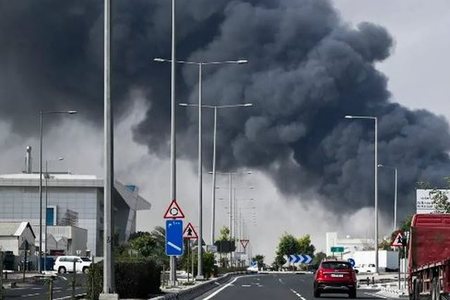
Portugal, the Pyrenees, southern France, Catalonia, Croatia, Albania. For days, firefighters in half of Europe have been battling uncontrollable fires, some of which cover thousands of hectares and require the involvement of up to a thousand firefighters.
In Piedmont, Savoie and the Pyrenees, the flames have climbed over 1,000 meters in height. Heat waves and the "gunpowder" effect have made the start of this season reminiscent of the statistics of 2025, the darkest year, when a record area burned in Europe.
At the end of last season, 228,000 hectares had burned in 1,182 different fires. This year, 155,000 hectares have already burned in 1,057 fires. The average for the last 20 years in Europe is 100,000 hectares burned and 476 fires.
This means that the number of fires has more than doubled, and we have not yet reached mid-July. The area currently considered at highest risk includes Portugal, Spain and southern France, but also extends across the entire Italian peninsula.
"The peak of the fire season in Italy has just begun. Between now and the second half of August we expect an exponential increase in fires," explains Roberto Inghilesi, head of the Environmental Monitoring Operational Center at ISPRA (Higher Institute for Research and Protection of the Environment).
"At the moment we are at the same levels as last year. We hope that the situation will remain like this and not end up worse...", he says. Considering that in 2025 an area more than double the European average burned, this hope is not at all reassuring.
"So far in Italy we have not had giant fires like those in the Iberian Peninsula. However, the fact that we are seeing fires so early in Piedmont is something unusual," Inghilesi continues.
"I was talking to some firefighters working on that front," says Sedano, who lives not far from the area. " They told me that usually, at this time of year, they move with vehicles and planes to the south," he emphasizes.
The heat wave will also move southward next week, hitting Sicily, Calabria and Puglia, the regions that are usually most affected by fires.
"In Europe, France, with 387 square kilometers of burned area, has already reached the highest levels for this time of year," notes Inghilesi, referring to statistics.
The third stage of the Tour de France cycling race was held without the public, banned due to a 2,000-hectare fire that was burning forests and bushes near the Pyrenees. “Spain has so far burned 560 square kilometers. It is not a record, but it is more than double the average for this period, which is 250 square kilometers. Even Germany has recorded 20 square kilometers of burned territory, a very unusual figure for this country,” Inghilesi declares.
Sedano doesn't want to make predictions for the whole of 2026. However, he acknowledges that conditions this year are extreme. Two heat waves in late June and early July followed each other almost without interruption. Their effects were cumulative and caused a large amount of water to evaporate from the ground.
"The vegetation burned this year is likely to regenerate. But the ability of forests to regenerate is not infinite. When fires continue to hit the same regions repeatedly, it is possible that a forest will never be able to return to its previous state," warns Inghilesi./ Adapted from "Pamphlet", from "La Repubblica.it"





Dhe ky sht,a pallosh në vend të avionit zjarrfikës ja fal 4 .ilion ze,akut. Dhëntë zoti dhe ka ferr që ta paguaj. Paa shpine ka mallkimin e një Ķombi. Monstra.