


 Shkruar nga Roberto Vivaldelli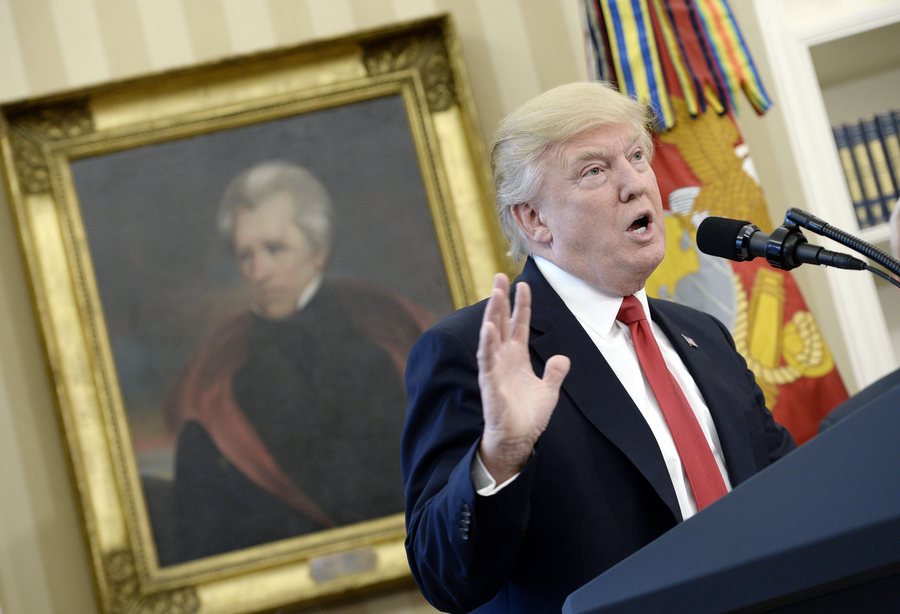
What will happen if the Republican mogul returns to the Oval Office?
The Ukrainian military's defeat in Avdiivka, in addition to the death of Russian blogger and dissident Alexey Navalny, combined with previous recent attacks by presumptive Republican nominee Donald Trump on NATO and European allies, have reignited the debate in the United States. about the role of the American superpower on the international stage.
What will happen to the US-led West if Washington decides to focus on domestic problems instead of taking on the role of "global policeman"?
What will happen if the Republican mogul returns to the Oval Office? These are questions that are animating the American public debate.
"Back to Normal"
Far from being new, this question represents an age-old dilemma that the United States has faced since its founding. In fact, as Manlio Graziano notes in his essay "The Island at the Center of the World", a geopolitics of the United States published by 'Il Mulino', Americans had the impression that they "lived isolated from the rest of the world, thanks to the physical protection guaranteed by the oceans and thanks to the immensity of the territory that provided them with everything they needed". Therefore, the researcher explains that, "in the temporal abstraction of American ideology, that particular condition was absolutized and metabolized as a prescription valid for all seasons." Like Trump, in 1920 the Republican from Ohio, Warren G. Harding, the 29th president of the United States, won the election by a landslide, proposing as his campaign slogan "Return to Normality," that is, a "return to normality" after the First World War and the Spanish flu that had shocked the world and the USA itself.
An "exceptionalism" understood as a return to the state before intervention in the European war, protected by the "rotten, corrupt and treacherous system of international transactions", which translated into an isolationism that was interrupted by Franklin Roosevelt and the arrival of World War II. This conception of America completely overturned the vision of Harding's predecessor, the Democrat Woodrow Wilson, promoter of the League of Nations - in which, paradoxically, the United States did not participate, thus causing its failure - which, as he noted Henry Kissinger, in 1915, proposed an "unprecedented doctrine, which stated that the security of America was inseparable from that of all mankind, implying that henceforth the United States would oppose aggression wherever it appeared."
The return of Jackson's "populism".
During his first presidential term, Donald Trump had himself photographed in the Oval Office with a portrait behind him: it was that of the seventh US president Andrew Jackson (from 1829 to 1837), a face that every American knows very well because it stands out on the twenty dollar bill. The connection between Trump and Jackson was first championed by former White House strategist Steve Bannon and then made authoritative by historian Walter Russell Mead in a 2017 essay in the journal Foreign Affairs.
Describing four schools of thought in American foreign policy: Hamiltonian, Wilsonian, Jeffersonian, and Jacksonian, according to Mead, Jacksonians like Trump are economic populists, distrustful of cosmopolitan elites and immigrants, and tend to avoid conflicts in foreign policy involving United States Abroad.
But if war becomes inevitable, the Jacksonians, Mead observed, "demand total victory and unconditional surrender." Although Mead's vision has since sparked debate and even been contested, the case of Trumpian Senator JD Vance, who is opposed to approving the aid package for Ukraine, underscored in a recent interview with the News Statesman that the "Jacksonian" approach of Trump, is "a mixture of extreme skepticism about intervention abroad, combined with an extremely aggressive attitude when intervening."
It remains to be seen whether this will really be Donald's approach, if he wins the next election and not a simple electoral strategy. Also in his first (and controversial) experience in the White House, Trump surrounded himself with "hawks" rather than "isolationists" like Mike Pompeo or John Bolton. One of many open questions about a potential Trump 2.0 administration as America debates its identity and vision for the world. / Adapted "Pamphlet" from 'Inside Over'


Lini një Përgjigje