


 Shkruar nga Diego Guelar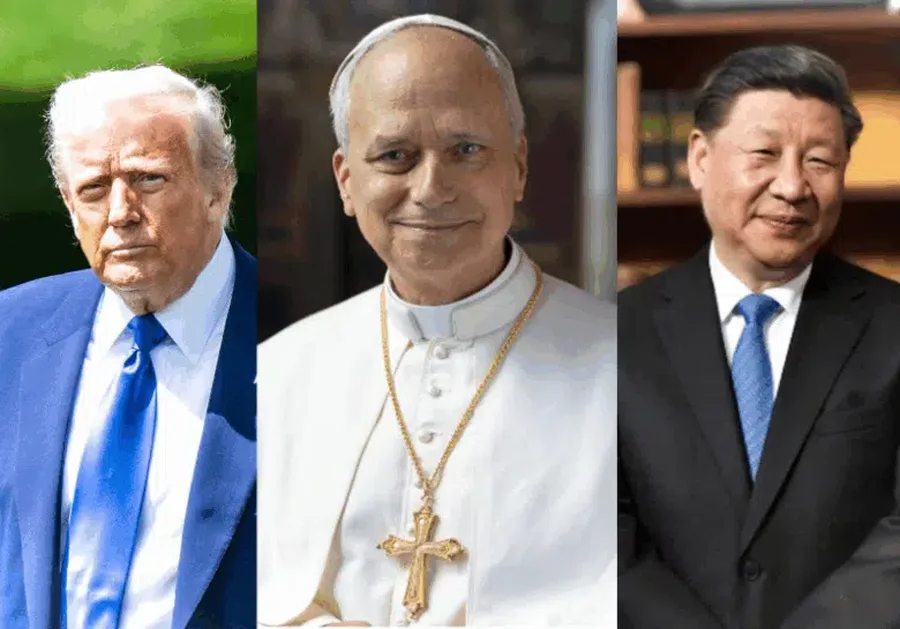
In the 1980s, an American president, a Soviet reformer and a charismatic pope helped end the Cold War and change the world. It was a “fortune” partnership, but could it be repeated today with Trump, China’s Xi and Pope Leo XIV?
In the 1980s, three of history's greatest statesmen were in power at the same time: US President Ronald Reagan, the last Soviet leader Mikhail Gorbachev, and Pope John Paul II.
This occurred in the closing stages of the Cold War, the global confrontation between two superpowers, the United States and the Soviet Union, which lasted from 1945 until the official dissolution of the Soviet Union on December 25, 1991.
When Reagan took office in 1981, the Soviet containment initiative, promoted by a previous Republican president, Richard Nixon, was at its peak. It involved the wooing and rapprochement of communist China as a kind of compensation for the United States' defeat in Vietnam (against the Soviet-backed Vietnamese communists).
Nixon's decisive presidency might have succeeded in that initiative, had it not been for the immediate costs and consequences of the failure in Vietnam and the Watergate scandal. It would be several more years before Reagan led the United States to the pinnacle of global power.
But what he needed was a “partner” in the Soviet Union to usher in what could have been a new era, with much better prospects for the world. This partner appeared in the form of the reformist Gorbachev, who was elected General Secretary of the Soviet Communist Party in 1985 and president in 1988.
He became the interlocutor the West needed, capable of facing the challenges of history. For about 45 years, the world had lived in anxiety from the threat of a nuclear war between the superpowers, which were already engaged in dozens of smaller proxy wars on all five continents of the world.
The election of Pope John Paul II, Karol Wojtyla, a Pole and staunch anti-communist whose homeland was under Russian communist control, produced the third actor for this phase. He had no weapons or army, but used the strength of the Catholic Church as a bearer of peace, wielding personal charisma and great spiritual weight among Western Catholics in a world where conflict had become a predominantly Western issue.
Thus was formed an “iron triangle,” which began to function very effectively. By the early 1990s, Russia had begun a transition to democracy, and the Pope was mobilizing large crowds around the world, reaching beyond the Catholic flock to become a Shepherd of Universal Peace.
Let us now return to the beginning of the 21st century, when a new actor, an economically powerful, communist-led China, emerged on the scene to challenge the world's dominant superpower. This conflict is not within the West, nor between antithetical economic systems, but between two cultures.
Today, the United States' share of the entire $100 trillion world economy is $23 trillion. China's is $19 trillion, with a clear trend toward parity by 2030.
The current US President, Donald J. Trump, has decided to start a full-scale trade war with its Chinese competitor, the consequences of which have not yet been seen. This time the conflict is not
It is within the West and not between opposing economic systems (capitalism and communism), but between two cultures - Eastern and Western - and clashing political systems, pluralistic capitalism and a one-party communist regime.
The power of both sides and the climate of uncertainty that accompanied Trump's so-called Liberation Day on April 4 (when he announced his tariffs) have outweighed the impact of both the Russian attack on Ukraine on February 24, 2022, and the Hamas attack on Southern Israel on October 7, 2023, despite their dire consequences in both countries.
The late Pope Francis tried to become a third protagonist alongside Presidents Trump and Xi, but was hampered by his health problems. However, he left behind a prominent legacy that looks set to be followed by the new pope, Robert Prevost, or Leo XIV.
Pope Leo XIV shares his predecessor's concerns for the poor and the discontented, and is inspired by the Social Doctrine, forged by a previous pope, Leo XIII. So we can say that the Triangle of Power, composed of Trump, Xi and Leo XIV, has been rebuilt, with a balanced chemistry, which we can also consider promising in a world that has become disordered and threatening.
Let us hope that they will work to prevent the spread of darkness in the form of extremism, fanaticism and dogmatism, which could lead us to complete destruction. Considering these three men as a new triangle of power, I see the future with cautious optimism. /Adapted from Pamphlet by “Worldcrunch”/


Lini një Përgjigje