


 Shkruar nga Pamfleti
Since the wave of protests, which has left thousands dead, Donald Trump has raised the threat of a new attack against the Islamic Republic, although in recent hours the two enemies seem to have favored the diplomatic path.
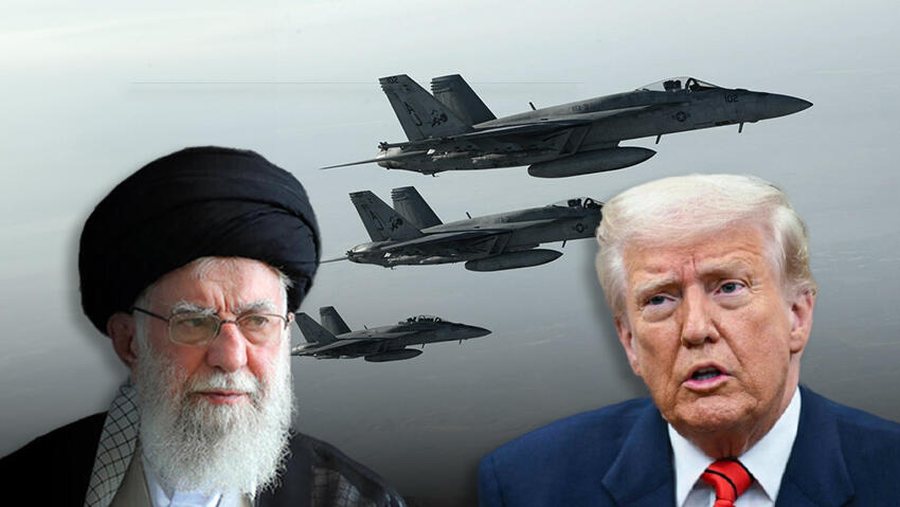
Iran's Supreme Leader, describing the recent protests as a "coup", warned today, February 1, of a regional war if the US decides to intervene with its military.
"The Americans should know that if they start a war, this time it will be a regional war," said Ayatollah Ali Khamenei, speaking for the first time since mid-January.
The United States bombed Iran during a twelve-day war in June that was initiated by Israel.
And since the wave of protests that has left thousands dead, Donald Trump has raised the threat of a new attack against the Islamic Republic, although in recent hours the two enemies seem to have favored the diplomatic path.
Pressure is also coming from the European Union, which has placed the Islamic Revolutionary Guard Corps, the ideological army of the Islamic Republic, on the list of "terrorist organizations."
Iran declares European armies "terrorists"
In retaliation, the Iranian parliament on Sunday declared European militaries as "terrorist groups," "in accordance with Article 7 of the law."
According to footage broadcast by state television, the speaker of the assembly, Mohammad Bagher Ghalibaf, was dressed, like other members of parliament, in a Revolutionary Guard uniform, as a sign of solidarity and defiance.
"Death to America!" "Death to Israel!" "Shame on Europe!" chanted elected officials in the hall, on the 47th anniversary of the return from exile in Iran of Ayatollah Khomeini, the founding father of the Islamic Republic.
The Pasdaran (Persian for "protector"), created in 1979 by the Supreme Leader immediately after the Islamic Revolution, is considered the regime's ideological army. It is extremely well-organized and controls entire sectors of the Iranian economy.
The immediate consequences of this announcement, which appears largely symbolic, were not immediately clear. This law was passed in 2019 in response to measures taken by Washington.
While the United States has deployed about a dozen ships to the Persian Gulf, including the aircraft carrier Abraham Lincoln, Iran will begin a naval exercise on Sunday in the Strait of Hormuz, a key transit point for global energy supplies that Tehran has threatened to block in the event of a US attack. But Iranian President Masoud Pezeshkian declared on Saturday evening that war was in neither Iran's nor the United States' interest, saying he preferred diplomacy. Another senior official reported "progress" toward "negotiations" with Washington.
Donald Trump, for his part, claimed that Iran was in talks with the United States, without giving any details. "Iran is talking to us and we'll see if we can do something," the US president told Fox News.
The Islamic Republic is suspected by Western powers of seeking to acquire nuclear weapons, which the Islamic Republic denies.
Diplomatic negotiations
Meanwhile, countries in the region are making diplomatic efforts to "bring the United States and Iran back to the negotiating table," according to Egyptian President Abdel Fattah Al-Sisi, who spoke with his Iranian counterpart on Saturday.
Qatar's Prime Minister and Foreign Minister, Sheikh Mohammed bin Abdulrahman Al Thani, traveled to Tehran. During a meeting with Ali Larijani, Secretary of Iran's top security body, the Qatari leader "reaffirmed his country's support for efforts to reduce tensions and find peaceful solutions that ensure the security and stability of the region ," according to a statement from his Ministry of Foreign Affairs.
Weakened by the June 2025 war, the Iranian regime has cracked down on recent protests, initially sparked by rising living costs, which have become a challenge to the government. More than 6,700 people, including 137 children, have been killed in Iran, according to an updated count by the US-based Human Rights Watch, which is investigating more than 17,000 possible deaths.
Iranian authorities admit that thousands of people were killed during the protests, but claim that the vast majority were members of the security forces or bystanders killed by "rebels."
"Protesters attacked police, government buildings, Revolutionary Guard barracks, banks, mosques and burned the Quran ... it was a real coup," Ali Khamenei declared on Sunday, as quoted by the Tasnim news agency, claiming that the attempt had "failed."/ Le Monde


Lini një Përgjigje