


 Shkruar nga Pamfleti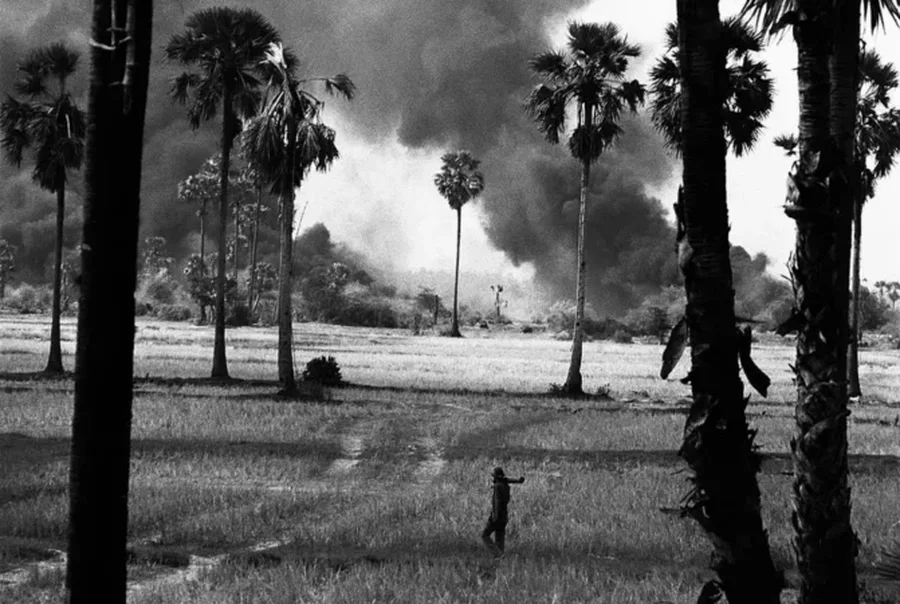
When news of Henry Kissinger's death broke this week, many former world leaders gave their impressions. Former US President George W Bush said the US had "lost one of its most trusted and distinctive voices on foreign affairs".
Former UK Prime Minister Tony Blair described the former US secretary of state as an artist of diplomacy who was motivated by "a genuine love of the free world and the need to defend it". Boris Johnson called Kissinger "a giant of diplomacy and strategy - and peacemaking".
But peacemaker is not a term you are likely to hear many in Cambodia use when describing Henry Kissinger. During the Vietnam War, Kissinger and then-President Richard Nixon ordered clandestine bombing of neutral Cambodia in an attempt to drive Viet Cong forces to the east of the country.
In total, the US dropped more than 2 million tons of bombs on Cambodia from 1965-1973. For context, the Allies dropped just over 2 million tons of bombs throughout World War II, including the bombs that hit Hiroshima and Nagasaki. Kissinger claimed that the bombing was aimed at the Vietnamese military inside Cambodia, not the country itself.
Vorng Chhut, 76, had never heard the name Henry Kissinger when the bombs started falling on his village in Svay Rieng province, near the Vietnamese border.
"Nothing was left, not even the bamboos. People escaped, while those who stayed in the village died," he said. "Many people died, I can't count all the names. The bodies remained there and when there was peace, people came and buried the corpses". A 2006 Yale University report, "Bombs over Cambodia," stated that "Cambodia may be the most bombed country in history."
A Pentagon report released in 1973 stated that "Kissinger approved each of the 3,875 bombing raids on Cambodia in 1969 and 1970," as well as "methods to keep them out of the newspapers." "It is an order, it must be done. Anything that flies, on anything that moves,'' Kissinger told a congressman in 1970, according to declassified transcripts of his phone conversations. The number of people killed by those bombs is unknown, but estimates range from 50,000 to 150,000.
One of the most infamous incidents was the accidental bombing of the small town of Neak Luong, where at least 137 Cambodians were killed and 268 others injured. A New York Times report by Sydney Schanberg, who was later portrayed in the movie Killing Fields, quoted a man named Keo Chan whose wife and 10 children had just been killed.
"My whole family is dead!" he said, crying and beating the damaged wooden bench with his fist. "My whole family is dead! Take a picture of me, take a picture of me! Let the Americans see me!" he added. Another man stood next to an unexploded bomb in the city and asked simply, "When are you Americans going to take it down?" Unexploded American bombs littered the Cambodian countryside, maiming and killing people for decades to come. Many also say that another consequence of Nixon and Kissinger's bombing campaign was that it helped pave the way for one of the worst genocides of the 20th century. About 1.7 million people died at the hands of the Khmer Rouge led by Pol Pot between 1975 and 1979, almost a quarter of the population.
Before this, the ultra-communists had little support, but their ranks swelled with the fall of American bombs. The CIA's director of operations reported in 1973 that Khmer Rouge forces were "successfully using damage from B-52 attacks as a major theme of their propaganda."
In 2009, the first Khmer Rouge official to stand trial for crimes committed under the regime's reign of terror told the UN-backed tribunal: “Mr. Richard Nixon and Kissinger allowed the Khmer Rouge to seize golden opportunities." Kissinger always rejected criticism about the bombing of Cambodia.
“I just wanted to make it clear that it was not a bombing of Cambodia, but a bombing of the North Vietnamese in Cambodia,” he said in 1973. When he was 90, he claimed that the bombs were dropped only on areas “within five miles from the Vietnamese border that were essentially unpopulated." Elizabeth Becker, an American journalist who covered the bombing campaign in 1973, said that was not the case. Many world leaders have praised Kissinger, who shared the Nobel Peace Prize in 1973 for his role in negotiating an end to the Vietnam War and was later awarded the Presidential Medal of Freedom - America's highest civilian award. But few who were in Cambodia in the 1970s will remember his legacy fondly.
Prum Hen, 70, was forced to flee her village when American bombs began to rain down. She said she knew little about Kissinger and felt little sympathy when informed of his death. "Let him die because he killed so many of our people," she said, adding that she still feels deep resentment toward the US. "They bombed our country, killing many people and separating people from their children. Later, the Khmer Rouge killed men, women and children.” Ms. Becker said the gravity of Kissinger's policies in Cambodia cannot be underestimated. “To say that the bombing was incorrect... it was inhumane. It's not just the number of people, it's the heritage. You can't overstate what he did to the country." /BBC/


Lini një Përgjigje