


 Shkruar nga Pamfleti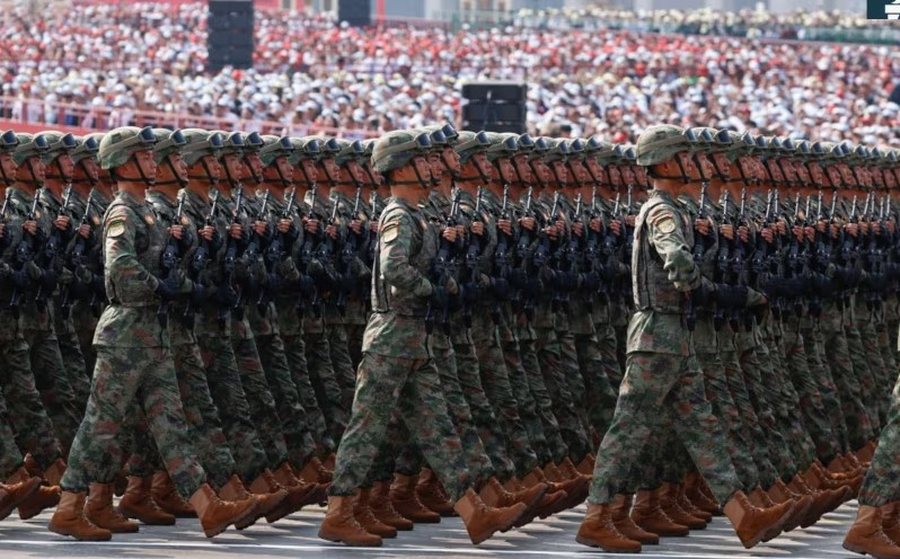
An 800-page dossier of contracts and correspondence shows that Russia is helping China prepare its military for a possible invasion of Taiwan, according to an independent think tank that has uncovered and independently verified the documents.
Oleksandr V. Danylyuk, a senior fellow at the Royal United Services Institute (RUSI), who obtained the leaked documents, along with co-author Jack Watling, spoke to Radio Free Europe/Radio Liberty about what these findings mean for the future of China-Russia military cooperation, as well as why Russia might be in favor of a Chinese invasion of Taiwan — the self-governing island of 23 million people that Beijing claims as its territory.
According to RUSI, the documents suggest that Moscow had agreed to sell the People's Liberation Army (PLA) a range of military equipment, including assault vehicles, anti-tank weapons and an airborne armored personnel carrier, to the People's Liberation Army of China (PLA) in 2023. The armored vehicles would be equipped to Chinese specifications, and Russia would train an elite battalion of Chinese paratroopers to operate the vehicles.
The contract also stated that Russia would transfer technology to China and allow China to produce similar weapons.
Such an agreement would strengthen China's air maneuvering capabilities, one of the few areas where Moscow's military has an advantage over the PLA, and would raise concerns that Beijing could seize infrastructure inland and simultaneously launch attacks on ports and beaches along the coast as part of a potential invasion.
About 800 pages of contracts and accompanying documents “appear authentic” and details from the documents have been independently verified, RUSI said. However, it added that there is a possibility that parts of the documents have been altered or removed.
Moscow has not commented on these leaked documents.
The interview below has been shortened and edited for clarity.
Radio Free Europe: Can you briefly explain to us what the main elements of these agreements are and why they are important to Beijing, regarding a possible invasion of Taiwan?
Oleksandr V. Danylyuk: So, in short, the agreement is about obtaining some very specific equipment that is necessary for airborne landing operations.
This includes a set of equipment for landing an airborne battalion and also specific equipment for special forces. Both of these equipment packages are necessary for an air invasion, which would then prepare the ground for a naval invasion by the Chinese military.
The idea is to have a special forces team on the ground, and using this Russian equipment, they would be able to drop from a civilian transport plane from a very high altitude and land on Taiwanese territory without being detected. They would also use these automated systems to send equipment – like Russian air tanks and armored fighting vehicles – there, so that not every [special forces] soldier would necessarily have to parachute into Taiwan – many of them would be able to enter Taiwan legally beforehand, as tourists.
We believe that this heavily equipped battalion would be only part of a larger number of battalions, so perhaps one battalion using Russian equipment and two or three using Chinese equipment.
This is enough to take control of at least the port of Taipei, which, in our opinion, is the key target for such an operation, as it gives China control of a vital port for a possible naval invasion by the Chinese military.
Radio Free Europe/Radio Liberty: The general opinion has always been that Russia has been very careful not to export military equipment in more advanced areas to China, for fear that it would be stolen and their technology copied. So why do you think that is changing now and what does this mean for the future?
Oleksandr V. Danylyuk: Politically, this kind of military cooperation is very important for the Russians, because they don't want to be in that club of states that are completely isolated. We can say that there is a kind of axis of like-minded states [vj analysts have started to refer to the military and political coordination between China, Russia, Iran and North Korea as the Axis of Troubles] and for the Russians the most important element of this axis is China.
Russia has invested so many resources in the war, and the only way to turn these assets into a real geopolitical power is through a broader war, a global war. And the most desirable territory for such a war is the Indo-Pacific.
Therefore, the Russians seem willing to do anything to push China to invade Taiwan, especially if this would lead to a conflict between the US and China.
I think the Russians are not interested in a Crimea-type scenario of invading Taiwan, where there is limited resistance and little international backlash. On the contrary, the Russians would like China to invade, not to attack quickly, but to take a long time because that would really create the possibility of escalation.
This, in turn, could involve the Americans and other countries, like Japan, in the war, which I believe is what they want.
Radio Free Europe/Radio Liberty: So, can we summarize it a little bit, because I think there are a lot of things that need to be analyzed. Are you saying that these documents not only show that Moscow would support China's invasion of Taiwan, but also that it is looking for ways to influence the situation so that this can happen?
Oleksandr V. Danylyuk: Yes, absolutely, that is correct.
Currently, you can't influence Chinese society in the same way as you can in a democratic society, and I would expect Russia to have some leverage over the Chinese government, although I don't know that for sure.
But the easiest way for Russia to create these preconditions for war and the invasion of Taiwan to seem inevitable is to influence Taiwanese society, and frankly, American society and politics.
As for these preconditions in Taiwan, look at what is happening in Taiwanese society. The real phase zero is not infiltration by special forces, but political destabilization.
The current political situation in Taiwan, where you have a Parliament controlled by the KMT [Kuomintang party] and then [President Lai Ching-te] by the Democratic Progressive Party [DPP] that has split and has spent most of the year blocking laws and obstructing appointments to the Constitutional Court, which has led to clashes in Parliament and mass protests.
This is an ideal precondition for trying to ignite a political crisis which is necessary for destabilizing the command and control system in Taiwan, both politically and militarily.
Radio Free Europe/Radio Liberty: So, beyond this air capacity, which is described in the documents you analyzed, what are the other areas that you think the Chinese military should turn to Russia to improve in relation to a possible invasion of Taiwan?
Oleksandr V. Danylyuk: An obvious area would be receiving advice on Russian missile and drone attacks.
So how do you suppress air defenses and also how do you leave them without ammunition? Russia has a lot of experience and all this knowledge can be transferred to a possible Taiwan scenario.
Radio Free Europe/Radio Liberty: With this kind of military cooperation that we talked about, what other aspect are you paying attention to in a scenario for Taiwan?
Oleksandr V. Danylyuk: I think the main question is to what extent Taiwanese society can avoid confrontation and polarization, and whether it can unite around the need to defend the island, which is an even more difficult task.
The natural reaction from Washington to this is to give Taiwan more military capabilities, but in my opinion, they have sufficient capabilities. The question is more about whether they can unite and be determined to resist and fight against an invasion.
An invasion of Taiwan would be extremely costly for the Chinese, so the real immunization against an invasion lies in the realm of morale and unity, and also in the ability of the United States to deliver a clear message of support.
Because the reality is quite simple: China is getting stronger and there is still a crisis in Europe. So, it remains to be seen./REL




Lini një Përgjigje