


 Shkruar nga Pamfleti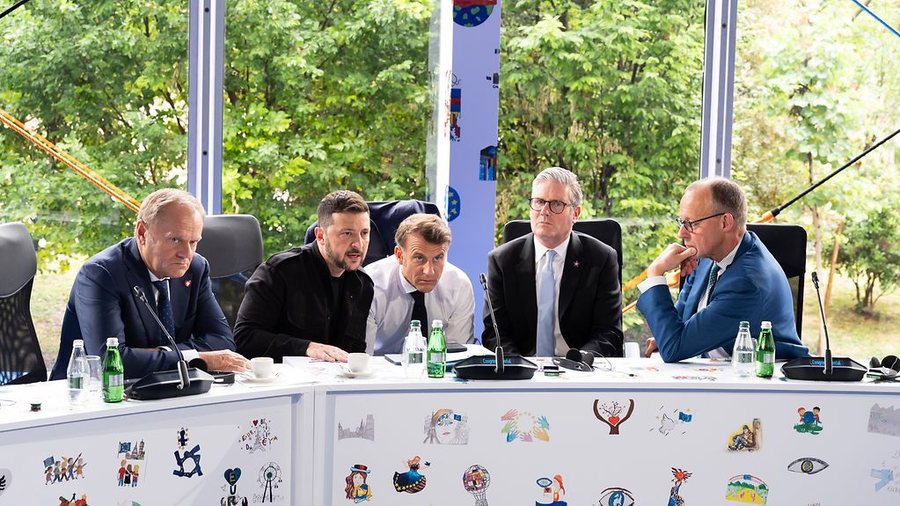
Trump has told Europeans that Putin has no intention of stopping the war – he feels confident of victory. In fact, although unofficially, the American leader seems ready to abandon Ukraine.
There is a word that is repeated in all the reports about the phone call between European leaders and Donald Trump: Chancellor Friedrich Merz was “shocked” . What really happened in that conversation, where Giorgia Meloni, Emmanuel Macron, Donald Tusk and Keir Starmer were also present, after the two-hour bilateral phone call between Trump and Putin, is known only by the leaders themselves. But the conclusion that Germany has drawn is clear: Putin has no intention of stopping the war and Trump will not support new sanctions , the ones that Merz had demanded in Kiev alongside Zelensky, if the Kremlin did not agree to enter into peace talks.
The phone call between the White House and the Kremlin in Berlin has already been dubbed the "Trump U-turn." A U-turn that in practice, although not officially, places the former US president in the position of abandoning Ukraine.
It was first reported by the Wall Street Journal, and later confirmed by the German press. Trump has told the Europeans that Putin has no intention of stopping the war. He feels confident of victory. A senior German official, who was present on the call (or read its contents), told Politico: “ It looks like Putin needs more time to fight — and Trump is helping him buy that time .”
The new tone of the German government also stems from this situation. Yesterday, Defense Minister Boris Pistorius, in his first interview after this turn of events for FAZ, declared that “Putin does not want peace yet .” Friedrich Merz’s rhetoric has also changed in a few days: “ There are no illusions. There will be no quick solution ,” he said in Vilnius, where he visited the 45th Armored Brigade, the first to be permanently stationed outside German territory. The German Chancellery believes it will be difficult to set a date or place for peace talks: “ This is a process that has just begun ,” said the Chancellor, “ which could last weeks, maybe even months . ”
Friedrich Merz is quickly learning what it means to make ultimatums and promises as a government leader that he then fails to keep. The 18 new European sanctions announced have been blocked by Trump, and the new chancellor has already been discredited, having declared "red lines" that were ignored by both Russia and the US.
However, the German commitment is serious. “ We are ready to do more, if necessary: more pressure on Russia and more aid for Ukraine. Funds will not be a problem ,” Merz declared. Meanwhile, Pistorius mentioned the possibility of restoring compulsory military service, as Germany aims to increase the number of troops: “ If we reach a point where we have more capacity than voluntary registrations, we can decide on compulsory service .”
The predictions for what is happening on the Ukrainian ground are bleak. The well-known military expert Nico Lange, former CDU deputy minister in the Ministry of Defense, is convinced that Putin “never asked for a ceasefire, but used the time to create new military facts” and that the ground offensive has already begun. According to him, Moscow, in addition to the four annexed territories, will aim to advance into three other regions: Sumy, Kharkiv and Dnipropetrovsk, to create new difficulties for the negotiations. Seven disputed regions, not just four.
The Germans and Europeans have a clear objective: to keep the Americans involved. From the first days of his mandate, Merz has pursued a soft approach, following Starmer’s British model: anticipate American demands and say “thank you” ahead of time. He wants to visit the White House, where he is expected within ten days. But the phone call about Ukraine has shaken him — he was “shocked” (and this was before Trump announced 50% tariffs on EU products).
It is known in NATO circles that American aid to Ukraine will last until the summer. After that, if Republicans in the Senate do not challenge Trump, the burden will shift to Europe – and primarily to Germany. As long as the US continues to share intelligence and support through Starlink satellites, Europe should be able to support Ukraine. But with Trump, anything is possible, even if, after turning his back on Ukraine, he makes an anti-Kremlin turn. As one German diplomat says: what we are seeing today was “the worst possible scheme”. And unfortunately, it seems to be coming true. / Adapted from “Pamphlet” by “Corriere Della Sera”





Lini një Përgjigje