


 Shkruar nga Pamfleti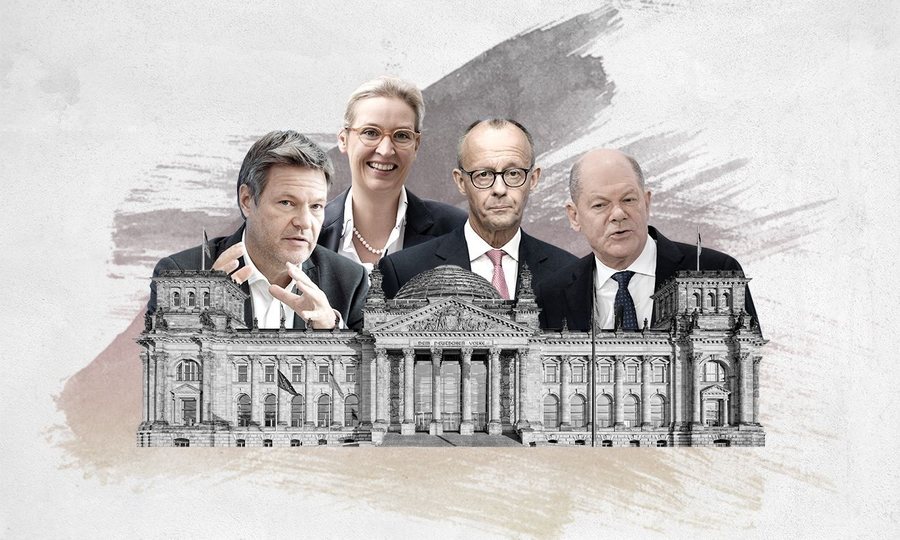
On Sunday, February 23, Germans will go to the polls to elect the 630 members of the Bundestag. Below you will find useful information about the crucial elections, which will determine the next chancellor.
Why are elections being held now?
These elections are taking place after two regional elections that yielded results that were not very favorable for the parties of Chancellor Olaf Scholz's former coalition, which consisted of the Social Democratic Party (SPD), the Greens, and the liberal Free Democratic Party (FDP).
In November 2024, amid tensions over planned economic policy and the debt issue, the Social Democratic chancellor dismissed the liberal Finance Minister, Christian Lindner. This decision dissolved the coalition and led to him seeking a vote of confidence in the Bundestag, which he lost on 15 January 2025 (with 207 votes in favour, 394 against and 116 abstentions). Shortly afterwards, President Frank-Walter Steinmeier dissolved the legislature and called elections for 23 February, six months ahead of the previously planned date of 28 September.
How does the electoral system work?
The German electoral system firmly follows the principle of proportional representation. And this philosophy was further reinforced by a reform of the electoral system adopted in 2023.
Voters cast two votes on the same ballot paper: one for their constituency and one for their state (Landin). The national result resulting from the "second votes" determines the number of seats allocated to each party. The final step is the distribution of the seats allocated to each party between the candidates for the constituencies and those included in their lists by state. Priority is given to the leading candidates in their constituencies.
Then, for each state, additional candidates, if necessary, are taken from the regional list of candidates, in order. Therefore, it is possible that the first candidates in their electoral district may not be elected due to the low national result of their party.
This voting system may seem strange to outsiders, because the election of a candidate does not depend entirely on their performance in their constituency. “It must be understood from the outset that this system is mainly about political parties, not personalities,” explained Aurore Gueye, a law professor at the Capitole University of Toulouse.
What do the polls say?
The right, represented by the Christian Democratic Union (CDU, together with its Bavarian partner, the CSU), has made significant progress, collecting around 30%, according to a consolidated average of opinion polls. Since the summer of 2024, the far-right AfD has overtaken the SPD, which has fallen to third place. The Greens, who briefly held second place in the polls in the summer of 2022, recently ranked fourth in the poll data.
How are German coalitions formed?
Due to the country's electoral system, it is extremely rare for a single party to win a majority of support in the Bundestag. This has only happened once, in 1957, for the Christian Democrats CDU/CSU. German political life is therefore characterized by coalitions formed between parties that come together to govern after a confrontation during elections.
Since their platforms can often be difficult to harmonize, it can take several months to finalize a coalition agreement under which they would govern together. The most recent agreement was reached in November 2021, between the SPD, the Greens and the FDP, assembled under the leadership of Olaf Scholz after two months of negotiations and was 177 pages long.
The grand coalition led by Angela Merkel since 2013 took two months of talks to negotiate the 170-page coalition agreement between the Christian Democrats and the Social Democrats.
In 2025, several possible coalition scenarios seem possible in light of current polls. Based on an exclusionary policy known as the "firewall" (which was recently dismantled), the AfD seems to be excluded from any future government.
Given their position in the polls, the conservatives of the CDU/CSU are likely to lead a future coalition. They would therefore either govern in coalition with the Social Democrats and/or the liberal FDP, as they did between 2005 and 2021, or in a three-way alliance with the Greens and the FDP (a combination that Germans call the "Jamaica" coalition, after the colors of the three parties).





Lini një Përgjigje